Why Sam Altman Wants Washington on His Cap Table
OpenAI is in early talks to hand Washington a 5% stake worth roughly $43 billion. It's framed as sharing AI's upside with the public. The precedents — Intel, MP Materials, Nvidia's export toll — suggest something else: the purchase of national-champion status, and a moat only incumbents can afford.

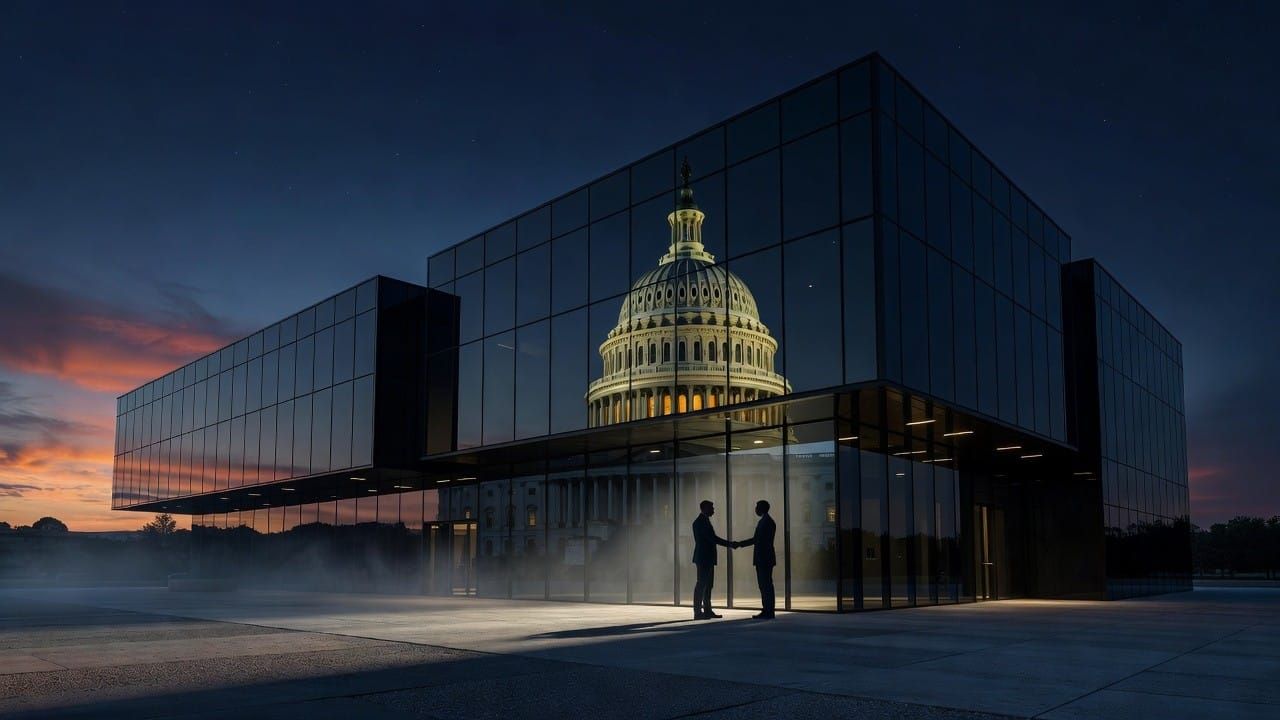
On July 2, the Financial Times reported something that would have sounded like satire five years ago: OpenAI is in early talks to hand the United States government a 5% stake in the company. At the $852 billion valuation OpenAI set in its March funding round, that stake is worth roughly $42.6 billion.
Sam Altman's framing, according to people familiar with the discussions, is that giving the public a financial interest in the company is the best way to share the upside of AI. The proposal reportedly goes further than OpenAI itself: Washington would hold 5% of each of the leading US AI developers — the names floated include Anthropic, Google, and Meta — through a sovereign-wealth-fund-style vehicle, modeled loosely on the Alaska Permanent Fund, which pays Alaskans an annual dividend from state oil revenue.
Altman has pitched versions of this to President Trump, Commerce Secretary Howard Lutnick, and Treasury Secretary Scott Bessent. He has also discussed it with Senator Bernie Sanders. Read that list again: it spans the entire ideological spectrum of people who could hurt him.
Let's be clear about what this is not, yet. There is no agreement. The talks are early and conceptual. Anthropic says it hasn't discussed government stakes at all. Google and Meta haven't commented, and it is hard to imagine their boards voluntarily donating 5% of shareholder equity to the Treasury.
But nobody offers to give away $43 billion for nothing. The interesting question is what Altman believes he is buying.
Washington's equity era
Start with the pattern, because there is one. In the past twelve months, the US government has quietly become a shareholder — or a toll collector — across the strategic economy:
- Intel, August 2025. The administration converted $8.9 billion in undisbursed CHIPS Act grants into 433.3 million shares at $20.47 apiece — a 9.9% stake that made Washington one of Intel's largest shareholders.
- MP Materials, July 2025. The Department of Defense invested $400 million in convertible preferred stock plus warrants — up to roughly 15% of the company — alongside a decade-long price floor for its rare-earth magnets. The DoD became MP's largest shareholder.
- Nvidia and AMD, August 2025. Not equity, but a toll: both companies agreed to pay the government 15% of revenue from certain AI chip sales to China in exchange for export licenses.
The common thread: Washington converted leverage into ownership. And in every prior case, the government did the asking. Grants became shares. Export licenses became revenue shares. The state saw a chokepoint and priced it.
The OpenAI story inverts the flow. This time, the company is asking the state to take the stake. That single detail should change how you read everything else.
What Altman is buying
Consider the pressure inventory OpenAI faces as of this week:
Washington can now switch off frontier AI products overnight. In June, an export-control directive forced Anthropic to suspend access to its two most advanced models. Access was restored on June 30 — after the company took government-mandated security steps. That episode established something new: frontier model availability in the US is now conditional on regulatory goodwill.
Chinese open-source models are eroding the moat from below. US enterprises are increasingly testing Chinese open-weight models that are nearly as capable and dramatically cheaper. That pressures OpenAI's pricing — and gives Washington a national-security rationale to want its domestic champions concentrated, funded, and cooperative.
The politics of AI are curdling. Tens of millions of Americans are seeing record electricity costs driven partly by data-center demand. White-collar job anxiety is becoming a campaign theme ahead of the November midterms. The populist case for extracting something visible from the AI industry is being made on both the left and the right — which is precisely why Altman is talking to both Bessent and Sanders.
And OpenAI still needs the largest IPO in history. The company raised $122 billion in March while projecting $14 billion in losses this year. At some point, the public market has to absorb this — at a scale no offering has ever attempted.
When your largest business risk is no longer a competitor but the state, equity is insurance. The premium — 5% — is not generosity. It is a price.
The question that matters for investors isn't whether Altman is being charitable. It's what a government stake actually does — to the IPO, to Microsoft, to the regulatory landscape, and to every lab that can't afford the same gift. That's where the money is.
The rest of this briefing is for paid members: what the Intel precedent did for the stock and what a sovereign anchor implies for an OpenAI IPO, the regulatory-moat mechanics a 5% "gift" sets in motion, the three-scenario framework with probabilities and triggers, and the bottom-line positioning.
AlphaBriefing Paid gets you every investment thesis, scenario framework, and catalyst brief we publish — the analysis private intel clients pay four figures for, at a fraction of that.