How a Myanmar Militia Ended Up Pricing the AI Boom
Tin is holding near record highs even as LME warehouses quietly refill. The reason: AI servers use three times the solder — and the supply map runs through a sanctioned militia, a Congolese conflict zone, and Jakarta's next export ban.

Yesterday, every terminal in the world was watching oil. The ceasefire headlines out of Washington sent WTI up more than 4%, gold fell, and the whole commodity complex traded like a geopolitics dashboard.
The commodity that says more about the next decade didn't make the screen. Tin — the dull, gray metal your entire digital life is literally held together with — sat near $53,000 a tonne on the London Metal Exchange, up roughly 60% in a year and within reach of the nominal all-time highs it set in January.
Here's what makes that price strange: by the usual playbook, tin should be falling. LME warehouse stocks have been rising for months, back above 8,000 tonnes. The futures curve is in contango — the structure of a market that has enough metal today. Reuters' own metals columnists spent last week describing a tin market that is "re-balancing." Every visible physical signal points down.
The price won't go down. That divergence — inventories loosening, price refusing to break — is the tell. The market isn't pricing the metal in the warehouses. It's pricing the map the metal comes from. And that map is one of the most fragile in the entire commodity complex.
The metal that holds everything together
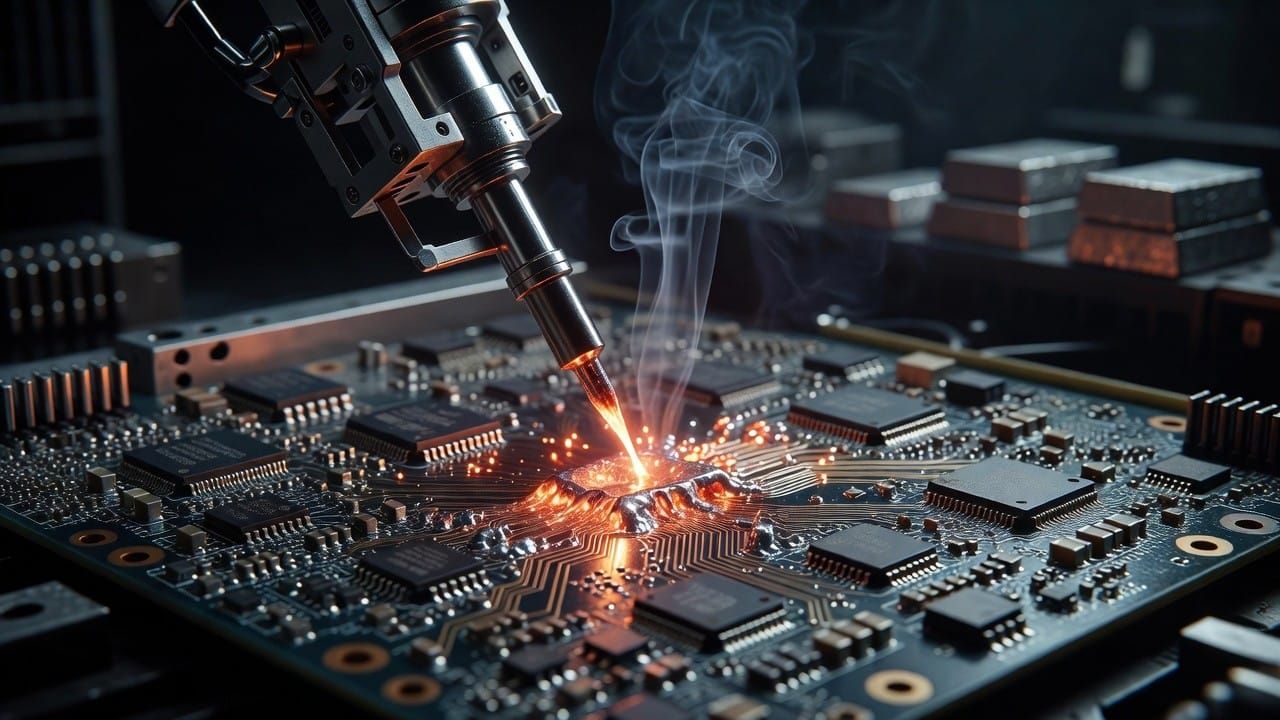
Tin's demand story is hiding in plain sight. Roughly half of all tin consumed on Earth goes into solder — the alloy that joins every component to every circuit board in every electronic device ever made. There is no substitute. Lead-free electronics, mandated across most of the world, means solder is now overwhelmingly tin. No tin, no boards. No boards, no servers.
Then AI arrived. An AI server — denser boards, advanced packaging, more power delivery hardware — uses more than three times as much tin as a conventional server. Industry analysts project tin demand from AI servers alone climbing from roughly 6,000–8,000 tonnes a year today toward 22,000–25,000 tonnes by 2030, with about 2,500 tonnes of net new demand landing in 2026 alone. Against a total mined supply of around 300,000 tonnes a year — a market so small most banks don't staff a tin analyst — that is not a rounding error. It's a structural demand leg growing at data-center speed.
The hyperscalers have spent two years locking up power, land, chips, and memory. Nobody locks up solder. It has always simply been there.
Briefings like this land in members' inboxes before the market prices them in. Join free →
The militia at the top of the supply chain
Now the supply side. The single most important tin-mining district on the planet is Man Maw, in Myanmar's Wa State — a self-governing statelet on the Chinese border, run by the United Wa State Army, a 20,000-plus-strong armed group under US Treasury sanctions since 2003 for narcotics trafficking. Before 2023, Man Maw made Myanmar the world's third-largest tin producer and supplied the bulk of China's imported tin concentrate, feeding the smelters in Yunnan that anchor global refined supply.
In August 2023, the UWSA suspended all mining in the district — officially to audit the resource and overhaul licensing. Myanmar's concentrate shipments to China collapsed by roughly three-quarters. Chinese smelters spent two years running near 70% capacity, scrounging feedstock from Africa and South America. The restart, when it finally began, has been exactly what you'd expect from a militia that has noticed what its resource is worth: slow, selective, and on its own terms — three-year permits for chosen operators, new fees, and, as of this March, a formalized cost-sharing scheme just to pump the water out of the deep shafts.
That is the entity at the top of the AI hardware supply chain. Not a mining major with a CapEx schedule and quarterly calls. A sanctioned armed group that has already demonstrated — for two and a half years, at will — that it can remove the world's swing supply of tin from the market.
And Man Maw is only the first of tin's three fragile legs. The second is a single mine in an active conflict zone in Congo. The third is a government in Jakarta that has been openly studying whether to ban tin exports outright — using the same playbook that rewired the global nickel market. What those two legs mean for price, which companies sit on the right side of the squeeze, and what would actually break this trade — that's the paid briefing.
The rest of this briefing is for paid members: the Congo mine producing 7% of global supply inside M23 territory, the Indonesian export-ban file and its nickel precedent, the inventory math showing why "re-balancing" is a mirage, the four equities with real tin torque — and the one data series that will call the top.
AlphaBriefing Paid gets you every investment thesis, scenario framework, and catalyst brief we publish — the analysis private intel clients pay four figures for, at a fraction of that.