Why German Balconies Have Solar Panels and American Ones Don't
More than a million German homes plug solar panels straight into wall outlets. In America it was never legal — until now. Ten states have passed laws, UL wrote the standard, and California votes this week on the bill that changes the market.

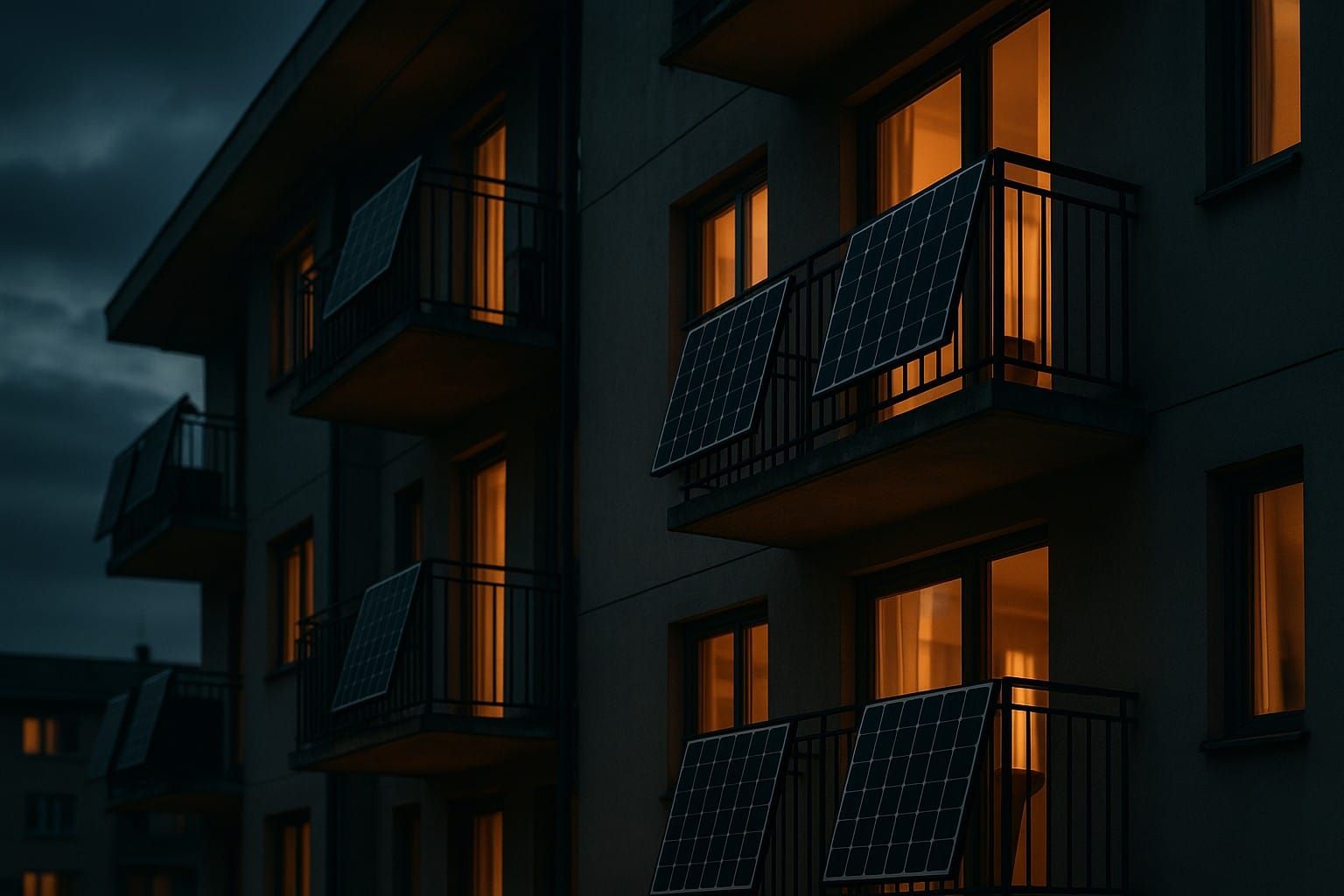
More than a million German households power part of their homes with solar panels that hang off balcony railings and plug into an ordinary wall outlet. No installer, no permit, no utility paperwork — you buy the kit, you clip it to the railing, you plug it in. Germans call them Balkonkraftwerke: balcony power plants.
In the United States, until last year, the number of legal installations was effectively zero.
Not because the hardware was banned. Because it was never made legal. American utility rules were written for rooftop systems the size of a car, wired in by licensed electricians and registered through interconnection agreements. A 400-watt panel that plugs into the wall like a toaster didn't fit any category regulators had imagined — so in most states, using one without applying to your utility for interconnection approval put you outside your utility's rules. The world's simplest solar product was locked out of the world's biggest consumer market by a paperwork gap.
That gap is now closing, fast — and this week is the pivotal moment. Ten states have passed laws legalizing plug-in solar. Bills have been introduced in at least 24. New York and New Jersey have legislation awaiting their governors' signatures. And California — the market that decides whether niche energy products become national ones — has Senate Bill 868, the "Plug Into the Sun Act," on the Assembly floor with the legislative session ending August 31.
The product America forgot to legalize
A plug-in solar system is deliberately small: most state laws cap output at 1,200 watts (Colorado allows 1,920). A typical starter kit is one or two panels and a microinverter that syncs with grid power and feeds electricity backward through a standard outlet into your home's circuits. Whatever your household is drawing at that moment — refrigerator, router, air conditioning — consumes the solar power first, and your meter slows down.
The numbers are modest but real. Analysis by the Environmental Working Group found a single 400-watt balcony system can cover roughly 14% of an average apartment's electricity use, saving about $250 a year. Kits sell today for under $500 at the low end — roughly $1.50 per watt, a half to a third of the cost of installed rooftop solar — and payback periods in the US run two to six years, according to industry figures cited by pv magazine. In Germany, where scale arrived a decade ago, kits routinely sell in supermarkets.
What makes the category interesting isn't any single unit's output. It's who can buy one. Rooftop solar is a product for homeowners with good roofs, good credit, and five-figure budgets. Plug-in solar is a product for renters — the third of American households that have never had access to solar power at any price. It requires no roof, no loan, and no landlord-financed construction. It moves with you when your lease ends.
Briefings like this land in members' inboxes before the market prices them in. Join free →
How the wall came down
Three things unlocked the US market, in sequence.
Utah went first. In 2025, the Utah legislature unanimously passed H.B. 340, the first state law allowing plug-in systems up to 1,200 watts to connect to standard outlets without an interconnection agreement — requiring only UL certification and compliance with electrical code. The bill's author, Rep. Raymond Ward, did something instructive: he sat down with Rocky Mountain Power, the state's dominant utility, and asked what the bill needed to say for the utility not to oppose it. It passed without a single no vote.
UL wrote the standard. For years, the safety-certification vacuum was the honest core of the utility objection. Plug-in solar reverses assumptions baked into American home wiring: branch circuits designed for one-way power flow can be overloaded by backfeed without tripping a breaker, exposed plug blades can be energized by sunlight, and bidirectional current can blind ground-fault interrupters. In late 2025, UL published UL 3700 — a dedicated construction, performance, and labeling standard for plug-in solar systems, now the basis for a certification program manufacturers can build to. The "there's no standard" argument is gone.
The states piled in. When 2026 legislative sessions opened, bills appeared in two dozen statehouses — Alaska to Hawaii, Indiana to Arizona — most copying Utah's template: a 1,200-watt cap, a UL 3700 requirement, and an exemption from interconnection paperwork. Ten states have now passed laws. New Hampshire's takes effect in January 2027. Maine, New York, and Vermont went further than most, requiring the entire kit — panels, inverter, cables, mounting — to carry certification, a bar no vendor has yet cleared.
California is the one that matters. SB 868, authored by Sen. Scott Wiener, advanced out of the Assembly Appropriations Committee in mid-August and heads to a floor vote before the session closes. The state's electricity rates have doubled in a decade, and its rooftop solar market has been shrinking since regulators slashed export compensation under NEM 3.0. Plug-in solar sidesteps that entire fight — which is precisely why its coalition looks so unusual.
Why the utilities aren't at war with this
The residential solar story of the last decade was trench warfare between utilities and the rooftop industry over net metering — who pays whom, and how much, for exported power. Plug-in solar mostly opts out of that war. These systems are sized to be consumed behind the meter: you're not selling power to the grid, you're just buying less of it. No export compensation means no "cost shift" argument, and the wattage caps keep any single system too small to matter to grid engineering.
That's why the politics look nothing like the net-metering fights. Utah's bill passed unanimously with the utility's blessing. The Bloomberg and Utility Dive headlines this month describe plug-in solar as the rare distributed-energy policy "utilities and lawmakers can agree on." When the industry's loudest opponents decline to fight, adoption curves stop depending on courts and commissions — and start depending on price.
And the price story has a striking feature: no subsidy. The federal residential solar tax credit is gone, state incentives are thinning, and the rooftop industry is contracting partly because its economics were built on those supports. Plug-in solar's economics were never subsidized in the first place. At $1.50 per watt and falling — Bright Saver, the nonprofit driving much of the state legislation, expects prices to drop sharply as scale arrives — this is the first American solar product designed to stand on retail economics alone, arriving at the exact moment the subsidized model is being dismantled.
What to watch, and what it's worth
The honest caveats first. A balcony kit offsets a slice of a power bill; it will not neutralize the rate increases rolling through American utilities as data-center demand tightens regional grids. The full-system certification some states demand doesn't exist yet, which will bottleneck those markets. Landlords and HOAs still hold veto power in practice, whatever state law says. And the category's safety record at US scale is unproven — UL 3700 exists precisely because the failure modes are real.
But the structural read is straightforward: a consumer product category with a million-unit proof of concept in Germany, a decade of hardware maturity, collapsing prices, and a regulatory wall that is coming down state by state in real time. If SB 868 clears the floor and reaches the governor's desk, the calculus changes the way it always does when California legalizes something: manufacturers that treated the US as a rounding error — the German and Chinese kit makers who already build these systems by the million — get a forty-million-person market with the country's most painful electricity prices, and American retail gets a new plug-and-play energy appliance to sell.
Solar in America has been a construction project for twenty years. The bet embedded in this legislative wave is that its next act is a consumer electronics product. Bright Saver's co-founder Cora Stryker put the stakes plainly in January: if California passes it, "the market will change permanently. We'll have economies of scale. We'll have manufacturers come into the American market, and it will never be the same."
The floor vote comes within days. For once, the most interesting thing in American energy policy fits on a balcony railing.
If this analysis was useful, this is what AlphaBriefing does every day — geopolitics and markets, connected to what it means for your money. Free members get the daily brief in their inbox; paid members get the investment frameworks, scenario pricing, and catalyst calendars behind the paywall.
Sign up free → — upgrade whenever it earns it.
Get this level of intelligence every day. Subscribe to AlphaBriefing — free, member, and paid tiers available.
Sources & Further Reading
- pv magazine USA — California advances slate of community solar, balcony solar, and virtual power plant bills
- pv magazine USA — Ensuring safety of plug-in solar
- pv magazine USA — "We are really looking at a movement here": the multi-state plug-in solar legislation push
- pv magazine USA — Balcony solar gains unanimous bipartisan support in Utah
- CleanTechnica — California Solar Power Bills Move Forward to Support Balcony Solar, Community Solar, and VPPs
- NC Clean Energy Technology Center — The 50 States of Solar, Q2 2026 Executive Summary
Disclaimer
AlphaBriefing is an independent intelligence publication. The content in this article is produced for informational and educational purposes only. Nothing published by AlphaBriefing constitutes financial, investment, legal, tax, or regulatory advice, nor should it be construed as a solicitation or recommendation to buy, sell, or hold any security, asset, or financial instrument.
All views expressed are those of the author at the time of writing and are subject to change without notice. Markets are volatile and unpredictable; past performance is not indicative of future results. Any investment involves risk, including the possible loss of principal.
AlphaBriefing and its principals, employees, or contributors may hold positions in securities or assets mentioned in this article. This should be considered a potential conflict of interest. No material relationship with any company referenced exists unless explicitly disclosed. Readers should conduct their own due diligence and consult qualified financial, legal, and tax advisors before making any investment decisions.
Information in this article is drawn from public sources believed to be reliable at the time of publication. AlphaBriefing makes no warranty, express or implied, as to the accuracy, completeness, or timeliness of any information herein. AlphaBriefing accepts no liability for any loss or damage arising from reliance on this content.
© AlphaBriefing. All rights reserved. Unauthorised reproduction or distribution is prohibited.