Why Data Centers Are Buying Old Jet Engines
Gas turbines are sold out to 2032 and prices are up 50% in a year — so data centers are bolting retired jet engines to concrete. Inside the first quarter where the scarcity trade blinked.

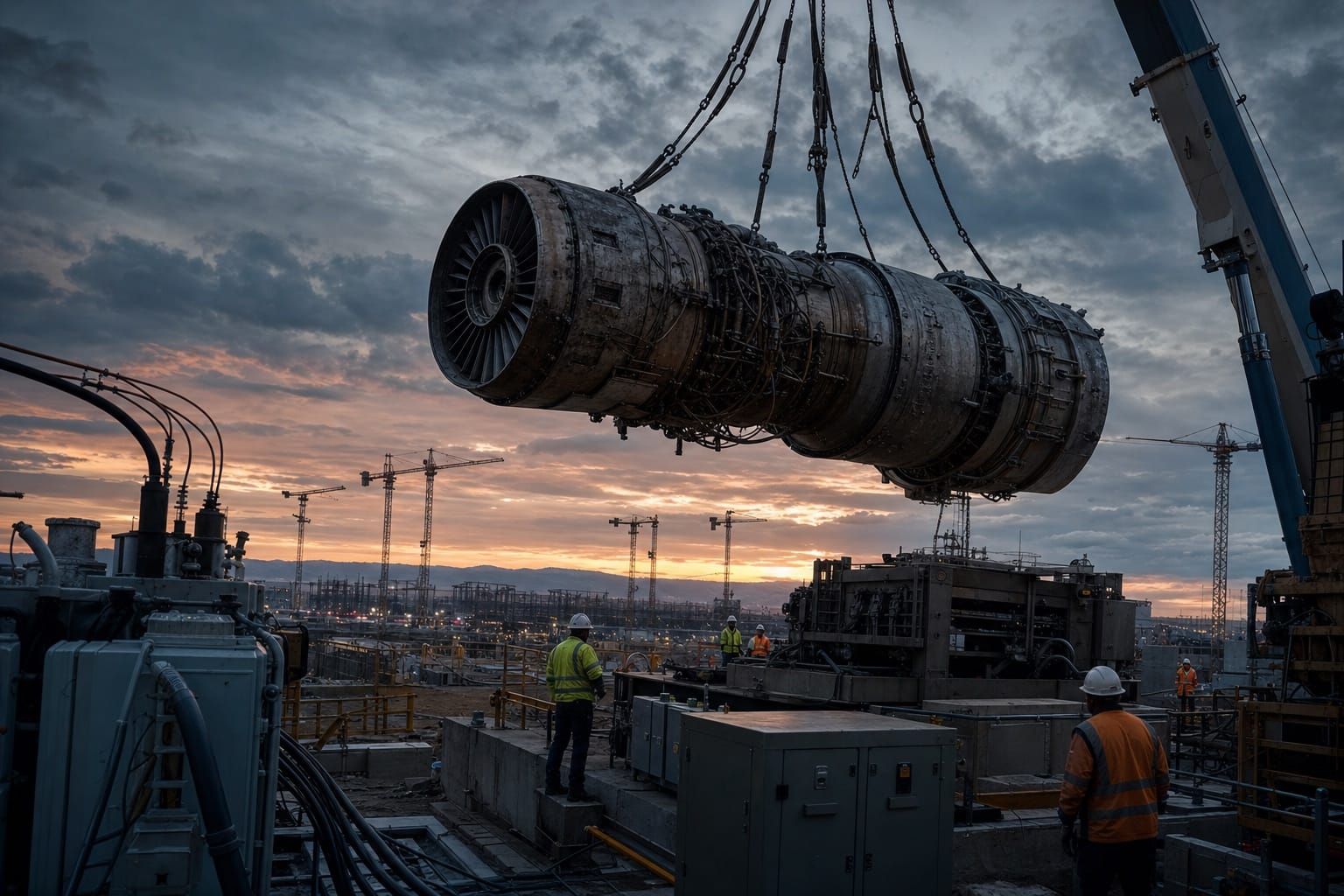
There is a reliable way to tell when a market has gone from tight to desperate: buyers start paying premium prices for equipment that was headed to the scrapyard. In housing, it's the bidding war over the teardown. In the AI power buildout, it looks like this: old jet engines, stripped from retired airliners, are being overhauled and bolted to concrete pads to generate electricity for data centers — a trend The New York Times documented in a report published Tuesday morning. Machines designed to cross oceans at 35,000 feet are burning natural gas at ground level because the proper tool for the job — the heavy-duty industrial gas turbine — cannot be bought at any price before the end of the decade.
Here is another symptom. Boom Supersonic, the Colorado company that set out to revive supersonic passenger flight, said last month it will build gas turbines for data centers at a new factory near Centennial Airport, according to local reports. When an aircraft startup pivots to power generation mid-flight, it is telling you where the margin went.
And last Wednesday, the company at the center of the shortage put numbers on it — numbers that cut both ways.
The best seller's market in heavy industry
GE Vernova ($GEV), the market leader in heavy-duty gas turbines, reported third-quarter results on October 28. The headline figures describe a seller's market with almost no modern precedent:
- A $196.7 billion order backlog, up from $135.3 billion a year earlier — a 45% jump. Management expects the figure to clear $200 billion next quarter.
- 122 gigawatts of gas turbine capacity under contract, up from 83 GW when 2026 began. The company is now taking reservations for delivery slots in 2032 — order a turbine today and it arrives when a child born this week is starting school.
- Prices up roughly 50%. Full-year 2026 order pricing is on track to come in about 50% above 2025, per CEO Scott Strazik. Third-quarter pricing alone ran more than 20% above the fourth quarter of 2025, helped by a richer mix of aeroderivative units — the jet-engine-derived turbines data centers favor because they can be deployed fast.
- Power segment revenue grew 25% year over year.
One detail worth correcting in the popular narrative: this is not purely an AI story. Strazik put the customer mix at roughly 80% traditional buyers — utilities and independent power producers — and 20% data centers. The AI bid is the marginal price-setter at the end of a queue that was already long. But the marginal buyer is the one scavenging jet engines.
The quarter the music slowed
Buried in the same earnings call was the other half of the story. Gigawatts under contract grew by just 6 GW in the third quarter — after double-digit quarterly additions in the first half of 2026. Slot reservation agreements declined. Per-kilowatt pricing is guided to dip next quarter on sales mix.
And the stocks have noticed. GE Vernova — still up about 33% this year — traded around $907 on Tuesday, roughly 23% below its 52-week high of $1,175. Siemens Energy, the second of the big three Western turbine makers, sits about 31% below its high. Mitsubishi Heavy Industries, the third, closed Monday in Tokyo at a 52-week low, down about 19% this year.
Sold out for six years, raising prices 50% a year — and the shares are rolling over. Either the market is wrong, or it sees something in the order book that the backlog number hides.
The same week as the earnings call, Wood Mackenzie published analysis that may be that something: by the consultancy's reckoning, a four-hour grid-scale battery is now cheaper to install than a gas peaking plant — not just in subsidized markets, but globally, for the first time.
So the question that decides the trade: was the third quarter the first print of the top of the turbine cycle — or a pause before the 2027 re-acceleration management is promising?
The rest of this briefing is free — it just requires a free AlphaBriefing account: what the order slowdown actually was (and the detail William Blair flagged that changes its meaning), the $9 billion acquisition that reveals where GE Vernova thinks the next bottleneck is, and a three-lane positioning framework for turbines, batteries, and grid equipment — with the signposts to watch into year-end.
Create your free account → — 30 seconds, no card.