Amazon's Space Internet Is Ready. The Rockets Aren't.
On November 13, ULA's grounded Vulcan rocket flies again — carrying 40 satellites for Amazon's answer to Starlink. What the launch means for AMZN, BA, LMT, and NOC.

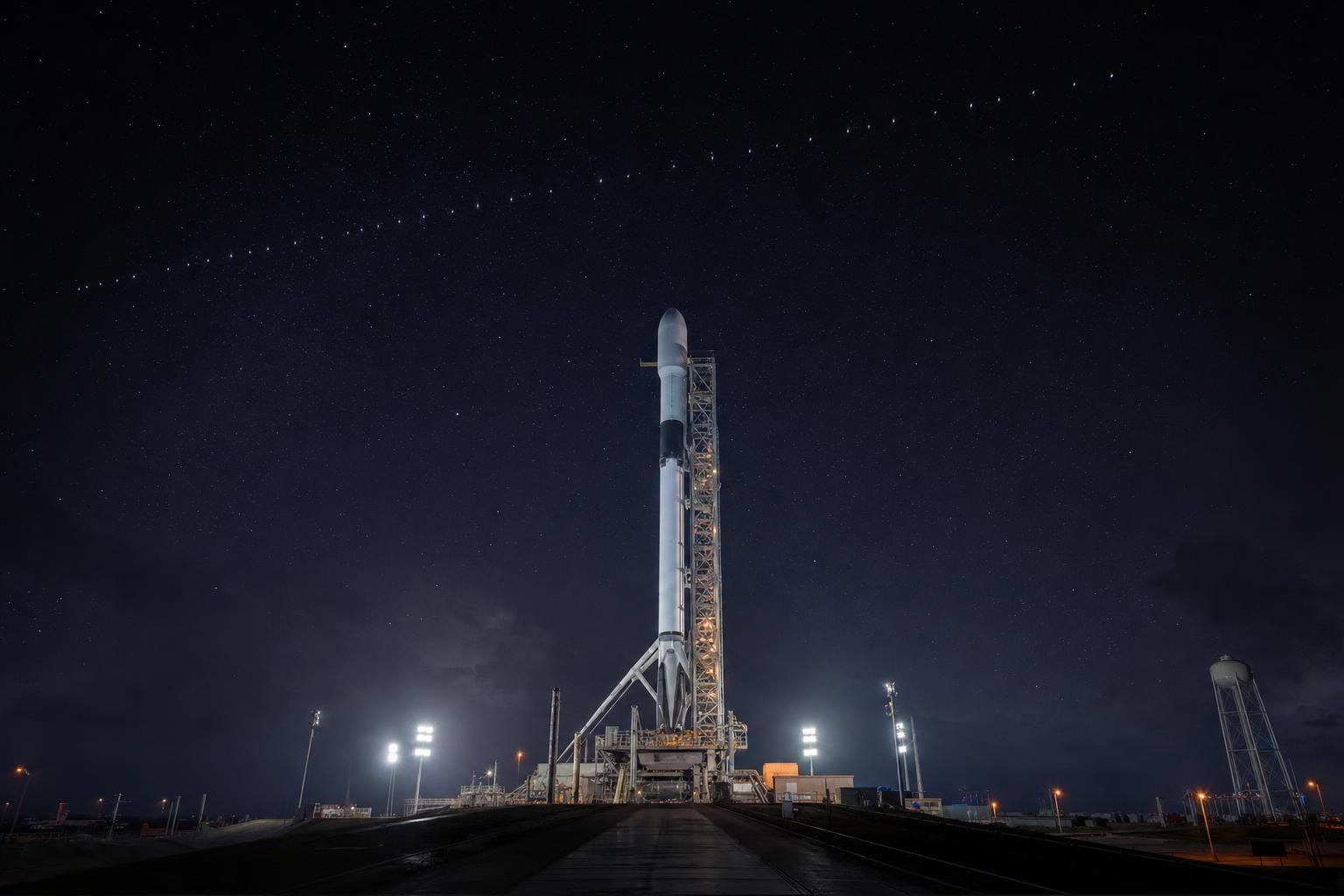
On Friday, November 13, a 221-foot rocket is scheduled to lift off from Cape Canaveral carrying 40 satellites for the most consequential challenger in the space economy. The rocket is United Launch Alliance's Vulcan, flying for the first time in nine months. The satellites belong to Amazon Leo — the broadband constellation formerly known as Project Kuiper — and they are the opening installment of 38 Vulcan flights Amazon has booked to deploy the bulk of its network.
Almost everything about this launch is load-bearing. For ULA, the 50-50 joint venture between Boeing and Lockheed Martin, it is the flight that determines whether its flagship rocket gets back into the Pentagon's good graces. For Northrop Grumman, which builds the solid rocket boosters that have now failed on two of Vulcan's four flights, it is a referendum on a fix that hasn't been fully explained in public. And for Amazon, it is the moment its $10 billion-plus answer to Starlink finally gets the heavy-lift cadence it has been waiting on for three years.
The stakes compound because Amazon says it is only weeks away from switching on commercial service. The satellites are ready. The network works. What Amazon doesn't control is the one thing that has bottlenecked this project from the beginning: rockets.
A rocket the Pentagon needs to trust again
Vulcan's grounding traces back to a problem ULA has suffered twice and never fully explained. On the rocket's second flight in October 2024, a nozzle on one of its Northrop Grumman-built solid rocket boosters failed shortly after liftoff. The rocket muscled through and completed the mission, and investigators blamed a manufacturing defect in an insulator. Then it happened again in February 2026 — a second nozzle failure, on what was only Vulcan's fourth flight. The rocket again reached orbit, but the US Space Force, Vulcan's anchor customer, lost confidence. The vehicle has not flown since.
That matters well beyond ULA's launch manifest. The Pentagon has entrusted Vulcan with roughly half of its major national security launches through the early 2030s — communications, navigation, missile warning, and surveillance satellites. During the grounding, the Space Force moved six missions off Vulcan onto SpaceX's Falcon 9 and Falcon Heavy, including three GPS satellites and a strategic missile-warning spacecraft, with ULA receiving future SpaceX-assigned missions in compensation.
ULA says the February anomaly has been addressed through design and process improvements to the nozzle, and the November 13 mission will fly the improved design — with a full complement of six solid boosters, the most Vulcan has ever flown. Neither ULA nor Northrop has publicly identified the root cause. Brigadier General Eric Zarybnisky, the chief rocket buyer at Space Systems Command, said the military wants to see data from Vulcan's commercial flights before clearing it to resume national security missions — meaning at least two Amazon Leo launches will fly before the Pentagon puts its own hardware back on the rocket, perhaps in early 2027.
There is a further wrinkle: Politico reported in October that SpaceX plans to eventually retire the Falcon rocket family in favor of Starship. If that reporting holds, the Space Force's only two certified launch providers are a company phasing out its workhorse and a company trying to prove its replacement works. The military's margin for error in the launch market has rarely been thinner.
Amazon's satellite machine finally works. Its ride doesn't.
While the rockets struggled, Amazon quietly solved the harder industrial problem. At its factory in Kirkland, Washington, the company recently completed its 1,000th Leo satellite. Production that once took six months to yield 27 satellites now turns out 27 a week, according to Rajeev Badyal, the executive running the program — a man Elon Musk fired from Starlink eight years ago for moving too cautiously, and who is now building the only serious competitor to it. Ars Technica, which interviewed Leo's leadership in October, describes Amazon as the world's second-largest satellite manufacturer, behind only SpaceX.
The constellation's first generation calls for 3,232 satellites. As of early October, Amazon had 396 in orbit — enough, the company says, to begin initial commercial service, which it still promises before the end of 2026. A second-generation constellation has already been filed with the FCC.
The gap between 1,000 satellites built and 396 in orbit is the whole story. Amazon deliberately spread its launch contracts across four providers — ULA, Blue Origin, Arianespace, and eventually SpaceX itself — buying more than 100 launches in what Amazon has called the largest commercial launch procurement in history. Then nearly everything slipped. Vulcan was grounded twice. Blue Origin's New Glenn, the most powerful rocket in Amazon's stable, exploded during a static-fire test in May 2026, a failure Blue Origin traced to a valve in its BE-4 engine. The 48 Leo satellites awaiting that launch escaped the fireball; the schedule did not.
The delays had regulatory consequences. Amazon's 2020 FCC authorization required half the constellation — 1,616 satellites — in orbit by July 30, 2026. Amazon couldn't come close. In June, the FCC waived the deadline entirely, with the Space Bureau writing that "waiver serves the public interest by promoting a second large satellite broadband constellation" and noting Amazon had already invested more than $10 billion. The hard deadline that remains: the full first-generation constellation must be in orbit by July 30, 2029. That is 2,800-plus satellites in under three years — a pace that requires Vulcan flying regularly, New Glenn flying at all, and nothing else going wrong.
So November 13 is not one launch. It is the first data point in whether the 2029 deadline is achievable, whether the Pentagon's launch duopoly still has two working members, and whether the only funded challenger to Starlink gets to market while the market is still winnable. Starlink now serves a reported 13.6 million subscribers and has had low-Earth-orbit broadband essentially to itself for half a decade. Amazon executives claim their network will deliver a gigabit downlink — triple what Starlink typically offers — and it has already pried Delta Air Lines away from SpaceX for in-flight Wi-Fi.
Which raises the questions that matter for your portfolio: what is Leo actually worth inside Amazon, who among the public contractors gets paid as this unfolds, and what has to go right between now and 2029?
A free membership gets you access to every free article at AlphaBriefing.com: Join AlphaBriefing
The rest of this briefing is free — it just requires a free AlphaBriefing account: the ticker-by-ticker read on $AMZN, $BA, $LMT, and $NOC exposure, the catalyst calendar from November 13 through the 2029 FCC deadline, and the scenario map for how a second Vulcan failure would reprice all four names.
Create your free account → — 30 seconds, no card.