Why Are America's Restaurant Chains All Closing at Once?
On the Border, Pizza Hut, Wendy's, and Red Lobster are all closing stores at once. It isn't the consumer cracking — it's the unit economics of the American restaurant breaking. Here's who inherits the empty tables.

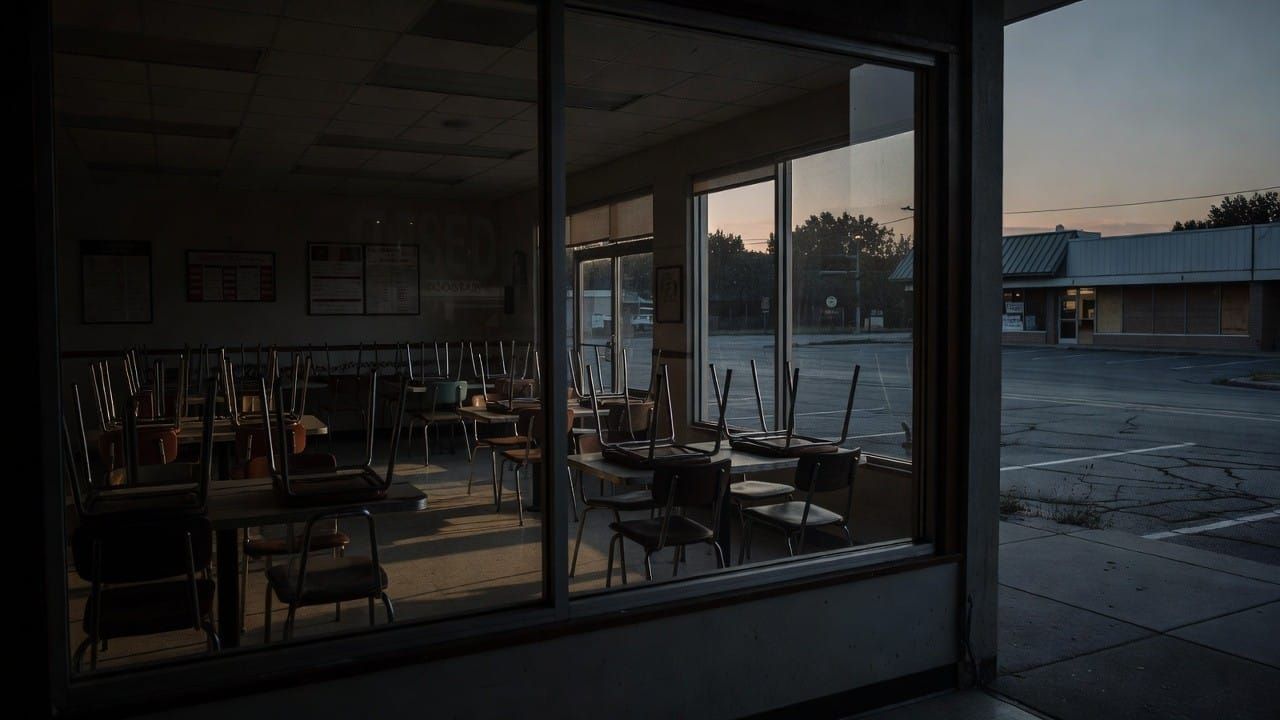
On the Border shut every company-owned location this month. Pizza Hut is closing 250 stores by July. Wendy's, Papa John's, and Red Lobster are pulling leases across the country. This isn't a string of bad operators — it's the unit economics of the American restaurant breaking all at once. Here's who inherits the empty tables.
Walk through any American strip mall this summer and you can read the story in the dark windows. The casual-dining Mexican chain On the Border closed every company-operated restaurant earlier this month, roughly a year after a buyer pulled it out of bankruptcy, leaving a skeleton of six franchisee-owned units. Red Lobster shuttered its Times Square flagship on June 14 and is still handing back leases. Smokey Bones is one of four sit-down chains to go dark since December.
The numbers behind the closures are larger than most people realize. Wendy's plans to close somewhere between 298 and 358 U.S. locations this year. Pizza Hut will shut 250 underperforming American stores by July 1. Papa John's is targeting around 200 closures across North America in 2026. The industry has a name for it now: the Great Contraction.
It is tempting to file this under "the consumer is tapped out." That is the easy story, and it is incomplete. The deeper truth is that the math underneath the American restaurant — the basic arithmetic of what it costs to put a plate on a table and what a customer will pay for it — has been permanently reset. The chains closing today are not failing because Americans stopped eating out. They are failing because the model that fed America for forty years no longer clears a profit. And when an entire industry's cost structure resets at once, the closures aren't a downturn. They're a transfer of ownership.
The cost base never came back down
Start with the input that operators complain about most: food. Average restaurant food costs now sit more than 35% above pre-pandemic levels, according to the U.S. Bureau of Labor Statistics. That is not a spike waiting to deflate — it is a new floor. Ninety-five percent of full-service operators and ninety-four percent of limited-service operators told the National Restaurant Association that food costs are a significant challenge heading into 2026.
Layer labor on top. The post-pandemic labor market reset wages across the entire service economy, and unlike a commodity spike, wage gains don't reverse. Add insurance premiums climbing alongside the broader property-insurance crisis, energy, and the swipe fees that take a cut of every card transaction, and you arrive at the number that matters: more than nine in ten operators cite food, labor, insurance, energy, and card fees as significant cost pressures. Last year, 42% of restaurant operators reported their business was not profitable — in an industry that was supposedly enjoying a post-pandemic dining boom.
Now the demand side. Sixty percent of operators reported softer customer traffic late last year. The NRA still projects the industry will cross $1.55 trillion in sales in 2026 — but dig into that figure and it falls apart as a growth story. Almost all of the increase comes from menu price hikes, not more diners walking in. Adjusted for inflation, real sales growth lands around 1%. The industry is running faster to stand still: charging more, serving fewer, and watching the gap between revenue and cost close to nothing.
This is the vise. Costs that won't fall, prices that have hit the ceiling of what a cautious consumer will pay, and traffic that is flat-to-down. For a high-volume, thin-margin business, that combination is not a soft patch. It is an extinction event for any operator without scale or pricing power.
Why casual dining dies first
The collapse is not evenly distributed, and that asymmetry is the whole investment story.
Full-service casual dining — the sit-down chains with table service, large kitchens, and big real-estate footprints — is the most exposed point in the entire industry. These restaurants carry the highest labor load (servers, hosts, bussers, line cooks), the largest physical boxes to heat, cool, and rent, and menus broad enough to make food-cost inflation hit everywhere at once. They occupy the squeezed middle of the market: too expensive to win the value-seeking diner trading down to fast food, not distinctive enough to win the affluent diner trading up to a genuine experience.
When the cost base resets, this is the segment with no room to absorb it. A quick-service chain can re-engineer its labor model around kiosks and a tighter menu. A fine-dining room can pass costs to a customer who isn't counting. The casual-dining middle can do neither — and so On the Border, Red Lobster, Smokey Bones, and the rest are the first dominoes, not the last.
There is a hard lesson for investors buried in those bankruptcies. Several of these chains had already been through private-equity ownership, a restructuring, or both. Financial engineering can extend a struggling restaurant's life, but it cannot fix unit economics that no longer work. When the underlying box loses money on every cover, more debt and a fresh logo only delay the closing.
Follow the money out of the dining room
Here is the part the closure headlines miss. A restaurant going bankrupt does not destroy the value in the business — it relocates it. Three layers of the industry get paid no matter which brands survive the shakeout, and they are where the durable money sits.
The asset-light franchisors. The most resilient business in the restaurant world isn't running restaurants — it's collecting a toll on other people's restaurants. Franchise royalty models typically take 4–8% of a franchisee's gross sales, plus another 2–5% for the marketing fund. That revenue is paid off the top line, before food, labor, or rent. The franchisor carries almost none of the operating risk and almost none of the capital cost; the franchisee owns the box and eats the margin squeeze. The most successful global restaurant companies long ago figured this out — the parent company is a royalty stream and a brand, not a kitchen. In a contraction, the strongest franchisors even benefit: weaker independents close, and surviving franchise systems capture their traffic.
The delivery rails. The aggregators take their cut regardless of whether the restaurant makes a dime. On a $25 order placed through a delivery platform, commissions of 20–30% mean the restaurant nets somewhere around $17.50 to $21.25 — before it has paid for a single ingredient, a minute of labor, or a square foot of rent. For a thin-margin operator, handing a fifth to a third of the ticket to the platform is often the difference between a profitable order and a loss. But for the platform, it is a high-margin toll booth sitting on top of the entire industry. The rails get paid in the boom and in the bust.
The landlords. Restaurant real estate doesn't vanish when a chain folds. Well-capitalized net-lease landlords collect rent through the lease term, and when a box does go empty, the strongest operators in the market are the ones positioned to re-tenant it — often to a surviving quick-service brand expanding into a now-cheaper location. The original operator absorbs the loss; the landlord recycles the asset. Decades ago, one of the most famous restaurant companies in the world quietly figured out that its real business was real estate, not hamburgers. That insight has never been more valuable than in a year when the tenants are the ones going under.
The bottom line
The wave of closures sweeping American restaurants is not a cyclical dip that a better economy will reverse. It is a structural reset — a cost base that ratcheted permanently higher colliding with a consumer who has hit the limit of what she'll pay. That collision is fatal for the high-cost, low-flexibility middle of the market, and survivable mainly for those with scale, pricing power, or an asset-light model.
For investors, the instinct to bottom-fish a beaten-down casual-dining name is the trap. The value isn't leaking out of the industry — it's moving to a different floor of the building. It's flowing to the franchisors collecting royalties off the top, the platforms taxing every delivery, and the landlords who own the dirt under the empty dining rooms. The tables are closing. The question worth asking isn't which chain comes back. It's who already owns the room when the lights come back on.
Get this level of intelligence every day. Subscribe to AlphaBriefing — free, member, and paid tiers available.
Sources & Further Reading
- National Restaurant Association — Persistent Cost Increases and Enduring Demand Will Shape the Restaurant Industry in 2026
- National Restaurant Association — 2026 State of the Restaurant Industry
- Restaurant Business — Chain shutdowns become more common after the pandemic
- TheStreet — Once-bankrupt Mexican chain begins another wave of restaurant closures
- Traders Union — U.S. restaurant chains plan widespread location closures in 2026
- Nation's Restaurant News — Restaurants face modest growth amid cost pressures in 2026
- QSR Magazine — QSR Franchising Industry Slated for Cautious Growth in 2026
Disclaimer
AlphaBriefing is an independent intelligence publication. The content in this article is produced for informational and educational purposes only. Nothing published by AlphaBriefing constitutes financial, investment, legal, tax, or regulatory advice, nor should it be construed as a solicitation or recommendation to buy, sell, or hold any security, asset, or financial instrument.
All views expressed are those of the author at the time of writing and are subject to change without notice. Markets are volatile and unpredictable; past performance is not indicative of future results. Any investment involves risk, including the possible loss of principal.
AlphaBriefing and its principals, employees, or contributors may hold positions in securities or assets mentioned in this article. This should be considered a potential conflict of interest. No material relationship with any company referenced exists unless explicitly disclosed. Readers should conduct their own due diligence and consult qualified financial, legal, and tax advisors before making any investment decisions.
Information in this article is drawn from public sources believed to be reliable at the time of publication. AlphaBriefing makes no warranty, express or implied, as to the accuracy, completeness, or timeliness of any information herein. AlphaBriefing accepts no liability for any loss or damage arising from reliance on this content.
© AlphaBriefing. All rights reserved. Unauthorised reproduction or distribution is prohibited.