Why America's Biggest Infrastructure Cut Won't Look Like a Cut
The $1.2 trillion infrastructure law expires September 30, and the Senate's 90-6 extension quietly drops $36.8 billion a year in guaranteed funding. A budget-scoring quirk means a 25% cut will arrive on the books looking like a flat budget.

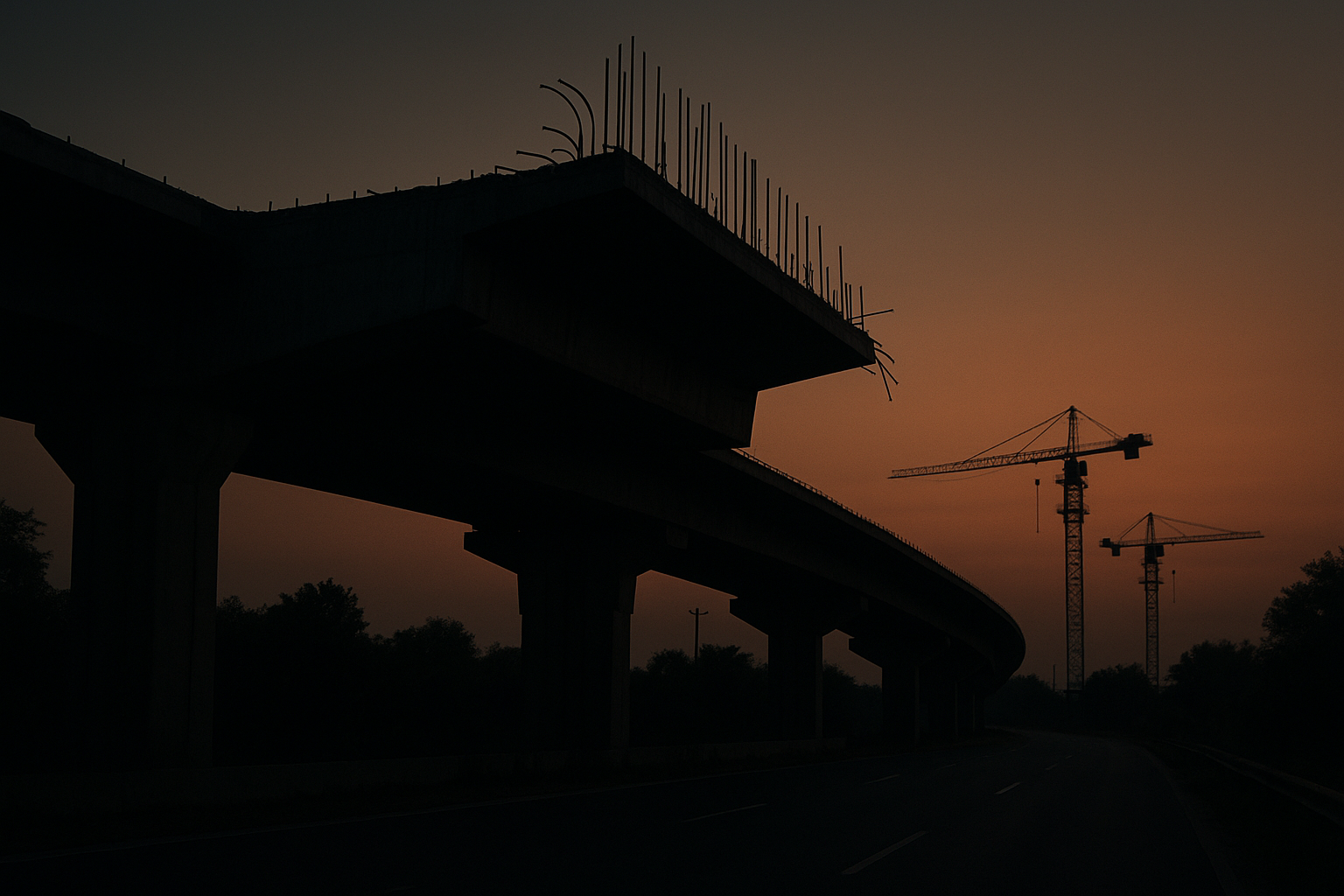
On August 8, the Senate voted 90 to 6 to keep America's transportation programs alive past September 30. It was the kind of lopsided, bipartisan vote that reads like Washington doing its job. Buried inside it is the largest infrastructure funding cut in modern American history — one designed, by the mechanics of congressional budgeting, to never look like a cut at all.
Here is the situation. The Infrastructure Investment and Jobs Act — the $1.2 trillion law signed in November 2021, the one that put "Bipartisan Infrastructure Law" signs next to half the highway projects in the country — expires on September 30, 2026. That is 32 days from now. Congress will not pass a successor in time. The House Transportation and Infrastructure Committee reported out a reauthorization bill (H.R. 8870) in May; it is going nowhere before the deadline. Instead, the Senate attached a short-term extension of the surface transportation programs to a continuing resolution that funds the government through December 11.
The extension keeps the programs. It does not keep the money. And the difference between those two things is $36.8 billion a year.
The Money That Doesn't Come Back
The IIJA was actually two laws stapled together, funded three different ways. The core highway and transit formula programs run on contract authority from the Highway Trust Fund — the gas-tax-fed account that has anchored federal road funding since Eisenhower. Those programs survive in the extension. A second tranche runs through ordinary annual appropriations, which Congress fights about every year as usual.
The third piece is the one that made the IIJA historic — and it is the piece now quietly dying. Division J of the law provided $156 billion in advance appropriations over five years: guaranteed money, delivered automatically, no annual vote required. Because Congress designated it as emergency spending, it was exempt from the usual budget caps. That is what funded the marquee programs — the Mega grants for billion-dollar bridges, the Bridge Formula Program rebuilding 40,000 structurally deficient spans, port infrastructure grants, intercity rail expansion, Safe Streets, transit Capital Investment Grants.
Division J's guarantee runs out with the law on September 30. The Senate's extension deliberately does not renew it. More than 100 industry, labor, and business groups — the people who pour the concrete and finance the projects — sent Congress a letter warning that the result is a $36.8 billion annual shortfall across the Department of Transportation starting October 1, with individual grant programs facing cuts of 50 to 100 percent. Intercity rail, which relied on Division J almost entirely, gets hit hardest.
Briefings like this are free to read with a free AlphaBriefing membership. Join free →
The Baseline Trick
Why would Congress let a third of the infrastructure law vanish while voting 90–6 to "extend" it? Because of how the money gets scored — and this is the part worth understanding, because it is how the cut stays invisible.
The Congressional Budget Office builds its spending baseline on the assumption that emergency appropriations are one-time events. Division J, as emergency-designated spending, falls out of the baseline entirely after fiscal 2026. The consequence is perverse: simply continuing the infrastructure funding that exists today scores as $166.5 billion in new spending over five years. Any lawmaker who wants to keep the status quo has to go find $166.5 billion in offsets — while any lawmaker who lets it lapse gets scored as spending nothing at all.
The White House budget shows how this plays out in practice. The administration's fiscal 2027 transportation request appears virtually flat — down 0.3 percent against the traditional baseline. Measured against what the government actually spent in fiscal 2026, with Division J included, it is a 25.9 percent cut. Both numbers are true. Only one of them will appear in the press release.
There is no announcement, no vote to cut infrastructure, no headline. The money simply stops arriving, and the official ledger says nothing changed. A quarter of federal infrastructure spending — roughly 24.7 percent of the IIJA's five-year total, per the Bipartisan Policy Center — evaporates by accounting convention.
The same dynamic is hitting the water side of the ledger: the IIJA's supplemental funding for the Clean Water State Revolving Funds expires on the same date, and every state faces reduced federal support for water system repair at a moment when, per the American Water Works Association, fewer than half of US utilities are funding asset renewal at all.
Why the Market Hasn't Priced It
If a quarter of federal infrastructure money is disappearing in a month, why are the infrastructure stocks not collapsing?
Because infrastructure money moves slowly — and that lag cuts both ways. Roughly 55 percent of the IIJA's federal highway funds are obligated but not yet spent. Money awarded in 2023 and 2024 is being poured as concrete in 2026 and 2027. Martin Marietta's management has told investors that IIJA-driven demand peaks in 2026, and the company raised full-year revenue guidance to $7.2–7.4 billion in its latest quarter. Vulcan Materials beat estimates. Aggregates pricing is firm. The present looks fine, because the present was funded three years ago.
The cliff lives in the future order book. State departments of transportation build their letting schedules — the calendar of projects they put out for bid — around expected federal apportionments. Those schedules for 2027 and 2028 are being drafted right now, against a federal picture that is $36.8 billion a year smaller and a Highway Trust Fund that CBO says cannot support another multiyear bill at current spending levels. The federal gas tax, 18.4 cents a gallon, has not been raised since 1993; the IIJA's general-fund transfers papered over the gap, and those end too. Martin Marietta has shed roughly 13 percent over the past month as the market has started doing this arithmetic.
The exposure is not uniform. Formula-funded highway work — the bread and butter of the aggregates producers — has the most protection, since contract authority survives the extension. The discretionary mega-projects are where the cuts concentrate: intercity rail, transit expansions, port upgrades, the signature bridges. Engineering and construction firms with heavy rail and transit backlogs face a different 2028 than firms mixing asphalt for state highway departments.
What to Watch
Three dates matter. First, September 30 — the House still has to pass the Senate's extension before the law lapses; failure means an immediate interruption in new obligations. Second, December 11 — the continuing resolution's expiration, when Congress gets one more chance to restore Division J money in a broader funding deal, with midterm-election politics in full swing. Third, the state DOT budget season this winter, when 2027 letting schedules reveal how much of the cut states intend to absorb versus pass through to canceled projects.
The infrastructure decade is not ending. The guarantee that funded it is. From October 1, every dollar that was automatic becomes a dollar Congress has to affirmatively vote for, under budget rules that score standing still as a spending increase. That is a fundamentally different regime — for states, for contractors, and for every investor holding the infrastructure trade on the assumption that the federal spigot stays open on autopilot.
The signs next to the highway projects will stay up for a while. The money behind them runs out in 32 days.
If this analysis was useful, this is what AlphaBriefing does every day — geopolitics and markets, connected to what it means for your money. A free membership gets you access to every free article on AlphaBriefing.com; paid members get the investment frameworks, scenario pricing, and catalyst calendars behind the paywall.
Sign up free → — upgrade whenever it earns it.
Get this level of intelligence every day. Subscribe to AlphaBriefing — free, member, and paid tiers available.
Sources & Further Reading
- Holland & Knight — Stakeholder Pressure Increases as IIJA Funding Expiration Draws Nearer
- Bipartisan Policy Center — How IIJA's Funding Structure Complicates Surface Transportation Reauthorization
- National Association of Counties — IIJA Authorities Expire September 30
- Transportation for America — Extend the IIJA for One More Year
- Congressional Research Service — Surface Transportation Reauthorization: Public Transportation
- AASHTO — Surface Transportation Reauthorization Policy Forum
- Smart Cities Dive — Aging Infrastructure, Climate Risks Shake Water Sector Confidence
Disclaimer
AlphaBriefing is an independent intelligence publication. The content in this article is produced for informational and educational purposes only. Nothing published by AlphaBriefing constitutes financial, investment, legal, tax, or regulatory advice, nor should it be construed as a solicitation or recommendation to buy, sell, or hold any security, asset, or financial instrument.
All views expressed are those of the author at the time of writing and are subject to change without notice. Markets are volatile and unpredictable; past performance is not indicative of future results. Any investment involves risk, including the possible loss of principal.
AlphaBriefing and its principals, employees, or contributors may hold positions in securities or assets mentioned in this article. This should be considered a potential conflict of interest. No material relationship with any company referenced exists unless explicitly disclosed. Readers should conduct their own due diligence and consult qualified financial, legal, and tax advisors before making any investment decisions.
Information in this article is drawn from public sources believed to be reliable at the time of publication. AlphaBriefing makes no warranty, express or implied, as to the accuracy, completeness, or timeliness of any information herein. AlphaBriefing accepts no liability for any loss or damage arising from reliance on this content.
© AlphaBriefing. All rights reserved. Unauthorised reproduction or distribution is prohibited.