Why Airlines Are Making More Money Flying Fewer People
Global air travel just contracted for the second straight month and Boeing halved its 2026 growth forecast — yet airline stocks are rising. Inside the quiet flip from volume business to pricing power, and who's still holding the growth assumption.

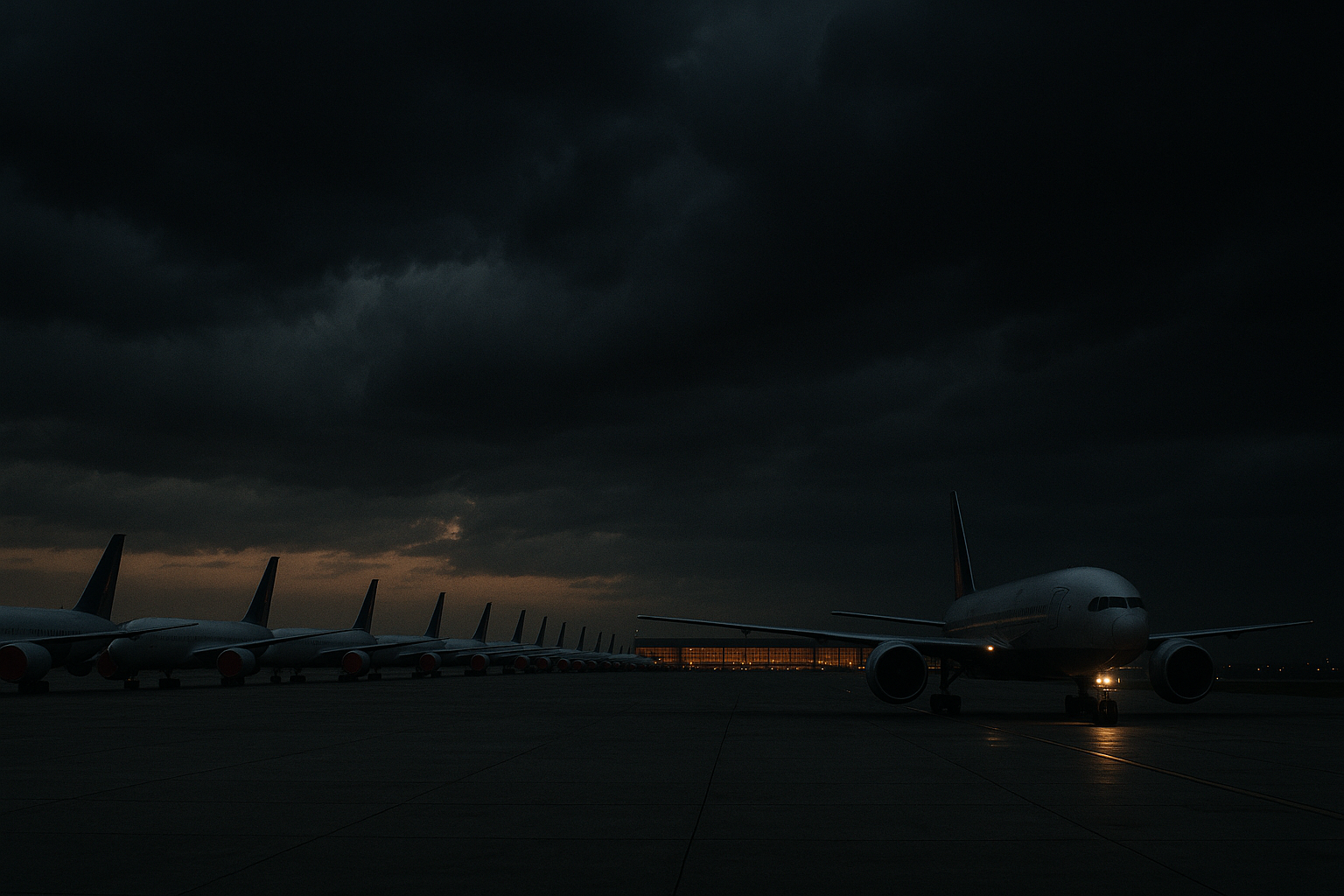
Two sets of numbers came out of the airline industry this summer, and they should not be able to coexist.
The first set: global passenger traffic fell 1.7% in June, measured in revenue passenger kilometers, after falling 2.2% in May — the first back-to-back monthly contraction in global air travel since the pandemic. Boeing, whose entire commercial business is built on the assumption that air traffic doubles roughly every fifteen years, cut its 2026 traffic growth forecast by more than half in July and now says the industry won't return to its long-term trajectory until the end of 2028.
The second set: Delta Air Lines is up 16% this year, just raised its dividend 15%, and reaffirmed full-year earnings of $6.50 to $7.50 per share. United raised its guidance — in the same quarter its fuel bill came in $6 billion over its original plan.
An industry that is shrinking for the first time outside a global crisis, whose single biggest input cost is up 75 to 80% year-over-year, is producing rising earnings, rising dividends, and rising share prices at its strongest operators. Something structural has changed, and the market is only pricing it at a handful of carriers.
The contraction is real
Start with the demand data, because it is worse than the headline number suggests.
IATA's June figures show total traffic down 1.7% year-over-year, with domestic travel — the bedrock of the world's three largest aviation markets — down 3.0%. China's domestic traffic fell 5.2%. Japan's fell 3.8%. The US fell 1.2%. The Middle East, still absorbing the fallout of the Iran war, saw traffic collapse 13.9% on capacity that was itself down 11%.
Strip out the war-torn Middle East and international travel still only grew 1.1% — for an industry whose baseline assumption is growth at roughly twice the rate of global GDP. Air travel has contracted before: after 9/11, in the financial crisis, in 2020. Every time, the cause was a shock, and every time, traffic came roaring back to trend. That's the pattern Boeing's "recovery by 2028" forecast leans on.
But this contraction has a different texture. It isn't fear of flying and it isn't a collapse in incomes. It's price. The Iran conflict took Iranian and Russian product exports offline and turned refining capacity into the global chokepoint — and jet fuel, the most refining-intensive thing airlines buy, absorbed the shock. US airfares are up 25.5% year-over-year. The marginal traveler — the one who flies because it's cheap — is being priced out of the sky, deliberately.
Briefings like this land in members' inboxes before the market prices them in. Join free →
The tell in the load factor
Here is the detail that resolves the paradox: while demand fell 1.7% in June, the industry cut capacity 1.3% — almost in lockstep. Load factor barely moved, down 0.4 points to 84.2%. Airlines across Asia pulled short-haul routes; international capacity within Asia-Pacific fell 4.8%. Middle East carriers cut 11%.
The planes are still full. That is not what a demand crisis looks like. That is what a pricing regime looks like.
For seventy years, the airline industry's defining pathology was that it could not stop adding seats — every cycle, growth-chasing capacity destroyed pricing, and the industry collectively earned less than its cost of capital. What the fuel shock has done, for the first time outside a pandemic, is force the entire global industry to shrink capacity in sync — and the scarcity of new aircraft means no one can defect from the discipline even if they want to.
The result is an industry quietly flipping from a volume business to a pricing business. Whoever is built for that flip gets paid. Whoever is built for the old game — moving ever more people at ever lower fares — is holding the bag.
The rest of this briefing is for paid members: the capacity-discipline math that turned a demand contraction into record fares, the one US carrier structurally built to profit from expensive fuel (and the one most exposed), the three groups still holding the volume bag — lessors, airports, and the ultra-low-cost model — and the two signals that tell you the regime is ending, including a catalyst that emerged this weekend.
AlphaBriefing Paid gets you every investment thesis, scenario framework, and catalyst brief we publish — the analysis private intel clients pay four figures for, at a fraction of that.