Who Profits When the World Drowns in Gas?
After a decade of scarcity, a wall of new LNG capacity flips the gas market to surplus in late 2026 — dragging prices toward single digits. Volumes rise, prices fall, and the two trades point in opposite directions. Here's who profits and who gets squeezed.

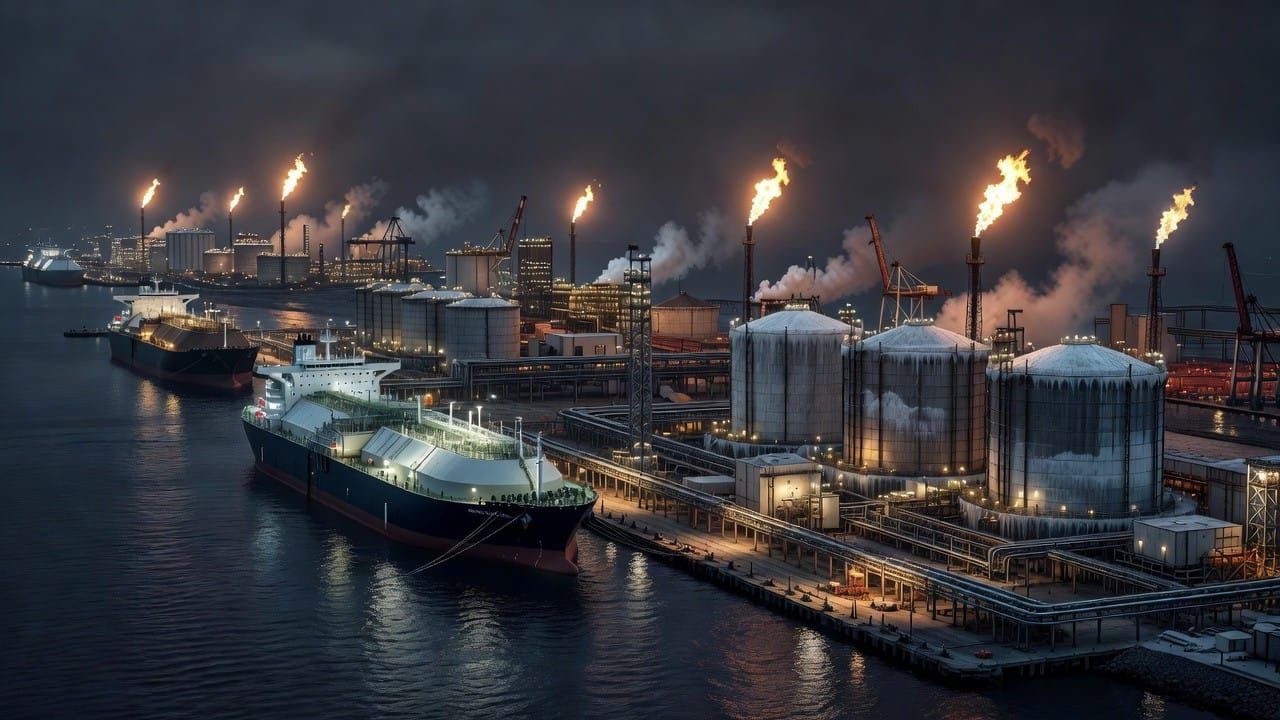
For most of the last decade, natural gas was a fuel you fought to secure. When Russia severed pipeline flows to Europe in 2022, governments scrambled, utilities signed twenty-year contracts at panic prices, and liquefied natural gas — LNG, the supercooled form that travels by ship instead of pipe — became one of the most strategically prized commodities on Earth. Asian and European buyers competed cargo by cargo. Prices spiked above $70 per million British thermal units at the worst of the crisis. The entire investment thesis around American gas exporters was built on one assumption: the world would always want more LNG than anyone could supply.
That era is ending. Not gradually — on a schedule.
A wall of new production is arriving, and the timing is not a forecast so much as a fact already locked into concrete and steel. More than 174 million metric tons per year of new liquefaction capacity is currently under construction worldwide — enough to lift global LNG supply roughly 42% above last year's level by 2030. The first and largest pulse of that wave lands now, across late 2026 and into 2027. After years of scarcity, the market is about to flip to surplus, and the price of gas is going to get honest.
For investors who built positions around permanent scarcity, this is the kind of regime change that rewrites a thesis. Here is what's actually happening — and, past the paywall, who profits and who gets squeezed.
The Wave Was Always Going to Break in 2026
The supply surge is led, overwhelmingly, by the United States. American LNG export capacity is climbing from roughly 17 billion cubic feet per day at the end of 2025 to more than 19 Bcf/d through 2026, and that's just the first step. Three projects do most of the lifting this year.
Plaquemines, Louisiana — Venture Global's giant facility — ramped faster than almost anyone modeled, climbing from 0.6 Bcf/d in 2024 toward 2.7 Bcf/d, with a full year of operation now feeding the global market. Corpus Christi Stage 3, Cheniere's Texas expansion, is bringing its trains online and lifting that site from 1.8 to roughly 3.2 Bcf/d. And Golden Pass, the ExxonMobil–QatarEnergy joint venture, shipped its first cargo from Train 1 on April 22, 2026 — the ninth LNG export terminal in the country — with Train 2 due in the second half of this year and Train 3 in early 2027.
None of this is speculative. The cargoes are loading. And the Trump administration has thrown its full weight behind the buildout, fast-tracking permits and treating LNG dominance as an instrument of foreign policy. Add Qatar's enormous North Field expansion and a queue of projects in Canada and beyond, and the picture is unambiguous: supply growth is set to outrun demand growth from the back half of 2026 onward.
What a Glut Actually Does to Price
The International Energy Agency and virtually every major trading desk now describe the same trajectory: a mild surplus emerging in the second half of 2026, widening into a sizable oversupply through 2027.
The price math follows directly. European and Asian benchmark prices, which averaged around $14 per MMBtu last winter, are projected to fall below $10 by the fourth quarter of 2026 — and potentially toward $8 in 2027. Forward curves already reflect it: TTF, the European benchmark, sits near $10.55 for 2026 and $9.30 for 2027, down sharply from a 2025 average above $12.
For buyers — utilities in Japan, South Korea, India, and across Europe — this is relief after years of pain. For sellers, it is the end of the windfall. The question that matters for capital is not whether prices fall, but which business models survive the descent intact and which were quietly leveraged to a boom that was never permanent.
This is where the analysis gets actionable. AlphaBriefing members get the full investment framework — scenarios, positioning, and the bottom line.
Subscribe to AlphaBriefing — Free, Member, and Paid tiers available.