What Happens If Washington Stops Insuring Floods?
The federal program behind $1.3 trillion in flood coverage expires September 30 — and a presidential council wants it shut down for good. Coastal real estate, mortgage markets, and a fast-growing private flood industry are all on the clock.

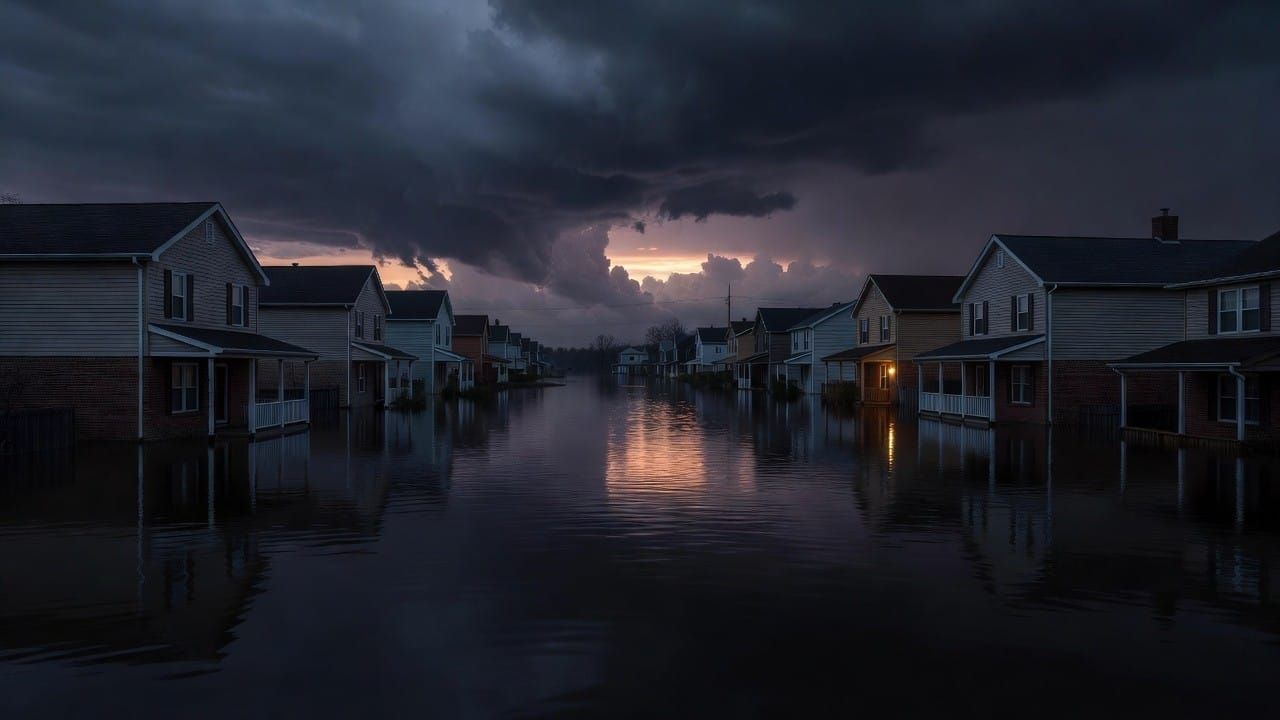
America's flood insurer of last resort has 85 days left on its authorization.
On September 30, the National Flood Insurance Program — 4.7 million policies, nearly $1.3 trillion in coverage, the largest single-line insurance program in the country — hits the expiration date Congress set when it patched the program back together in February. That deadline would be routine; Congress has extended the NFIP more than thirty times since 2017, usually at the last minute, occasionally not.
What is not routine is the other document on the table. In May, the review council President Trump appointed to redesign FEMA delivered its proposal, and one recommendation stood out from everything else: shut the National Flood Insurance Program down and hand flood coverage to the private market.
For the first time since 1968, the question in Washington is not how to patch the program. It is whether the federal government should be in the flood insurance business at all. And the answer — extend, reform, or wind down — will reprice coastal real estate, a corner of the mortgage market most investors never look at, and a private flood industry that has been quietly doubling while nobody watched.
The program that exists because markets said no
The NFIP was not born from ideology. It was born from abandonment. After Hurricane Betsy drowned New Orleans in 1965, private insurers concluded that flood was uninsurable at scale — losses too correlated, too concentrated, too catastrophic. They exited. Congress filled the vacuum in 1968 with a federal program that would write flood coverage in any participating community, at rates the private market would never touch.
That founding bargain is also the program's original sin. For decades the NFIP charged premiums that reflected politics rather than water. The gap between what it collected and what it paid accumulated into roughly $22.5 billion of debt to the US Treasury — and that is after Congress simply forgave $16 billion of it following Hurricane Harvey in 2017. The program collects about $4.6 billion a year in premiums, pays interest on its debt, and waits for the next Katrina-sized event to blow through its remaining borrowing room.
FEMA has spent the past few years trying to fix the math. Risk Rating 2.0, the pricing overhaul that began rolling out in 2021, reprices every property on its actual risk — elevation, distance to water, rebuilding cost — instead of crude flood-zone averages. The direction is honest; the politics are brutal. Statutory caps limit most annual increases to 18%, which means properties that were underpriced for fifty years are climbing toward their true rate on a decade-long escalator. Policy counts have fallen from a peak near 5.7 million to under 5 million as premiums rise and homeowners without a mortgage requirement quietly drop coverage.
That is the machine Congress must reauthorize by September 30: actuarially sounder than it has ever been, still carrying $22.5 billion it will never repay, shrinking, and now — for the first time — marked for possible demolition by the executive branch that runs it.
Briefings like this land in members' inboxes before the market prices them in. Join free →
What actually happens if it lapses
The mechanics of a lapse are narrow but sharp. Existing policies stay in force until they expire. But FEMA cannot write new policies or renew old ones — and that is where the damage concentrates, because flood insurance is not optional for much of the housing market. Any federally backed mortgage on a property in a designated Special Flood Hazard Area must carry it. No policy, no closing.
The Congressional Research Service estimates a lapse would disrupt roughly 1,300 property transactions per day — about 40,000 closings a month, concentrated in exactly the coastal and riverine markets where inventory is already strained. When the program lapsed for several weeks in June 2010, the National Association of Realtors estimated tens of thousands of sales stalled. A lapse this September would land in a market where Florida alone accounts for more than a third of all NFIP policies.
The Association of State Floodplain Managers spent the spring warning of something less visible than a lapse: what it called an "NFIP Code Blue" — lapsed contracts, delayed funding, and hollowed-out program operations inside FEMA even while the authorization technically holds. A program can die by statute, or it can die by neglect. Both clocks are running.
The privatization bet
The case for winding down the NFIP rests on a real trend: the private flood market is no longer theoretical. Private residential flood policies nearly doubled from 277,000 in 2020 to roughly 569,000 by 2024, growing about 20% a year. In Florida, the most developed market, private carriers now write about 35% of flood coverage. Specialist writers like Neptune Flood — which made Palomar its exclusive carrier partner in 2025 — plus Hiscox, Wright, and the surplus-lines market offer dwelling limits of $5 million or more, replacement-cost contents, and living expenses the NFIP has never covered. The NFIP caps residential dwelling coverage at $250,000, a number set decades ago and never indexed.
Better catastrophe models, cheap satellite elevation data, and a deep reinsurance market genuinely did change what is insurable. The 1968 assumption — that no private balance sheet can hold American flood risk — is no longer entirely true.
But here is what the privatization argument skips: the private market's growth is selection, not substitution. Private carriers are writing the elevated new build in a moderate zone, the high-value home that outgrew the $250,000 cap — the risks the models like. What they are not competing for is the NFIP's actual book: the repetitive-loss properties that have flooded five times, the pre-1968 construction at negative elevation, the entire communities that exist below the waterline of honest pricing. The NFIP holds those risks because no one else will — that was the founding transaction, and fifty-eight years of climate change have made it more true, not less.
Shut the program down, and those properties do not migrate to Neptune and Hiscox. They migrate to uninsured. Florida offers the preview: about 20% of households there carry flood coverage, 90% of it through the NFIP — in the state with the most developed private flood market in America. Even FEMA's own capital-markets experiment points the same direction: the agency has been buying reinsurance and issuing FloodSmart Re catastrophe bonds since 2018 to push flood risk into private hands, and it quietly halted its planned 2025 issuance. The private market prices flood risk. It does not absorb it.
Where the money moves
Whatever Congress does in September, the direction of travel is the same — flood risk is getting repriced toward reality — and the difference between scenarios is speed.
A clean extension (the base case; it is what Congress has done thirty-plus times) keeps the escalator running: Risk Rating 2.0 grinds premiums upward at the statutory caps, the private market keeps skimming the best risks at 20% a year, and the September cliff reappears in a year.
Reform — some version of the long-stalled reauthorization bills — likely means means-tested affordability support, more mitigation money, and a faster glide to full-risk rates. That accelerates the same trade.
Wind-down is the tail scenario, but it is no longer unthinkable, and its price effects would be immediate. Peer-reviewed estimates put unpriced flood risk in US residential property at $121–237 billion of overvaluation. Federal flood insurance is the mechanism that lets that overvaluation persist — it converts an uninsurable location into a bankable mortgage. Remove it, and the correction stops being theoretical. Coastal Florida, the Gulf Coast, the Carolina lowlands, and riverine towns across Appalachia and the Midwest would reprice first and hardest — and the regional banks holding concentrated coastal mortgage books would find out what their collateral is worth without a federal backstop under it.
The beneficiaries are easier to name. Specialty flood writers and their carrier partners collect share in every scenario — faster in every scenario that shrinks the NFIP. Reinsurers and the catastrophe-bond market, which just posted record issuance, are the balance sheet privatization would have to rent. Catastrophe modelers and flood-analytics firms become the pricing layer of an honest market. And mitigation — elevation, floodproofing, buyouts — turns from a FEMA grant line into a market with a hard-dollar return, because every inch of elevation now shows up in an insurance quote.
One more irony worth pricing: NOAA forecasts a below-normal hurricane season this year — 8 to 14 named storms, with El Niño shear suppressing the Atlantic. A quiet season is exactly the political window in which Congress finds it easiest to do nothing about flood insurance — and exactly the window in which winding it down looks cheapest. The program's fate may be decided in the calmest year it has had in a decade. Water does not read forecasts. The 30-day waiting period on a new NFIP policy means that by the time a storm has a name, the decision has already been made.
The bottom line
The NFIP is the load-bearing wall between American coastal real estate and the actual price of water. On September 30 it either gets propped up again, rebuilt, or scheduled for demolition. The market consequences are not symmetrical: extension preserves a slow repricing already underway; wind-down converts it into a step-function. Watch the reauthorization language, not the hurricane tracker — the most important flood event of 2026 is happening in a committee room.
If this analysis was useful, this is what AlphaBriefing does every day — geopolitics and markets, connected to what it means for your money. Free members get the daily brief in their inbox; paid members get the investment frameworks, scenario pricing, and catalyst calendars behind the paywall.
Sign up free → — upgrade whenever it earns it.
Get this level of intelligence every day. Subscribe to AlphaBriefing — free, member, and paid tiers available.
Sources & Further Reading
- FEMA — National Flood Insurance Program Congressional Reauthorization
- Congressional Research Service — Introduction to the National Flood Insurance Program
- Congressional Research Service — What Happens If the NFIP Lapses?
- WWSB — Proposed FEMA Overhaul Could End Federal Flood Insurance Program
- NOAA — NOAA Predicts Below-Normal 2026 Atlantic Hurricane Season
- Fitch Ratings — US Private Flood Insurance Exposure Limited, Growth Accelerates
- Association of State Floodplain Managers — NFIP Code Blue
- EESI — The National Flood Insurance Program Is Perpetually Underwater
Disclaimer
AlphaBriefing is an independent intelligence publication. The content in this article is produced for informational and educational purposes only. Nothing published by AlphaBriefing constitutes financial, investment, legal, tax, or regulatory advice, nor should it be construed as a solicitation or recommendation to buy, sell, or hold any security, asset, or financial instrument.
All views expressed are those of the author at the time of writing and are subject to change without notice. Markets are volatile and unpredictable; past performance is not indicative of future results. Any investment involves risk, including the possible loss of principal.
AlphaBriefing and its principals, employees, or contributors may hold positions in securities or assets mentioned in this article. This should be considered a potential conflict of interest. No material relationship with any company referenced exists unless explicitly disclosed. Readers should conduct their own due diligence and consult qualified financial, legal, and tax advisors before making any investment decisions.
Information in this article is drawn from public sources believed to be reliable at the time of publication. AlphaBriefing makes no warranty, express or implied, as to the accuracy, completeness, or timeliness of any information herein. AlphaBriefing accepts no liability for any loss or damage arising from reliance on this content.
© AlphaBriefing. All rights reserved. Unauthorised reproduction or distribution is prohibited.