What Happened to America's EV Charging Network?
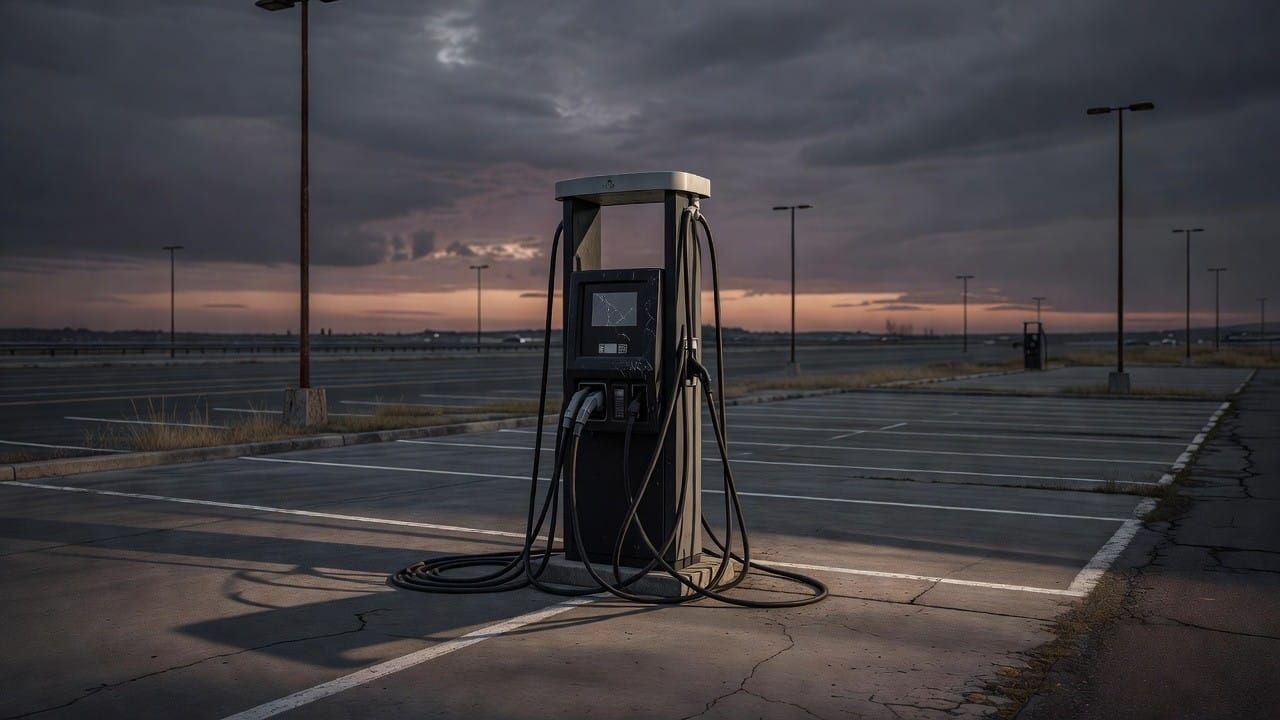
Washington pledged $7.5 billion to wire America for the electric age. Years on, almost nothing's been built, the chargers that exist often don't work — and the company that took none of the money set the standard everyone now builds toward.

What Happened to America's EV Charging Network?
Four years ago, Washington promised to wire the country for the electric age: a $5 billion federal program to plant fast chargers every 50 miles along America's highways, plus another $2.5 billion for community charging. By now, the map was supposed to be filling in. Instead, the headline number is one almost nobody believes: as of early 2025, roughly 57 federally funded stations were operational across 15 states. Out of a $7.5 billion mandate, the government had energized a few hundred charging ports — a rounding error against the tens of thousands promised.
The chargers that do exist often don't work. And the standard everyone is now building toward belongs to a company that took none of the federal money. The story of America's charging buildout is a case study in how public capital, private execution, and a fragmented market collide — and it points to where the durable value in this sector is actually accruing.
The buildout that didn't
The National Electric Vehicle Infrastructure program — NEVI — was the centerpiece. Passed in the 2021 infrastructure law, it handed states $5 billion to build a national fast-charging backbone. The logic was sound: range anxiety, not sticker price, is what keeps mainstream buyers out of EVs, and only the government could justify chargers on thin rural corridors that no private operator would build alone.
Then it stalled. The program routed money through 50 state transportation departments, each writing its own plan, running its own solicitations, and clearing federal review at each step. Permitting, utility interconnection, and equipment lead times did the rest. By the time the first NEVI station opened in Ohio in late 2023 — two years after the bill passed — critics had a number to throw around, and they've been throwing it ever since.
In early 2025 the new administration froze the program entirely, ordering states to stop spending while it rewrote the rules. A federal court intervened: in Washington v. DOT, a June 2025 order and a January 2026 final ruling forced the government to release the obligated funds. Revised guidance issued in August 2025 loosened the spacing requirements, let states build on any public road once a corridor was "complete," and sped up approvals.
So 2026 is, in effect, a reboot. Nine states reopened funding rounds early in the year, with a dozen more expected to follow. The money is flowing again. But the lost years are real, and the central lesson stands: a program designed to move fast moved at the speed of 50 bureaucracies.
The reliability problem nobody fixed
Here's the part that matters more than the slow rollout. Even where chargers exist, a meaningful share of them don't deliver a charge.
Harvard researchers pegged the reliability of America's public chargers at roughly 78% — meaning better than one in five charge attempts runs into a problem. Independent network data tells a similar story: nearly one in three charging attempts still fails in some markets, and success rates that start around 85% at brand-new stations fall below 70% by year three as hardware ages and goes untended. Industry trackers estimate that at any given moment, up to 43% of public chargers are effectively out of reach — roughly a quarter broken outright, the rest blocked by congestion in dense cities.
The failures are mundane and maddening: dead screens, broken card readers, plugs that won't lock, payment systems that time out, software that reports a charger as "available" when it's bricked. Nearly half of surveyed users cited hardware malfunctions. The regional spread is stark — the Pacific Coast logged 21% failed visits in 2025 against a 14% national average, with Seattle and Los Angeles above 24%.
There has been real progress. National reliability scores nudged up to about 93.5 in early 2026, and the worst-performing states pulled their floor up from the low-70s into the 80s. But the gap between a well-run network and a neglected one is the whole game now. The first wave of the buildout was about plugging in. The next wave is about uptime — and that shift quietly rewires where the money goes.
Tesla won the standard war without trying
While the federal program churned, the most consequential development in American charging happened in a boardroom, not a state DOT.
For years the US split between two fast-charging plugs: Tesla's connector and the "CCS" standard everyone else used. Then, beginning in 2023, automaker after automaker — Ford, GM, Rivian, Mercedes, BMW, Hyundai, Kia, Volvo — announced they would adopt Tesla's plug. It has since been blessed as an official engineering standard (SAE J3400) and rebranded the North American Charging Standard, or NACS. Today it is the de facto plug for the continent. New EVs are shipping with the Tesla port; older cars get adapters.
That hands Tesla a structural advantage it didn't have to spend a federal dollar to win. Its Supercharger network — the most reliable in the country, by a wide margin — is now open to nearly every brand. Even as Tesla's share of new ports falls (it built 26% of new US ports in early 2026, down from above 40% the year before), it still owns roughly 51% of all charging ports ever built and sets the technical terms everyone else builds around.
The rest of the industry is racing to catch up. Non-Tesla operators added enough NACS stalls in early 2026 to grow that footprint 41% in a single quarter. ChargePoint, the EVgo network, BP Pulse, and the automaker-backed Ionna and Electrify America are all retrofitting and expanding. Electrify America actually holds the largest all-time non-Tesla port count, ahead of ChargePoint and EVgo. The competitive field is real — but it is now competing on Tesla's rails.
Where the value is actually accruing
Step back and the investable shape of this sector comes into focus. This is not a story about a single charging stock going to the moon — most of the pure-play charging companies have been brutal to own, burning cash in a capital-intensive business with thin utilization. It's a story about which layer of the stack captures the value as a fragmented, unreliable market consolidates.
Three layers are worth watching.
The standard-setter and premium network. Tesla's energy and charging business is a small line item against its car and AI ambitions, but the Supercharger network is the closest thing the sector has to a moat: best uptime, the winning plug, and now a captive audience of other brands' drivers paying to use it.
The reliability layer. As the market pivots from building chargers to keeping them alive, the companies that handle maintenance, software, payment reliability, and uptime guarantees move from afterthought to necessity. The metric that matters is shifting from "ports installed" to "charge sessions successfully completed" — and whoever owns that data and that service relationship owns a recurring revenue stream the hardware never had.
The boring picks-and-shovels. Grid interconnection, transformers, electrical contracting, and the utilities that ultimately deliver the power all sit upstream of every charger, federal or private. They get paid whether a given network thrives or folds — and they're the same bottleneck throttling AI data centers, which is exactly why capital keeps crowding into them.
The federal buildout will eventually deliver its chargers; the money is too large and too committed to vanish. But the lesson of the last four years is that pouring public capital into a fragmented market doesn't automatically produce a working network. It produces a slow-motion scramble in which the disciplined operators, the standard-setters, and the infrastructure underneath quietly win — while the headline program takes the blame.
For investors, the signal is the same one that shows up across America's infrastructure story in 2026: the glamour is in the thing being built; the durable returns are in the unglamorous layer that keeps it running.
Get this level of intelligence every day. Subscribe to AlphaBriefing — free, member, and paid tiers available.
Sources & Further Reading
- U.S. Department of Transportation — Revised NEVI Guidance to Allow States to Actually Build EV Chargers
- Alternative Fuels Data Center — National Electric Vehicle Infrastructure (NEVI) Formula Program
- Harvard Institute for Business in Global Society — The State of EV Charging in America
- Paren — EV Charger Reliability & Utilization Data (Q1 2026)
- InsideEVs — One of America's Biggest EV Charging Networks Is Betting Big On NACS
- EV Charging Stations — Largest DC Fast-Charging Networks in the US: January 2026
- GreenCars — NEVI Charging Network Reboots in 2026
Disclaimer
AlphaBriefing is an independent intelligence publication. The content in this article is produced for informational and educational purposes only. Nothing published by AlphaBriefing constitutes financial, investment, legal, tax, or regulatory advice, nor should it be construed as a solicitation or recommendation to buy, sell, or hold any security, asset, or financial instrument.
All views expressed are those of the author at the time of writing and are subject to change without notice. Markets are volatile and unpredictable; past performance is not indicative of future results. Any investment involves risk, including the possible loss of principal.
AlphaBriefing and its principals, employees, or contributors may hold positions in securities or assets mentioned in this article. This should be considered a potential conflict of interest. No material relationship with any company referenced exists unless explicitly disclosed. Readers should conduct their own due diligence and consult qualified financial, legal, and tax advisors before making any investment decisions.
Information in this article is drawn from public sources believed to be reliable at the time of publication. AlphaBriefing makes no warranty, express or implied, as to the accuracy, completeness, or timeliness of any information herein. AlphaBriefing accepts no liability for any loss or damage arising from reliance on this content.
© AlphaBriefing. All rights reserved. Unauthorised reproduction or distribution is prohibited.