Washington Promised 500,000 EV Chargers. The Market Built the Network Instead.
The $5 billion federal charging program produced a few hundred ports in five years and just lost half a billion in funding. Private networks are switching on 1,000+ fast-charging stalls a month — and the winners are already visible.

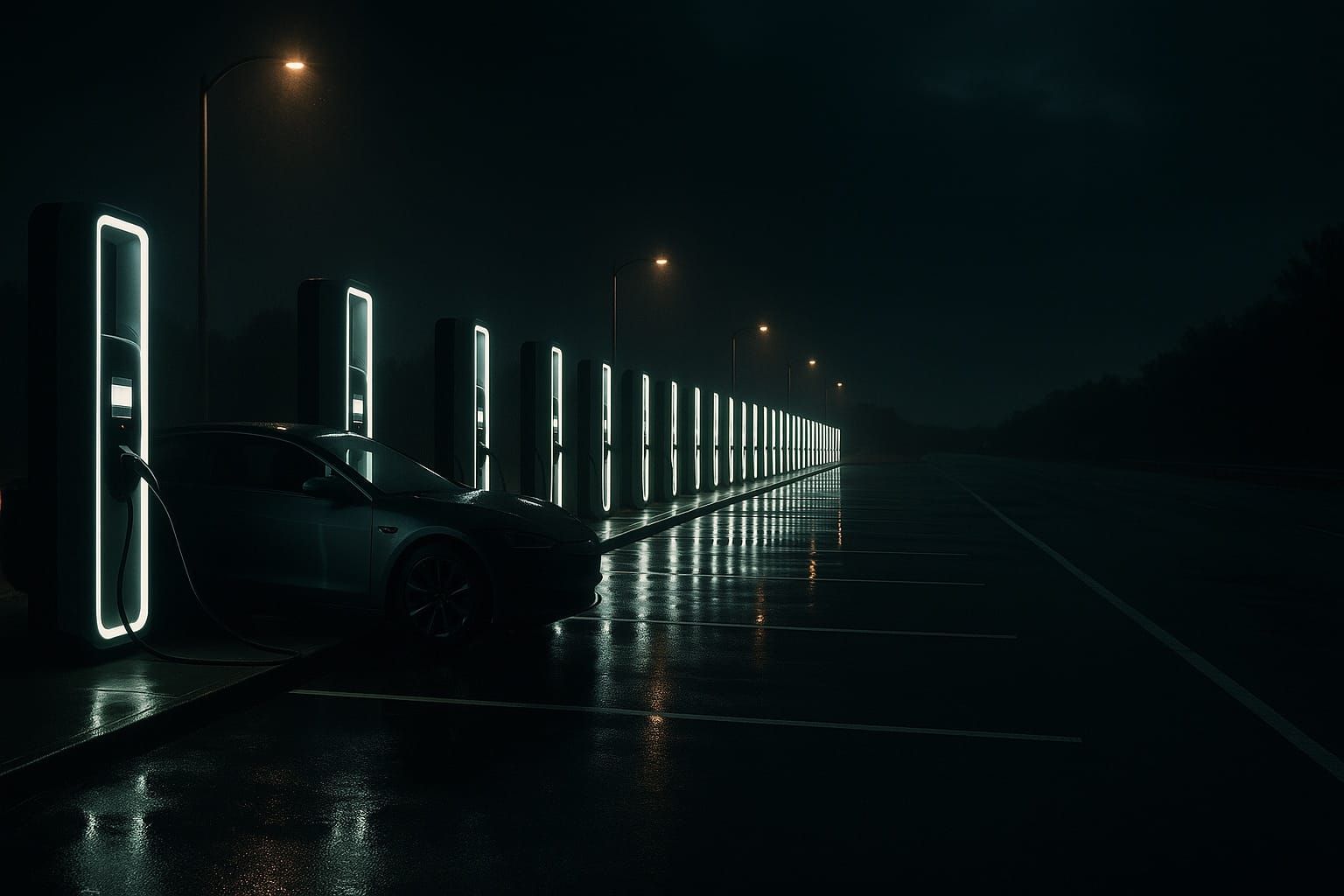
In August 2026, private charging networks in the United States switched on 1,131 new DC fast-charging stalls. That is one month of output.
The federal government's flagship charging program — $5 billion, signed into law in November 2021, sold with a promise of 500,000 public chargers by 2030 — had opened roughly 400 ports by the start of this year. That is five years of output.
This is not a story about EVs being dead. America's fast-charging network grew 23% over the past twelve months and now counts 76,236 public DC fast-charging ports across nearly 16,000 locations. The network is getting built — faster than ever, more reliably than ever. It just isn't Washington building it. And for investors, the gap between those two numbers is the whole story: it tells you which charging business models survive the next five years and which ones were always a subsidy in a trench coat.
The program that couldn't spend money
The National Electric Vehicle Infrastructure program — NEVI — was the centerpiece of the 2021 infrastructure law's $7.5 billion charging push: $5 billion in formula funds to states to build fast chargers every 50 miles along interstate corridors, plus $2.5 billion in discretionary grants.
The design had a certain logic. Range anxiety was the stated barrier to EV adoption; blanket the highway system with chargers and the cars would follow. But the money had to flow from the Federal Highway Administration to 50 state DOTs, each of which had to write an EV deployment plan, get it approved, run procurement, select sites, and comply with federal contracting and domestic-content rules — agencies that build roads, asked to become charging network developers.
The result: as of January 21, 2026, states had actually spent $94 million of the $4.4 billion made available. Two percent. In five years.
Then politics finished what bureaucracy started. The incoming administration froze NEVI funding in early 2025; the freeze lasted seven months before courts and pressure from states forced a partial restart. On February 2, 2026, the president signed a budget deal that trimmed NEVI by $503.8 million outright. Roughly $1.4 billion that states had already obligated for 2026 construction now faces uncertain federal reimbursement — money contractors were counting on for sites already designed and permitted. Analysts had projected NEVI-funded sites would double this year. Electrical contractors' trade groups now describe crews trained and ready with projects stalled in limbo.
If the private sector had also stood still, this would be an EV-transition crisis. It didn't.
Briefings like this land in members' inboxes before the market prices them in. Join free →
The network got built anyway
While NEVI was processing paperwork, the market solved the problem it was created to solve. The industry has averaged more than 1,000 new fast-charging stalls per month through 2026 — meaning private networks now deploy more charging in five weeks than the federal program has delivered in five years.
Who built it is the interesting part. As of September 1:
- Tesla Superchargers: 37,995 ports — 49.8% of the entire US fast-charging network. One company, no federal formula funds required for the overwhelming majority of it.
- Electrify America: 5,936 ports (7.8%) — born from Volkswagen's diesel-scandal settlement, arguably the last great charging network built by government compulsion.
- EVgo: 5,246 ports (6.9%) and ChargePoint: 4,937 (6.5%).
- Ionna: 1,458 ports — the joint venture funded by eight of the world's largest automakers, adding 268 stalls in just the past two months and committed to 30,000 ports by 2030.
The top ten networks control 83.8% of all ports. This is what a maturing infrastructure market looks like: consolidation around operators with real balance sheets and real utilization, while subscale players fade.
And the buildout is being pulled by demand, not pushed by grants. Charging operators learned the economics the hard way: a charger on a rural interstate segment that sees six cars a day is a loss forever; a 20-stall site in a dense metro with rideshare fleets pays for itself. NEVI's every-50-miles corridor mandate optimized for the first kind. Private capital builds the second kind. That is why the private network grows while the federal one stalls — and why the updated federal guidance quietly loosened the corridor requirements, conceding the point.
Tesla becomes the arms dealer
The most telling deal of the year: EVgo — nominally Tesla's competitor — announced in August that it is buying Tesla's V4 Supercharger hardware (up to 500 kW) and deploying it under EVgo's own brand, with the first sites operational in the second half of 2026.
Read that again. The number-three charging network concluded that the best charging hardware in America comes from the number-one charging network, and it would rather buy from its rival than keep sourcing elsewhere. Tesla is quietly converting a decade of Supercharger engineering into a hardware-supplier business — picks and shovels sold to everyone, on top of owning half the network outright. With nearly every automaker now shipping cars with Tesla's NACS connector, the standards war is over, and the company that won it collects either way: drivers charge on Tesla's network, or competitors buy Tesla's equipment to serve them.
Meanwhile Ionna answers the question of who funds corridor charging if Washington doesn't: the automakers themselves, who need charging to exist in order to sell EVs, and who can treat the network as a strategic cost rather than a standalone profit center — the same logic that built gas stations a century ago.
What this means
The subsidy-dependent charging model is being repriced. Companies whose deployment pipelines leaned on NEVI reimbursement now carry real receivables risk on obligated-but-unpaid federal funds. Companies that built for utilization — dense metro sites, fleet contracts, automaker partnerships — kept compounding straight through the funding freeze.
Infrastructure that pays for itself gets built; infrastructure that doesn't, doesn't. The 23% annual network growth happened during a federal freeze and a budget cut. Charging demand — from a US EV fleet that keeps growing regardless of policy mood — is now sufficient to finance the network's expansion. That is the milestone worth marking: somewhere in the last two years, American EV charging crossed from policy project to self-sustaining infrastructure business.
The open question is the map, not the math. Private capital will overbuild metros and underbuild the empty quarters of the interstate system — precisely the gaps NEVI existed to fill. If federal money stays frozen, rural corridor charging becomes either an automaker consortium's loss leader or it simply doesn't happen, and the EV transition develops a geography problem: fine on the coasts and in cities, thin in the spaces between. Watch whether states redirect their obligated funds through the new, looser guidance — and whether Ionna's 30,000-port commitment reaches beyond the metros.
The federal program promised a network. The market built one instead. The investors who noticed which was which are the ones who owned the right half of it.
If this analysis was useful, this is what AlphaBriefing does every day — geopolitics, policy, and markets, connected to what it means for your money. Get the next briefing free in your inbox: Join AlphaBriefing.
Get this level of intelligence every day. Subscribe to AlphaBriefing — free, member, and paid tiers available.
Sources & Further Reading
- IECI — EV Charging Trajectory Uncertain in 2026
- EV Charging Stations — Largest DC Fast-Charging Networks in the US: September 2026
- Congressional Research Service — Implementation of Electric Vehicle Charging Infrastructure Programs: CFI and NEVI
- US Department of Energy, Alternative Fuels Data Center — NEVI Formula Program
- EVgo — EVgo Expands Fast Charging in the US with Supercharger Deployment
- GreenCars — EV Charging in 2026: More Ports, Better Reliability, New Competition
Disclaimer
AlphaBriefing is an independent intelligence publication. The content in this article is produced for informational and educational purposes only. Nothing published by AlphaBriefing constitutes financial, investment, legal, tax, or regulatory advice, nor should it be construed as a solicitation or recommendation to buy, sell, or hold any security, asset, or financial instrument.
All views expressed are those of the author at the time of writing and are subject to change without notice. Markets are volatile and unpredictable; past performance is not indicative of future results. Any investment involves risk, including the possible loss of principal.
AlphaBriefing and its principals, employees, or contributors may hold positions in securities or assets mentioned in this article. This should be considered a potential conflict of interest. No material relationship with any company referenced exists unless explicitly disclosed. Readers should conduct their own due diligence and consult qualified financial, legal, and tax advisors before making any investment decisions.
Information in this article is drawn from public sources believed to be reliable at the time of publication. AlphaBriefing makes no warranty, express or implied, as to the accuracy, completeness, or timeliness of any information herein. AlphaBriefing accepts no liability for any loss or damage arising from reliance on this content.
© AlphaBriefing. All rights reserved. Unauthorised reproduction or distribution is prohibited.