Wall Street Is Buying California's Burned Land
The fires destroyed roughly 16,000 California homes. Private equity and institutional buyers are now snapping up 40% of the vacant lots in Pacific Palisades, Altadena, and Malibu. A new Senate bill is trying to stop it — and it probably won't.

Wall Street Is Buying California's Burned Land
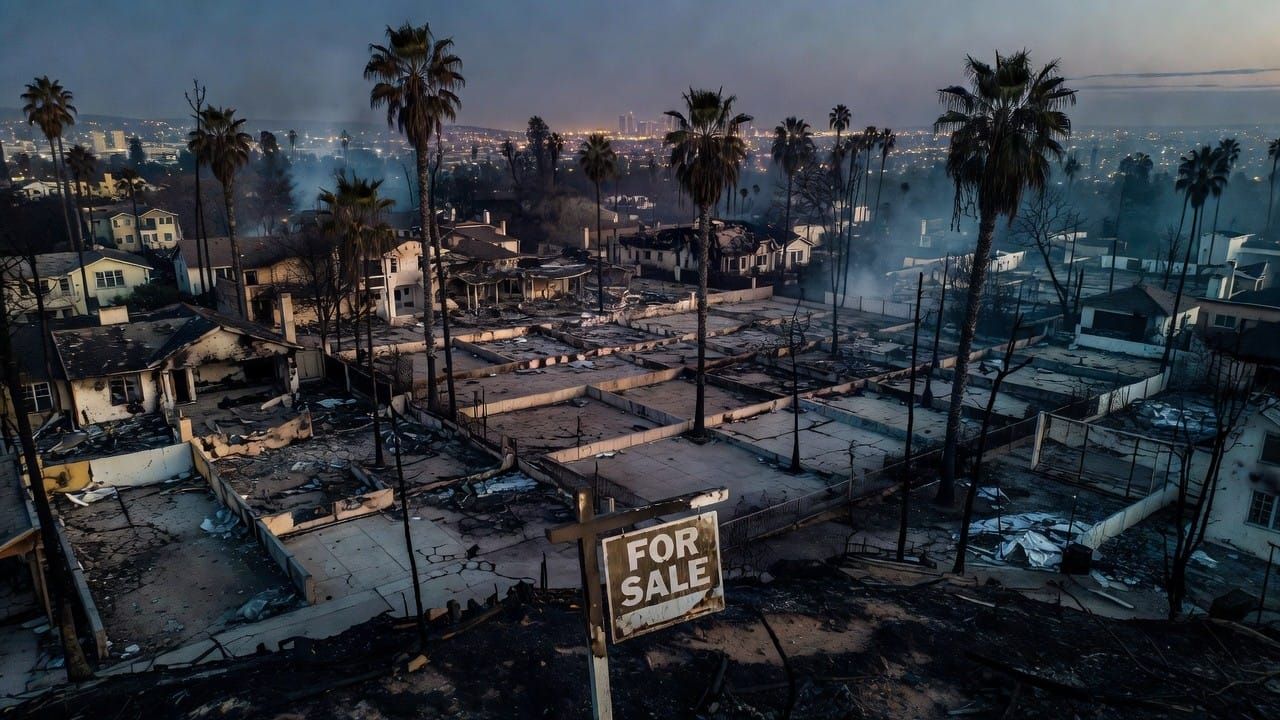
The fires destroyed the homes. The capital is buying the dirt. A new Senate bill is trying to slow it down — and it probably won't.
When the Palisades and Eaton fires burned through Los Angeles in January 2025, they took roughly 16,000 structures with them and left behind something nobody had priced: a sudden, concentrated supply of dirt cheap residential land in some of the most desirable ZIP codes in the country. Eighteen months later, that land is changing hands — and not back to the families who lost it.
According to a Redfin analysis of county records, real estate investors purchased about 40% of all vacant residential lots sold in the fire zones in Q3 2025. Specifically:
- Pacific Palisades (90272): 48 of 119 lots — 40.3%
- Altadena (91001): 27 of 61 lots — 44.3%
- Malibu (90265): 19 of 43 lots — 44.2% (more than double the 21.4% investor share a year earlier)
A year before the fires, investor share of vacant-lot sales in these ZIP codes was effectively zero. There was nothing to buy. By the time the smoke cleared, there were hundreds of listings — and a different kind of buyer showed up.
This is the part of the disaster cycle that nobody puts in the recovery brochure. It is also where the money is moving.
The trade
The setup is mechanical. A homeowner who lost everything is sitting on a charred lot with three problems: insurance payouts that came in below replacement cost, rebuild estimates that are running 30–50% over pre-fire pricing thanks to materials, labor, and code upgrades, and a permitting backlog that pushes any new build 18–24 months out. Many of them also no longer have the income elasticity to carry a construction loan on top of whatever mortgage shortfall remains.
So they sell the dirt. The going rate in the burn zones has been running at roughly half of pre-fire land values, often lower. The buyers — cash, LLCs, holding companies — are doing one of three things with it:
- Land bank. Sit on it, wait for the rebuild cycle to compress and prices to recover, and exit to a wealthier buyer in 2028–2030.
- Speculative build. Put up a high-margin, fire-resilient spec home and sell into what is expected to be a much smaller, much wealthier post-fire community.
- Subrogation plays. A parallel hedge-fund trade is buying the insurance recovery claims tied to the fires — betting on a payout from utility-company settlements (Edison, in Eaton's case) that could run into the tens of billions.
None of this is new. It happened after Katrina in New Orleans. It happened after Sandy on the Jersey Shore. It happened, on a smaller scale, after the Camp Fire in Paradise. What is new is the scale, the speed, and the names.
The named players
Thomas James Homes, a single-lot builder backed by Oaktree Capital Management, has positioned itself as the dominant rebuild platform in the Palisades. The pitch: a fixed price of roughly $650 per square foot, a 12-month construction guarantee once permits clear, and pre-approved fire-resilient plans (Class A roofing, ember-resistant vents, noncombustible siding). As of early 2026, more than 30 families were actively rebuilding with TJH — more than any other builder in the neighborhood — and the company is targeting close to 100 homes in the recovery cycle. Oaktree's involvement is not coincidence. This is a textbook private-equity distressed-real-estate play: standardize the product, capture margin on speed and certainty, exit when the neighborhood reprices.
Zuru Group, the consumer-goods conglomerate owned by the New Zealand-based billionaire Mowbray brothers, paid roughly $128 million for 16 burned beachfront lots in Malibu — the single largest reported developer acquisition in the burn zone. The expected exit: ground-up rebuilds projected to sell at around $25 million each.
A separate, still-unnamed foreign buyer has spent more than $65 million quietly assembling at least nine iconic Malibu oceanfront lots through agents. The identity remains undisclosed.
And underneath the named transactions sits a wider layer of LLCs, family offices, and out-of-town cash buyers — many from the Bay Area — picking up individual lots in the $1.5–3 million range. In parts of Altadena, local advocacy groups tracking deeds report that corporate or investor ownership of post-fire sales has hit 60% in some months, up from a pre-fire baseline closer to 14%.
This is a community changing hands.
Why the political response will not stop it
The displacement story has gotten loud enough that Sacramento and Washington noticed. Governor Gavin Newsom issued an executive order within days of the fires barring unsolicited lowball offers to fire victims for a 90-day window. That window has long since closed. In March 2026, Senator Adam Schiff announced he would introduce federal legislation restricting large corporations and private equity firms from buying properties in federally declared disaster zones.
Whether the bill becomes law is one question. Whether it would meaningfully slow the trade is another, and the answer is almost certainly no — for three reasons:
One: PE and institutional capital does not need to own the lot to capture the trade. A Schiff-style ownership ban gets routed through pass-through LLCs, joint ventures with local developers, or simple senior debt positions on someone else's name on the deed.
Two: The economic gravity is too strong. A burn-zone lot at half of pre-fire value, in a neighborhood where the long-term land scarcity is structurally worse after the fire because thousands of homeowners have permanently exited, is one of the cleanest distressed-real-estate setups in the country. Capital will find a way in.
Three: The state itself has a structural interest in the dirt being rebuilt fast. Empty lots produce no property-tax revenue. They produce no construction jobs. They sit there reminding everyone that California's most expensive ZIP codes are also its most flammable. Sacramento wants rebuilds. Institutional capital can deliver rebuilds. Local families, in many cases, cannot.
What it means for money
A few things follow from this, none of them comfortable.
The post-fire California housing stock will be wealthier, denser at the high end, and less owner-occupied than what burned. Spec builds and PE-backed rebuilds tend to skew larger, more expensive, and more often used as second homes or short-term-rental product. The communities that come back will not be the communities that left.
Insurance industry losses are not the end of the financial story — they are the beginning. The subrogation claims against utilities (Edison faces an estimated $25–40B in potential Eaton-fire liability) are themselves a tradable asset, and hedge funds are already accumulating them at discounts from claimants who want cash today. Watch for litigation-finance vehicles and specialty insurance-recovery funds to scale around this.
The "uninsurable California" narrative is incomplete. Yes, traditional carriers are pulling back. But where insurance fails, capital substitutes — through self-funded rebuilds, fire-resilient construction standards that command an underwriting premium, and a new product category of catastrophe-resilient spec homes that are essentially priced as a structural hedge against the next fire. There is a real investable thesis in builders, materials companies (Class A roofing, fiber-cement siding, ember-resistant ventilation), and the suite of "fire hardening" services that didn't really exist as an industry five years ago.
And politically, this is going to get louder. The Schiff bill is the first move, not the last. Expect state-level transfer-tax surcharges on corporate post-disaster purchases, lottery-style first-refusal rights for former homeowners, and possibly community-land-trust models that get federal support. Capital will route around all of it. But the headlines will be ugly, and any publicly traded developer with visible exposure to the burn zones will be wearing a target.
The bottom line
The fires destroyed roughly 16,000 California homes. The land underneath them is being repriced in real time, in deeds, in LLCs, and in private-equity portfolios that did not exist as a category 24 months ago. The political class is moving to slow it down. The math says they probably can't. And the part of this story that most analysts are still missing is that the interesting trade is not the burned lot itself — it is the second-order infrastructure being built around the rebuild: the standardized builders, the fire-hardening supply chain, the subrogation funds, and the insurance products designed for a state where the old underwriting model no longer works.
California is not becoming uninsurable. It is becoming differently insured — and that is the trade.
Get this level of intelligence every day. Subscribe to AlphaBriefing — free, member, and paid tiers available.
Sources & Further Reading
- Redfin — Los Angeles Wildfires Anniversary: Investors Bought 40% of Vacant Lots in Burn Zones
- Los Angeles Times — California Senator Wants to Halt Investors Buying Properties After Disasters
- Bloomberg — Los Angeles Fire Recovery: Inside the Rebuild
- Los Angeles Business Journal — Mission: Rebuild Pacific Palisades (Thomas James Homes)
- Realtor.com — Malibu's Mystery Buyer of Burned Oceanfront Lots
- California Governor's Office — Newsom Order to Protect Fire Victims from Predatory Real Estate Speculators
- Insurance Journal — Hedge Funds Move Into California Wildfire Subrogation Claims
- Enterprise Community — LA Wildfires One Year Later: A Challenging Road to Recovery
Disclaimer
AlphaBriefing is an independent intelligence publication. The content in this article is produced for informational and educational purposes only. Nothing published by AlphaBriefing constitutes financial, investment, legal, tax, or regulatory advice, nor should it be construed as a solicitation or recommendation to buy, sell, or hold any security, asset, or financial instrument.
All views expressed are those of the author at the time of writing and are subject to change without notice. Markets are volatile and unpredictable; past performance is not indicative of future results. Any investment involves risk, including the possible loss of principal.
AlphaBriefing and its principals, employees, or contributors may hold positions in securities or assets mentioned in this article. This should be considered a potential conflict of interest. No material relationship with any company referenced exists unless explicitly disclosed. Readers should conduct their own due diligence and consult qualified financial, legal, and tax advisors before making any investment decisions.
Information in this article is drawn from public sources believed to be reliable at the time of publication. AlphaBriefing makes no warranty, express or implied, as to the accuracy, completeness, or timeliness of any information herein. AlphaBriefing accepts no liability for any loss or damage arising from reliance on this content.
© AlphaBriefing. All rights reserved. Unauthorised reproduction or distribution is prohibited.