The U.S.–China Port-Fee War Restarts in Nine Days. The Paperwork to Stop It Isn't Finished.
The Section 301 port-fee truce expires November 9 at 11:59 p.m. Washington has agreed to extend it — but has only published a request for comments. Who pays if it snaps back, and what the market has already decided.

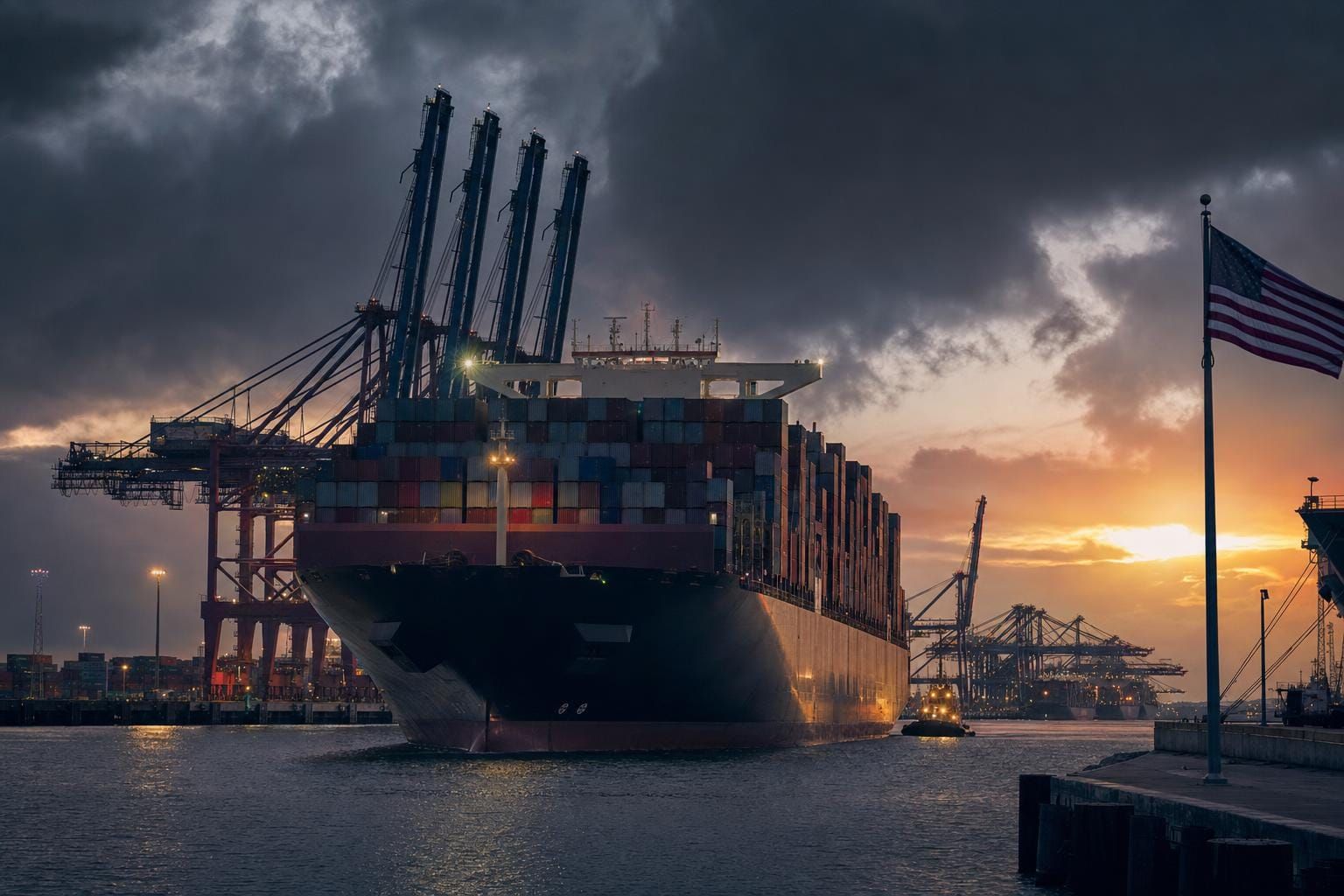
The most consequential line item in global shipping currently reads $0.00. It has read $0.00 since November 10, 2025. And unless the Office of the U.S. Trade Representative publishes one more document in the next nine days, it stops reading $0.00 at 11:59 p.m. Eastern on Monday, November 9.
That line item is the Section 301 port fee on China-linked vessels — the closest thing the maritime world has to a trade war of its own. Everyone in shipping assumes the truce gets extended. Treasury Secretary Scott Bessent said in September that it would be. But as of this writing, the only thing USTR has formally published is a request for comments on a proposal to extend it. The comment window closed Friday. The final notice that actually stops the fees from snapping back has not appeared.
In an industry that carries over 80% of world trade by volume, per UNCTAD, the gap between "announced" and "implemented" is nine days wide. Here is what sits inside it.
Twenty-Seven Days of a Trade War
The fees date to April 17, 2025, when USTR concluded a Section 301 investigation into China's targeting of the maritime, logistics, and shipbuilding sectors and announced a set of escalating charges on vessels calling at U.S. ports:
- Chinese-owned or Chinese-operated vessels: $50 per net ton, scheduled to step up each year — a figure that turns a single port call by a large container ship into a seven-figure invoice.
- Chinese-built vessels, regardless of who owns or operates them: a separate, lower fee schedule.
- Foreign-built vehicle carriers: originally $150 per car-equivalent unit, revised before taking effect to $46 per net ton after industry comments showed the unit-based version was both gameable and miscalibrated, capped at five charges per vessel per year.
China answered on October 10, 2025 with mirror-image "special port fees" on vessels with a U.S. nexus — owned, operated, flagged, or built. Both sets of charges went live on October 14, 2025.
They survived exactly 27 days. On October 30, 2025, President Trump and President Xi met in Busan, and as part of the broader trade arrangement announced afterward, both sides suspended their port fees for one year, effective November 10, 2025. The schedules froze in place: a planned April 2026 escalation of the Chinese-operator fee from $50 to $80 per net ton simply never happened. The machinery was never dismantled — just switched off, with a one-year timer attached.
That timer runs out on November 9.
Briefings like this are free to read with a free AlphaBriefing membership. Join free →
The Truce Is Verbal. The Deadline Is Written.
On September 23, 2026, after meeting Chinese Vice Premier He Lifeng ahead of President Xi's Washington summit the following day, Secretary Bessent announced the two sides had agreed to extend the Busan arrangement by two months — pushing the reinstatement date from November 10, 2026 to January 10, 2027 — to buy time for what he described as a broader economic and trade agreement rather than a series of smaller ones.
The formal U.S. follow-through arrived on October 26: a Federal Register notice (docket USTR-2026-0694) proposing to further suspend the Section 301 action through January 9, 2027, with public comments due by October 30. During the extended suspension, no party would accrue liability for the maritime transport service fees, and the suspension of additional duties on certain Chinese cargo-handling equipment would also roll forward.
Read that sequence carefully, because the order matters. The extension exists as a political handshake and a proposed modification open for comment — not, as of this writing, as a final implementing notice. Maritime lawyers covering the docket have been explicit: absent further action, the current suspension expires at 11:59 p.m. ET on November 9, 2026, and the fees resume by default. A lapse requires no decision by anyone. It is the path of least administrative action.
There is even a live technical question buried in the public record: if the fees did snap back, nothing USTR has published resolves whether the Chinese-operator fee would resume at the original $50 per net ton or the escalated $80 rate that was scheduled before the freeze. China's side carries the same asterisk — its Ministry of Transport suspended its countermeasures for twelve months from November 10, 2025, and as of late October no mirror extension had been formally published in Beijing either.
To be clear about the base case: this is almost certainly paperwork lag, not policy reversal. Washington and Beijing both want the extension. But "almost certainly" is doing real work in a market where the downside scenario reprices entire fleets — and the deeper story is what the calendar now looks like. The one-year Busan truce has become a rolling two-month truce. January 9 is not a resolution date; it is the next cliff.
Why the Fee Exists at All
The underlying dispute is not going anywhere, because it is structural. In 2024, China captured over 53% of global commercial shipbuilding market share, per CSIS; the United States accounted for 0.1%. In the second half of 2024, as shipowners rushed to lock in slots ahead of potential USTR restrictions, more than 75% of all new tonnage ordered globally went to Chinese yards — the highest share in years. China's Ministry of Industry and Information Technology reported 2025 output of 53.69 million deadweight tons, up 11.4% year on year, its sixteenth consecutive year as the world's largest shipbuilder.
The port fees were designed as leverage against exactly that dominance — and the suspension has critics who think the leverage was surrendered early. Senators Elizabeth Warren and Mark Kelly reportedly wrote to USTR in June 2026 pressing for reinstatement, citing a renewed surge in orders at Chinese shipyards after the truce — including, within days of the suspension's announcement, a large newbuild order placed by a major container carrier at a Chinese yard.
So the machinery stays armed, the politics stay unresolved, and every two months the switch comes up for review. Which raises the questions that actually matter for positioning: if the fees ever do snap back, who writes the checks — and what has the market already decided about how this ends?
A free membership gets you access to every free article at AlphaBriefing.com: Join AlphaBriefing
The rest of this briefing is free — it just requires a free AlphaBriefing account: the carrier-by-carrier exposure math (one line faces costs roughly 80 times its biggest rival's, per analyst estimates), what Friday's closes in New York and Seoul say the market has already priced, and the three scenarios between here and January 9.
Create your free account → — 30 seconds, no card.