Uranium Says Boom. Nuclear Stocks Say Bust. Which Market Is Lying?
Uranium term prices hit a nominal record while Oklo, NuScale, and Centrus lost half their value. The divergence between the physical market and nuclear equities is the most important signal in commodities right now.

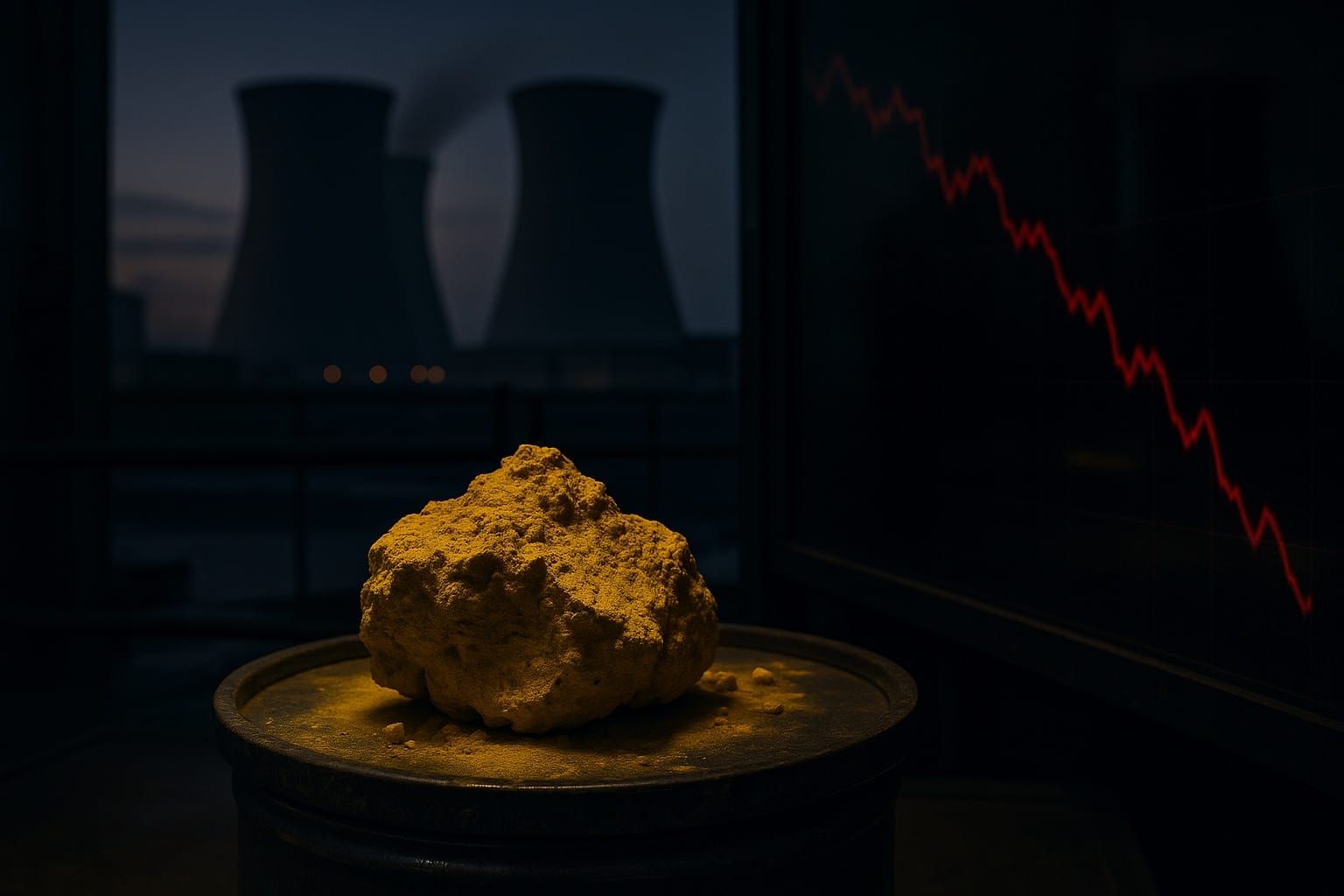
The uranium market delivered everything its bulls promised this year. Supply discipline from the world's largest producer. A structural deficit that new mines can't close before the 2030s. Demand headlines that would have sounded like fan fiction five years ago: $17.5 billion in conditional U.S. federal loans for ten new reactors, Google-backed groundbreakings, a 38-country pledge to triple nuclear capacity by 2050.
The commodity responded exactly as advertised. Spot uranium sits near $90 per pound — up roughly 13% over the past year, according to Trading Economics' benchmark tracker — and long-term contract price indicators reached the mid-$90s this fall. Industry trackers put September's term-price indicator around $96.50 per pound, a nominal all-time high. Kazatomprom's CEO called term-price levels an 18-year maximum back in August and declared that "the era of 'cheap' uranium is fading away."
Then there are the stocks.
In Wednesday trading, Oklo — the small modular reactor developer that became 2025's favorite nuclear-AI proxy — is down 58% in 2026 and roughly 83% below its 52-week high. NuScale Power is down 58% this year and 89% off its high. Centrus Energy, the only publicly traded American enrichment play, has lost 49% year to date. Cameco, the Western world's largest producer, is down about 10% on the year and nearly 39% below its high. The Global X Uranium ETF is off 16%; the Sprott Uranium Miners ETF, 22%.
One major name in the complex is up this year: Kazatomprom, the Kazakh state producer, whose London-listed shares have gained about 12% in 2026.
The physical market and the equity market are telling two different stories about the same industry. This briefing is about which one is lying — and the uncomfortable possibility that neither is.
The commodity did everything right
Walk through the fundamental news flow of 2026 and it reads like a uranium bull's wish list.
Supply kept disappointing. Kazatomprom — which accounts for roughly a fifth of global primary production — announced it would cut 2026 output by about 10% rather than ramp back toward full capacity, explicitly saying the supply-demand balance didn't justify a return to 100% production levels. In August, CEO Meirzhan Yussupov told investors that pricing power is returning to producers with large proven reserves and that "every single pound we produce will have a clear, committed, and waiting buyer." Meanwhile Cameco's Cigar Lake mine lost 12 days of operation this year when sulfuric acid supply at the McClean Lake mill ran short — a reminder of how little slack exists in a supply chain where one reagent outage at one mill moves global output. (Full-year Cigar Lake guidance of 17.5–18 million pounds survived.)
Sanctions tightened the Western market further. The United Kingdom's comprehensive ban on Russian-origin uranium came into force on May 20, closing another door in a Western fuel cycle that spent three decades quietly dependent on Russian material.
Demand news was extraordinary. The U.S. Department of Energy approved $17.5 billion in conditional loans to support construction of ten Westinghouse AP1000 reactors across five sites by 2030 — the largest direct federal investment in nuclear in decades. TerraPower began construction of its Natrium plant in Wyoming — the first utility-scale advanced non-light-water reactor build in U.S. history. Kairos Power broke ground on its Google-contracted demonstration plant in Tennessee. Australia ratified uranium exports to India, which is targeting an expansion from 8 gigawatts of nuclear capacity to 100 by 2047. Thirty-eight countries representing over 70% of global GDP have signed the pledge to triple nuclear power by 2050.
New supply is coming — Orano broke ground in Mongolia, Denison started construction at Phoenix in Saskatchewan, Uranium Energy Corp began commercial production at Burke Hollow in Texas — but almost none of it arrives at scale before 2028 at the earliest, and the largest projects land in the 2030s.
A commodity with inelastic demand, disciplined supply, and a decade-long deficit visible in the forward curve: that is the textbook setup. The textbook worked. The pound of uranium did its job.
The stocks did everything wrong
So why is nearly every equity in the complex in a bear market?
The short answer: the stocks were never really pricing uranium. They were pricing a narrative about artificial intelligence — and that narrative cracked.
Nuclear equities spent 2025 being repriced as AI infrastructure derivatives. Every hyperscaler power-purchase announcement sent the small modular reactor developers vertical; Oklo touched $174 within the past year, NuScale $53. Those prices embedded assumptions about speed — that data-center demand would convert into signed reactor orders, construction starts, and revenue on a venture-capital timeline.
2026 called that bluff. As investors turned skeptical of AI capital-expenditure math generally, they got especially skeptical of the furthest-out, least-contracted claims on that capex — and nothing is further out than a reactor company with no operating reactors. When hyperscalers need megawatts in 2027, they buy gas turbines and grid interconnects, not a first-of-a-kind fission plant with a 2030s delivery date.
The capital markets window slammed shut mid-year with unusual violence. X-Energy completed a $1.02 billion IPO on Nasdaq in the spring — the largest advanced-nuclear listing ever. By September, Holtec — the NRC-authorized operator of the Palisades plant, with an $825 million offering marketed at $15–18 per share — suspended its IPO mid-roadshow and then withdrew the registration entirely, with Reuters tying the pullback to investor scrutiny of AI-adjacent capital deployment. Same industry, same year: a record IPO in the spring, a failed one by fall.
That is the equity market's verdict: the fuel is real, the deficit is real, but the 2025 valuations assumed an adoption curve the customers never signed up for.
Which leaves the question that actually matters for positioning. The physical market — spot near $90, term indicators at nominal records, the world's biggest producer withholding supply — is not cracking. The equity market is. One of these prices is information. The other is noise. Sorting out which is the difference between catching the next leg of a structural bull market and buying a sector that just told you its growth story was borrowed from someone else's capex budget.
Get the next briefing free in your inbox: Join AlphaBriefing
The rest of this briefing is free — it just requires a free AlphaBriefing account: the one chart-level divergence inside the complex that reveals what's actually being repriced, the signal buried in the only uranium stock that's up this year, and the three-tier framework for how the physical market, the producers, and the developers resolve from here.
Create your free account → — 30 seconds, no card.