Cargo Thieves Don't Break Into Trucks Anymore. They Buy the Trucking Company.
Strategic cargo theft has turned U.S. freight into a fraud market: criminals buy real trucking companies for $22,000 and drive off with millions. Losses doubled to $304.6M last quarter — and Washington is finally moving.

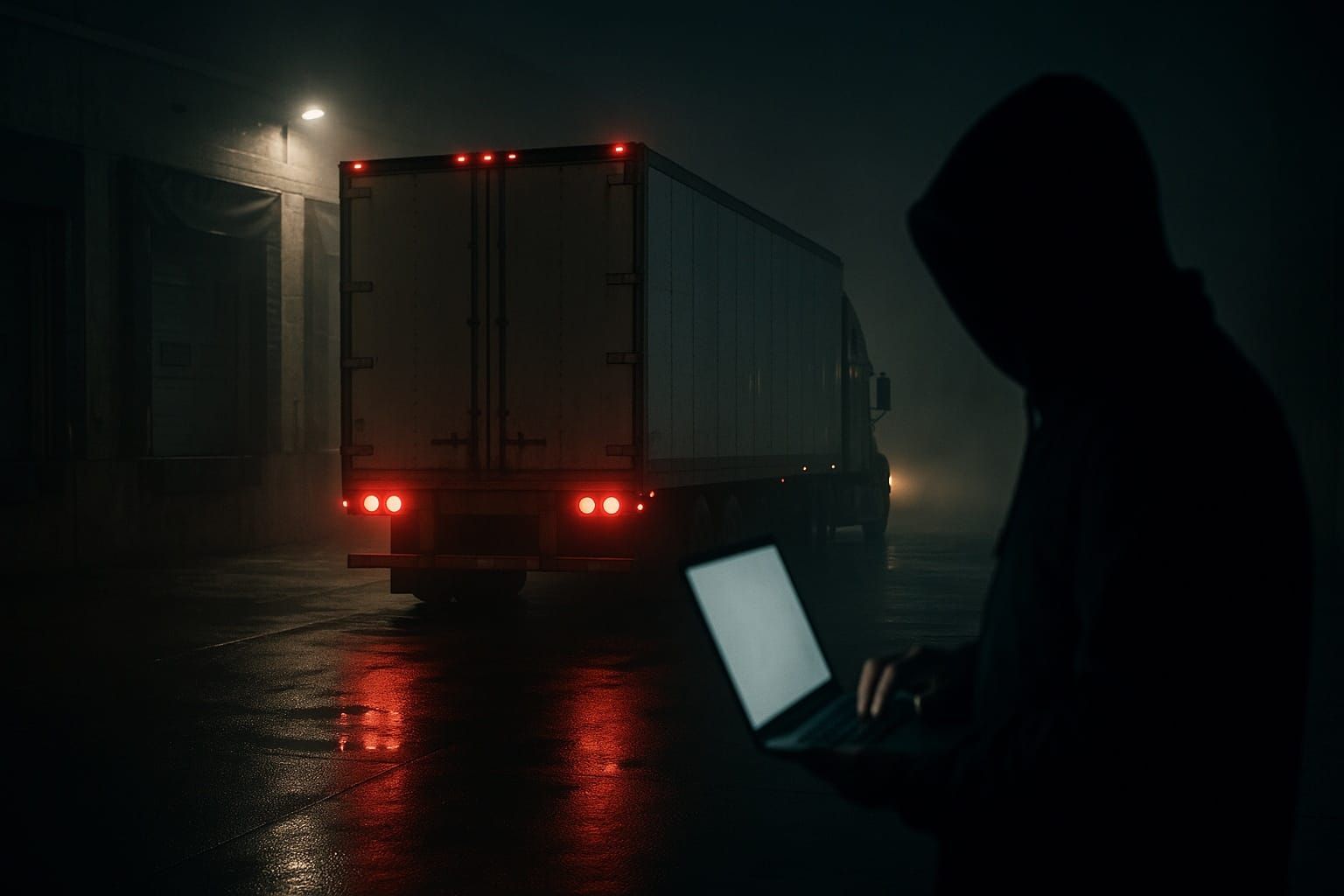
For about $22,000, a 28-year-old from Sacramento bought a Texas trucking company called Z&F Transportation LLC. He didn't want the trucks. He wanted the company's federal operating authority — the credential that tells brokers and shippers a carrier is legitimate. Within weeks, according to evidence presented at a federal trial in Los Angeles, a co-conspirator used that authority to pick up a load of televisions in Fontana, California, bound for Florida. The televisions never arrived. Neither did the laptops, solar panels, appliances, shoes, or tires that followed, booked through legitimate brokers — including Uber Freight — under company names that checked out on paper.
In late September, a jury convicted two men in that scheme, which prosecutors tied to at least $2 million in losses. Sentencing is set for January 2027. The case is unremarkable in every way except one: it is now the standard playbook. The dominant form of cargo theft in America no longer involves bolt cutters, a dark truck stop, or anyone touching a lock. It involves paperwork.
Today — October 14 — is the trucking industry's third annual Freight Fraud Awareness Day, a campaign backed by insurers and freight-tech firms that exists because, as one organizer put it, victims keep discovering the same thing: it's not just me. It is a strange milestone. The industry that moves most of America's domestic freight now needs an awareness day for the crime of trucks simply driving away with the cargo they were hired to haul.
The theft happens before the truck arrives
The old model of cargo crime was physical. A thief waited at a truck stop, broke a seal, and took whatever happened to be inside. Law enforcement calls that "straight theft," and it still happens — but it is no longer where the money is.
The new model is what the industry calls strategic theft: identity-based fraud that captures the freight through the transaction itself. The variants share one architecture. Criminals acquire a legitimate carrier identity — by purchasing a real company, hijacking a dormant registration, or impersonating an active one — then bid on real loads through load boards and brokers. The cargo is handed to them voluntarily, by people following procedure.
Jeremy Baker, an assistant special agent in charge who helps oversee the FBI's Memphis Cargo Theft Task Force, described the shift bluntly in an interview with FreightWaves last month: "Through cyber-enabled means, the theft has been done even before that truck arrives. All they have to do is have the truck arrive." Compromised email accounts and hacked transportation-management systems let crews identify exactly which shipments are worth taking before anyone approaches a dock. "They know exactly what they're picking up," Baker said.
The structure of the freight market makes this hard to stop. A shipper hires a broker; the broker hires a carrier; the carrier may re-broker the load again. Each party assumes someone else ran the checks. "The broker is kind of onto the next deal," Baker explained. "They've done their part and they think they've made a good deal with a legitimate company." Meanwhile the warehouse releases the goods to whoever shows up with the right paperwork — and the paperwork is real. Only the intent is fake.
Briefings like this land in members' inboxes before the market prices them in. Join free →
Fewer thefts, double the losses
The clearest signal that cargo crime has professionalized is in the numbers — specifically, the way they are moving in opposite directions.
Verisk's CargoNet, the industry's main theft-intelligence network, documented 677 cargo theft incidents across the United States and Canada in the second quarter of 2026. That was down 26% from a year earlier — welcome news on its face. But estimated losses went the other way: $304.6 million for the quarter, more than double the $135.7 million reported in Q2 2025. The average value of a stolen shipment reached $564,009.
Fewer, bigger, better-chosen. "The groups driving the largest losses are not necessarily trying to steal more freight; they are trying to identify the right shipment," Keith Lewis, CargoNet's vice president of operations, said when the data was released. Metal thefts rose from 54 incidents to 80 year over year, with copper the most-targeted commodity for two years running — the longest streak veteran investigators say they have ever seen. Enterprise computing gear, networking equipment, and cryptocurrency-mining hardware round out the target list: multimillion-dollar loads that move as ordinary dry freight.
Industry veterans caution that one good quarter on incident counts proves nothing. "It's not going to be a trend until we see it for maybe two or three quarters consecutively," Scott Cornell, chair of the Transported Asset Protection Association's Americas chapter, told FreightWaves in August.
The annual bill is contested, and the range itself tells the story. The American Transportation Research Institute, the trucking industry's research arm, put the direct annualized cost of cargo theft at up to $6.6 billion — more than $18 million per day — in an October 2025 study, with motor carriers averaging over $520,000 in annual theft losses and logistics providers averaging $1.84 million. But ATRI's figure is built on reported incidents, and fraud-prevention specialists argue most events never make it into any database — written off as operational losses, settled quietly, or never recognized as fraud at all. Some industry estimates, extrapolating from assumed reporting rates of 10-15%, put the true annual exposure at $40 billion to $60 billion. Those larger figures are modeled, not measured, and should be treated as directional. But the direction is the point: whichever number you believe, it is growing faster than the systems built to stop it.
Washington finally noticed
For years, cargo theft fell into an enforcement gap. Local police treated a missing truckload as a civil dispute between shipper and carrier. Federal prosecutors had bigger cases. The registration system practically invited abuse: a motor carrier number could be obtained with minimal identity verification, and a revoked operator could re-enter the market days later under a fresh name — the industry calls them "chameleon carriers."
That gap is now closing, slowly, from several directions at once:
- Legislation. In April 2026, Rep. Brad Knott (R-N.C.) introduced the Securing American Freight, Enforcement and Reliability (SAFER) in Transport Act, the House companion to a Senate bill from Sen. Todd Young (R-Ind.). The package would create a federal Freight Fraud and Theft Advisory Committee, formalize coordination between the Transportation Department and the Justice Department, tighten oversight of commercial driver's licensing — and, most consequentially, phase out the motor carrier number system entirely within five years, forcing every carrier, broker, and freight forwarder onto a single, more verifiable registration.
- Enforcement. Federal task forces — the FBI's Memphis cargo theft unit has been at it for nearly two decades — are pairing agents with local police, and 2026 has produced a steady drumbeat of federal convictions, from the Los Angeles purchased-carrier ring to an alleged $10 million international cargo theft conspiracy charged in July.
- The private market. Carrier-vetting and identity-verification services have become a booming corner of freight tech, and insurers — several of which now sponsor Freight Fraud Awareness Day itself — are responding with new coverage products and tighter underwriting scrutiny.
The investment-relevant point is structural: fraud at this scale functions as a tax on every freight transaction, and the response — identity infrastructure layered onto a $900 billion trucking market that has run on faxes and trust for decades — is a multi-year spending cycle, not a news cycle. Verification, insurance repricing, and compliance budgets all move in one direction from here, whatever the quarterly theft counts do.
The thieves understood before the regulators did that the American freight system's core vulnerability was never the padlock on the trailer. It was the assumption that a company that exists on paper exists in good faith. Repricing that assumption — in legislation, in insurance, in software — is what the next several years of this story look like.
If this analysis was useful, this is what AlphaBriefing does every day — geopolitics and markets, connected to what it means for your money. Free members get the daily brief in their inbox; paid members get the investment frameworks, scenario pricing, and catalyst calendars behind the paywall.
Sign up free → — upgrade whenever it earns it.
Get this level of intelligence every day. Subscribe to AlphaBriefing — free, member, and paid tiers available. Or get the next briefing free in your inbox: Join AlphaBriefing.
Sources & Further Reading
- Verisk CargoNet — Cargo Theft Losses More Than Double to $304 Million in Q2 Despite a Drop in Thefts
- American Transportation Research Institute — New ATRI Research Confirms the High Costs of Cargo Theft to Industry
- FreightWaves — LA jury convicts 2 in $2M nationwide cargo theft ring using purchased trucking companies
- FreightWaves — FBI's Memphis Cargo Theft Task Force warns cyber schemes put millions in freight at risk
- FreightWaves — CargoNet reports $304.6M in losses, Scott Cornell says Q2 theft drop is no trend yet
- Land Line — House bill targets freight fraud with sweeping reforms
- Congress.gov — H.R. 8267, SAFER in Transport Act
- FreightWaves — Freight Fraud Awareness Day returns as strategic cargo theft reshapes trucking
Disclaimer
AlphaBriefing is an independent intelligence publication. The content in this article is produced for informational and educational purposes only. Nothing published by AlphaBriefing constitutes financial, investment, legal, tax, or regulatory advice, nor should it be construed as a solicitation or recommendation to buy, sell, or hold any security, asset, or financial instrument.
All views expressed are those of the author at the time of writing and are subject to change without notice. Markets are volatile and unpredictable; past performance is not indicative of future results. Any investment involves risk, including the possible loss of principal.
AlphaBriefing and its principals, employees, or contributors may hold positions in securities or assets mentioned in this article. This should be considered a potential conflict of interest. No material relationship with any company referenced exists unless explicitly disclosed. Readers should conduct their own due diligence and consult qualified financial, legal, and tax advisors before making any investment decisions.
Information in this article is drawn from public sources believed to be reliable at the time of publication. AlphaBriefing makes no warranty, express or implied, as to the accuracy, completeness, or timeliness of any information herein. AlphaBriefing accepts no liability for any loss or damage arising from reliance on this content.
© AlphaBriefing. All rights reserved. Unauthorised reproduction or distribution is prohibited.