The World's Data Runs Through Cables Anyone Can Cut
97% of intercontinental data and roughly $9 trillion in daily transactions travel through fiber on the seafloor — and it's being severed at an unprecedented rate. Why the undersea cable network just became the most underpriced risk in global finance.

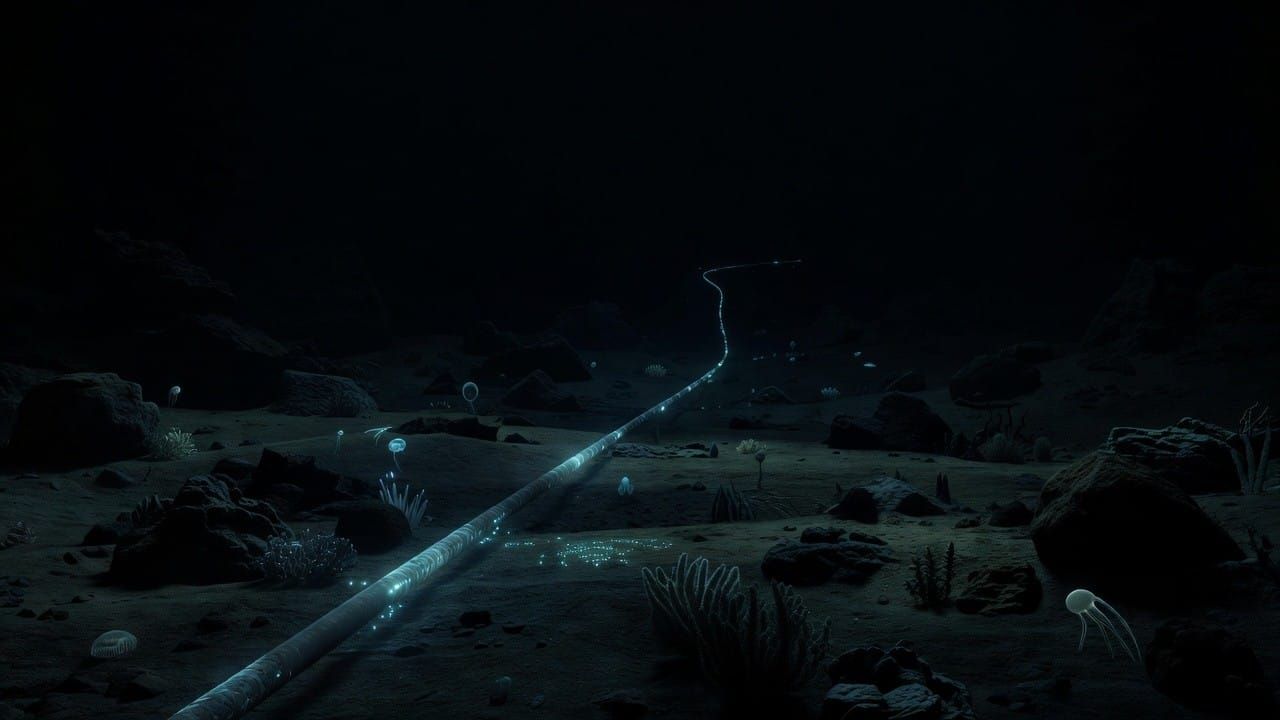
There is no part of the modern economy more important, and less visible, than a bundle of glass fibers the width of a garden hose lying in the dark at the bottom of the ocean.
Roughly 1.4 million kilometers of submarine cable — enough to circle the Earth more than thirty times — carry an estimated 97 percent of all intercontinental data. Every transatlantic stock trade, every dollar moved between banks, every cloud login and video call and military order travels through them. Industry and government estimates put the value of financial transactions running across these cables at around $9 trillion every single day.
And over the past 18 months, they have been cut at a rate without precedent in the history of the network.
The arteries of modern civilization
We talk about "the cloud" as if data lives in the sky. It doesn't. It lives on the seafloor. Satellites — including Starlink's sprawling constellation — handle a tiny fraction of global traffic. The overwhelming majority of the world's data crosses oceans through fiber-optic lines laid by a handful of specialist ships, often following routes mapped more than a century ago for the first telegraph cables.
This is, by design, an efficient system. It is also an extraordinarily fragile one. A cable can be severed by a dragged anchor, a fishing trawler, an earthquake — or by someone who wants it severed. Repairs require a specialized vessel to locate the break, haul the cable to the surface, splice it, and lower it back down. There are only around 60 such ships in the world, and a single repair can take weeks.
When the U.S., U.K. and Australia signed a trilateral pact on May 31 to defend seabed infrastructure, the language was unusually blunt for a diplomatic communiqué. Officials called the cables "the arteries of modern civilization." That is not hyperbole. Sever enough of them in the right places and you don't slow the internet down — you amputate entire countries from it.
An unprecedented wave of damage
The numbers are moving in the wrong direction, fast.
- Taiwan has reported five cases of seabed cable damage in 2026 already — compared with just three in all of 2023 and three in 2024. Authorities charged the Chinese captain of the cargo vessel Hong Tai 58 with damaging a communications cable linking Taiwan to its Penghu Islands.
- The Baltic Sea has become a recurring crime scene. Multiple cables and pipelines have been damaged in incidents that investigators have tied to commercial vessels dragging anchors across the seabed for miles — a pattern too consistent to look like accident.
- Ireland's government was warned this spring that a worst-case coordinated attack could leave the entire island disconnected from the global internet.
- Western intelligence services see growing risk of deliberate Russian and Chinese sabotage, and fresh concern that Iran could exploit the dense web of cables running through the shallow waters of the Persian Gulf.
What makes this so dangerous is the deniability. A cargo ship "accidentally" dragging its anchor is nearly impossible to prosecute. By the time a cable is cut, the vessel is in international waters or a friendly port. One European telecom executive recently compared coordinated cable cuts to nuclear weapons — not in destructiveness, but in deterrence: a capability you hold in reserve precisely because the other side knows you have it.
Why this is a financial story, not just a tech story
For investors, the instinct is to file this under "geopolitics" and move on. That's a mistake. The undersea cable network is a chokepoint sitting directly underneath the global financial system, and chokepoints are where risk concentrates and where money gets made.
Consider what actually depends on these lines staying intact:
Settlement and trading. High-frequency and cross-border trading is exquisitely sensitive to latency. A severed cable doesn't just slow data — it reroutes it across longer paths, adding milliseconds that ripple through arbitrage strategies and, in a crisis, can freeze cross-border settlement entirely. The $9-trillion-a-day figure is not abstract; it is the plumbing of global capital.
The AI buildout. Every hyperscaler — the same companies pouring hundreds of billions into data centers and nuclear power — is now also an undersea infrastructure company. Google, Meta, Amazon and Microsoft have become some of the largest funders of new transoceanic cables precisely because AI workloads are devouring bandwidth between continents. Australia's new AUKUS submarine base is being wired directly into subsea cables to carry the data load. The "AI trade" runs through the seafloor whether the market prices it that way or not.
Insurance and sovereign risk. Cable damage is increasingly a question for marine insurers, reinsurers, and the sovereigns whose connectivity — and therefore whose GDP — hangs on a few vulnerable landing stations. Island and peripheral economies carry the most concentrated risk.
And then there's the defensive spend. The AUKUS pact commits to a new generation of unmanned undersea vehicles to patrol and protect seabed infrastructure, with deliveries slated for next year. A protect-the-seabed industry — sensors, autonomous submersibles, surveillance, rapid-repair capacity — is being born in real time, funded by defense budgets that rarely shrink once they start.
What it means
The undersea cable network is the clearest example of a truth the market keeps relearning: the most critical infrastructure is often the least visible, the least redundant, and the most underpriced — right up until it fails.
For the better part of a century, these cables were a quiet engineering miracle that nobody thought about. That era is over. They are now contested terrain — a place where great-power competition, the AI capital cycle, and the basic functioning of the financial system all converge on the same fragile strand of glass.
You don't need to know which company will win the contract to patrol the Atlantic seabed. You need to understand that the question now exists at all. The map of global risk just gained a new layer, and it runs along the bottom of every ocean on Earth.
Get this level of intelligence every day. Subscribe to AlphaBriefing — free, member, and paid tiers available.
Sources & Further Reading
- CNN — US, UK and Australia agree pact to protect undersea cables, 'the arteries of modern civilisation'
- Bulletin of the Atomic Scientists — Seabed zero: Baltic sabotage and the global risks to undersea infrastructure
- CSIS — Risk Beneath the Waves: Safeguarding Subsea Cables for a Secure Global Network
- The Irish Times — Attacks on undersea cables could cut off Ireland from global internet, Government warned
- RAND — Undersea Cables Are Vulnerable to Sabotage—but This Takes Skill and Specialist Equipment
- Wikipedia — 2024 Baltic Sea submarine cable disruptions
Disclaimer
AlphaBriefing is an independent intelligence publication. The content in this article is produced for informational and educational purposes only. Nothing published by AlphaBriefing constitutes financial, investment, legal, tax, or regulatory advice, nor should it be construed as a solicitation or recommendation to buy, sell, or hold any security, asset, or financial instrument.
All views expressed are those of the author at the time of writing and are subject to change without notice. Markets are volatile and unpredictable; past performance is not indicative of future results. Any investment involves risk, including the possible loss of principal.
AlphaBriefing and its principals, employees, or contributors may hold positions in securities or assets mentioned in this article. This should be considered a potential conflict of interest. No material relationship with any company referenced exists unless explicitly disclosed. Readers should conduct their own due diligence and consult qualified financial, legal, and tax advisors before making any investment decisions.
Information in this article is drawn from public sources believed to be reliable at the time of publication. AlphaBriefing makes no warranty, express or implied, as to the accuracy, completeness, or timeliness of any information herein. AlphaBriefing accepts no liability for any loss or damage arising from reliance on this content.
© AlphaBriefing. All rights reserved. Unauthorised reproduction or distribution is prohibited.