The War Beneath the Waves
Ninety-seven percent of intercontinental data — and roughly $10 trillion in daily financial transactions — runs through cables on the ocean floor. Russia, China, and the Houthis have all figured this out. Wall Street is about to.

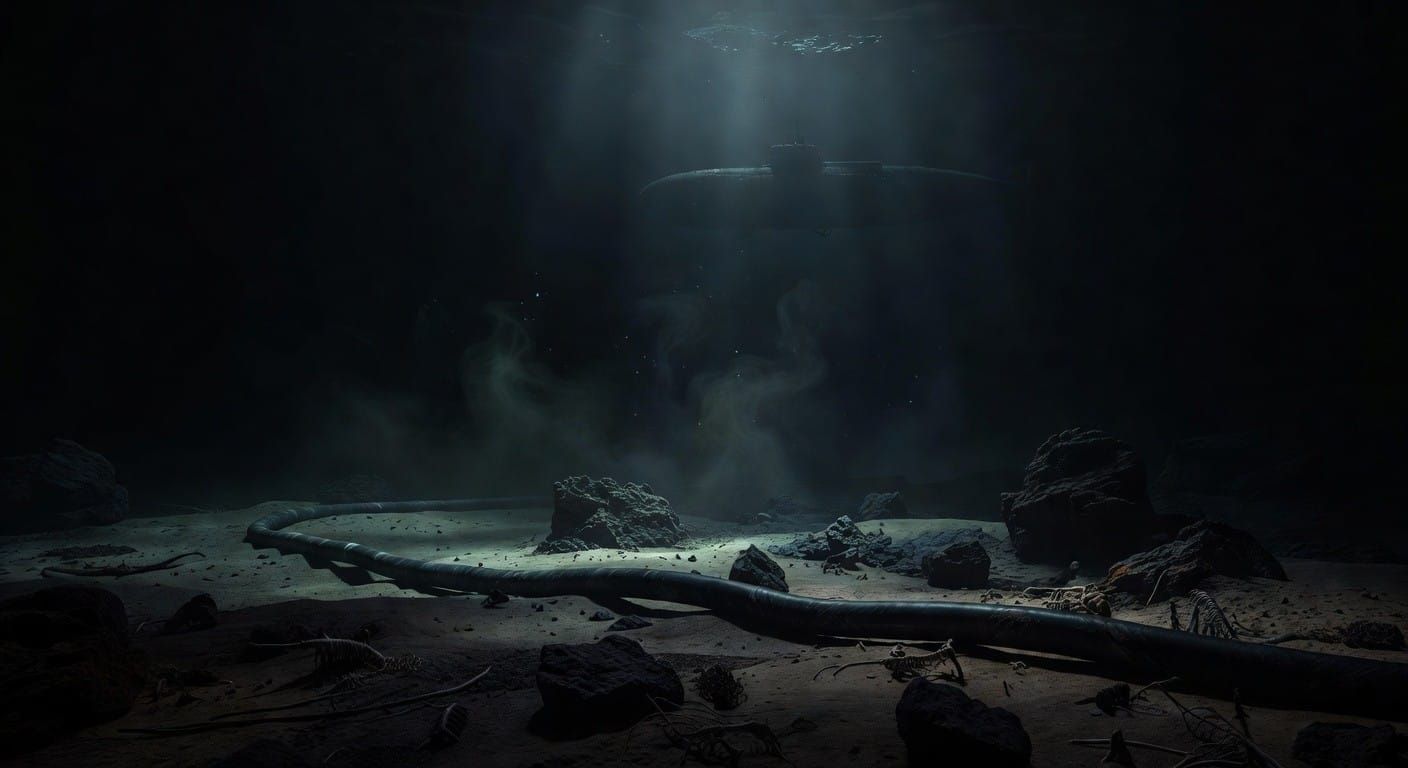
A little before five in the morning on the last day of 2025, engineers at the Finnish telecoms operator Elisa watched a fiber-optic line linking Helsinki to Tallinn go dark. By the time anyone reached a phone, a Russia-linked cargo vessel called the Fitburg — bound from a Russian port to Israel and carrying sanctioned steel — was already dragging its anchor across the seabed. Finnish authorities chased it down, boarded it, and seized it. Less than four weeks later, a separate fiber line connecting Latvia to the Swedish island of Gotland failed under suspicious circumstances. NATO opened an investigation.
These were not isolated events. They were the latest two entries in a list that, since the start of 2023, now runs to dozens — and is rewriting the security and investment landscape of the global internet.
The Most Important Infrastructure You Never Think About
There are around 600 active submarine cables running across the world's oceans. They carry roughly 97% of intercontinental data traffic and an estimated $10 trillion in financial transactions every single day. Every Zoom call from Europe to America, every SWIFT settlement, every cross-border AI training run, every streaming feed — almost all of it lives on these lines.
They are also, by infrastructure standards, almost comically vulnerable. Most are no thicker than a garden hose. Once they leave a beach manhole, they often sit completely exposed on the ocean floor for thousands of miles. The vast majority of damage is caused by trawlers and anchors. But increasingly, the damage looks deliberate.
The Pattern Is No Longer Plausibly Random
- Baltic Sea (2023–2026): A near-continuous run of cable and pipeline incidents — the Newnew Polar Bear in 2023, the Yi Peng 3 in late 2024, the Eagle S tanker (linked to Russia's shadow fleet) which cut the Estlink 2 power cable and four data cables on Christmas Day 2024, and now the Fitburg and the Latvia–Gotland line in early 2026.
- Red Sea (September 2025): Multiple cables — including SMW4 and IMEWE — were severed near Jeddah, degrading internet in Pakistan, India, the UAE and Saudi Arabia, and pushing latency up across Microsoft Azure's Middle East regions. The International Cable Protection Committee blamed "commercial shipping activity," diplomatic code for a vessel that probably knew exactly what it was doing.
- Taiwan Strait: Cables to Taiwan's outlying Matsu islands have been cut more than 30 times since 2023, almost always by Chinese-flagged fishing or "research" vessels. Taiwan now treats each cut as a peacetime rehearsal for a wartime blockade.
Western intelligence services have pointed, on background, to Russia's GUGI — the Main Directorate of Deep-Sea Research, which operates the Yantar and a fleet of purpose-built deep-sea vessels — and to China's increasingly forward "civilian" research fleet. The Houthis have publicly denied responsibility for the Red Sea cuts, but their leadership has openly named submarine cables as a legitimate target.
NATO Wakes Up
In January 2025, NATO launched Baltic Sentry — a multinational surveillance and protection mission specifically designed to deter undersea sabotage. Frigates, patrol aircraft, unmanned underwater vehicles, and AI-driven anomaly detection on shipping AIS data are now permanently deployed across the Baltic. The EU has followed with a dedicated funding package for cable hubs and resilient routing. Britain has stood up a Joint Maritime Security Centre with a specific cables remit. Australia, Japan and South Korea are all rebuilding their sovereign repair-ship capacity.
For the first time since the Cold War's North Atlantic GIUK Gap, sub-sea infrastructure protection is back as a first-tier defense priority. And for the first time ever, it has a comparable footprint in private sector capital allocation.
This is where the analysis gets actionable. AlphaBriefing members get the full investment framework — scenarios, positioning, and the bottom line.
Subscribe to AlphaBriefing — Free, Member, and Paid tiers available.