Putin's Payday: How the Iran War Handed Russia Its Biggest Oil Windfall in a Decade
The US went to war with Iran to contain a nuclear threat. Two months later, Russia is collecting $10 billion a month in extra oil revenues — and the sanctions regime is in ruins.

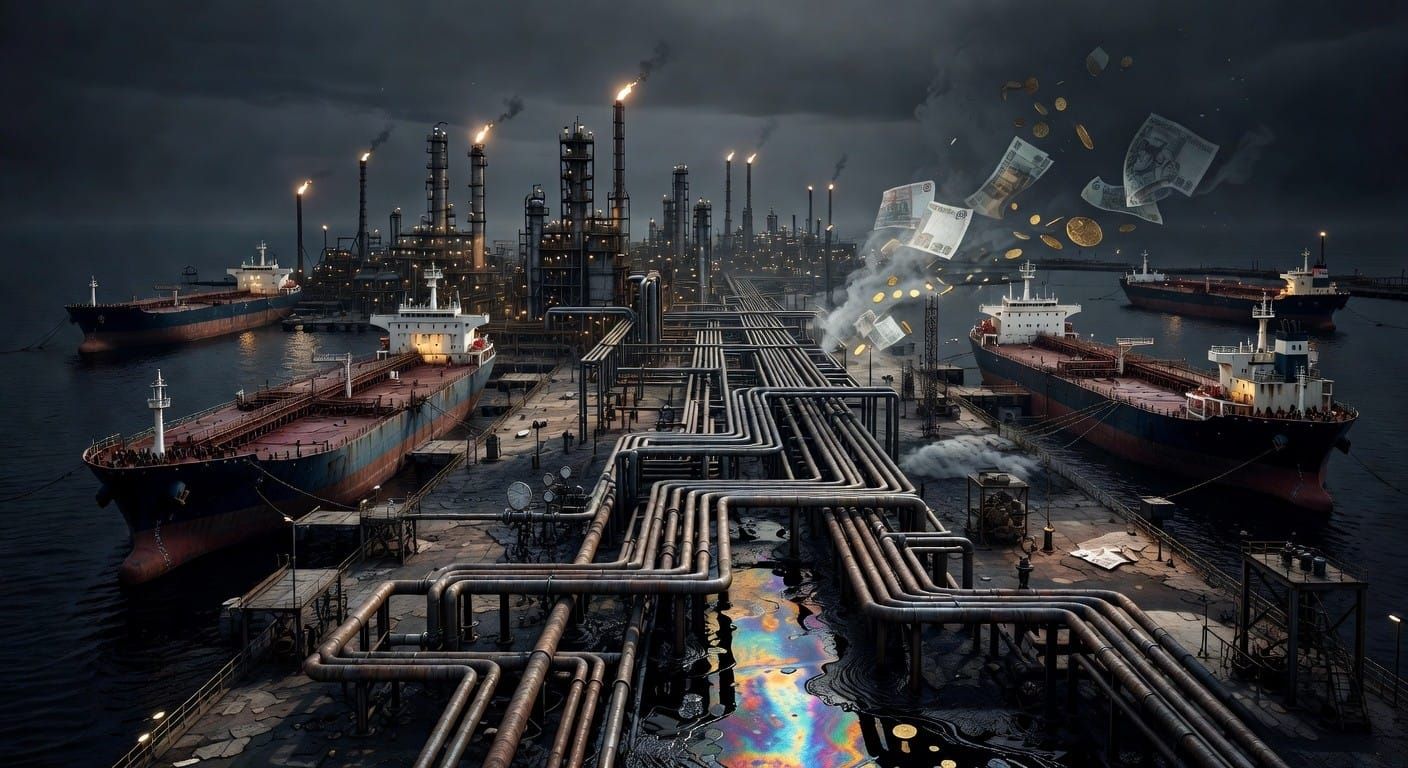
The United States went to war with Iran to neutralize a nuclear threat and restore regional order. Two months later, the biggest winner isn't Washington or Jerusalem — it's Moscow.
Since US and Israeli forces launched strikes against Iran on February 28 and Tehran retaliated by effectively closing the Strait of Hormuz on March 4, global oil prices have surged from roughly $67 per barrel to well above $110. Brent crude has touched $120. And no country on Earth has profited more from that spike than Russia.
The Numbers Are Staggering
Russia's main oil tax revenue — the mineral extraction tax that funds the federal budget — is projected to hit $9 billion for April alone, doubling from pre-war levels. Crude and refined product exports brought in $19 billion in March, up from $9.7 billion in February. Urals crude, Russia's benchmark blend, has surged past $100 per barrel for the first time in over a decade.
Since the war began, Russia has collected an estimated $7 billion in extra fossil fuel revenues — money that flows directly into a war chest already strained by the grinding conflict in Ukraine.
The former head of the International Energy Agency's oil division called it bluntly: the Iran war has been "an enormous financial gift" to Vladimir Putin.
How It Works
The mechanics are straightforward but devastating in their implications.
When Iran closed the Strait of Hormuz, it choked off roughly 20% of global seaborne oil flows — between 10 and 12 million barrels per day that normally transit the narrow waterway between Iran and Oman. Gulf producers like Saudi Arabia, Iraq, Kuwait, and the UAE suddenly couldn't get their oil to market through the strait. Global supply tightened overnight.
Russia, which exports predominantly through Baltic Sea ports, Black Sea terminals, and Pacific pipelines to China and India, faced no such bottleneck. Its export routes remained wide open while competitors were strangled.
The result: a massive premium on every barrel Russia sells. Moscow is now collecting roughly $10 billion per month in additional revenue compared to pre-war baselines.
And Russia has been gaming the system further. Shadow fleets of tankers — many flagged to obscure jurisdictions — continue to ship Russian crude to eager buyers in Asia, often above Western price caps that were supposed to limit Moscow's earnings. With global supply this tight, enforcement has become an afterthought.
Putin's Strategic Windfall
The timing couldn't be better for the Kremlin.
Russia's 2026 federal budget was built on assumptions of oil prices around $60-65 per barrel and total oil/gas tax revenue of 7.9 trillion rubles (roughly $88 billion). At current prices, Moscow is on track to overshoot that target by tens of billions of dollars. The government has already delayed planned changes to its fiscal rules specifically to capture the windfall rather than saving it.
That money has immediate strategic utility. Russia's war in Ukraine shows no signs of ending. The army needs ammunition, replacement vehicles, and recruitment bonuses for soldiers. Russia's defense budget was already swelling before the Iran war — now it has the cash to sustain the burn rate indefinitely.
Chatham House, the UK's preeminent foreign policy think tank, published a stark assessment in April: "The Iran war has been an economic gift to Putin." The report detailed how every dollar added to the price of oil translates into roughly $2 billion in annual Russian revenue — and prices have risen by over $40 per barrel since February.
The Strategic Irony
Here's what makes this story so uncomfortable for Washington.
The United States launched the Iran campaign partly to reassert control over the Middle East's energy architecture. Instead, the war has increased global dependence on Russian energy while enriching the very adversary the US has spent three years trying to economically isolate through sanctions.
The sanctions regime — painstakingly constructed after Russia's 2022 invasion of Ukraine — was designed to cap Russian oil revenues and starve the Kremlin of funds. For two years, it worked imperfectly but measurably. Russian oil was selling at steep discounts. Budget revenues were under pressure. The ruble was volatile.
The Iran war erased all of that. Russian oil is now selling at premiums, not discounts. The budget is flush. The ruble has stabilized. And the diplomatic leverage that comes with being a reliable energy supplier to China and India — while Western-aligned Gulf producers are locked behind a war zone — is immense.
Ukraine Pays the Price
The cruelest dimension is what this means for Ukraine.
With the US military focused on Iran — deploying carrier strike groups, running a naval blockade, and absorbing the logistical demands of a multi-front Middle East operation — attention and resources have shifted away from the Ukraine theater. Congressional debates about aid packages have been overshadowed. Pentagon planning bandwidth is consumed.
Meanwhile, Russia can afford to escalate. Fresh revenues fund more missiles, more drones, more mercenary recruitment. Ukraine's own drone campaigns against Russian refineries and oil ports have inflicted an estimated $2.3 billion in damage in March alone and knocked out roughly 40% of some Russian export capacity — a remarkable achievement by a country fighting for survival. But it's not enough to offset the windfall from $110 oil.
The math is brutal: even after accounting for Ukrainian strikes, Russia's net oil revenues are higher than at any point since the 2022 invasion.
What Investors Should Watch
The Russia windfall story has direct implications for global markets:
Oil prices remain structurally elevated. As long as the Strait of Hormuz is contested and Iranian exports are offline, there is no path to cheap oil. Brent above $100 is the new baseline until the conflict resolves — and there's no resolution in sight.
Russian assets are untouchable but proxies exist. Western investors can't directly access Moscow's gains, but the same dynamics lifting Russian revenues are lifting energy stocks globally. European integrated majors, US shale producers, and oilfield services companies are all beneficiaries of sustained high prices.
The sanctions architecture is functionally broken. The G7 price cap on Russian oil was designed for a world where oil was abundant and Russia was desperate for buyers. Neither condition holds. Expect policy debates about tightening enforcement — or acknowledging failure.
European defense spending accelerates. If the US is simultaneously fighting Iran and enriching Russia, the case for European military autonomy becomes urgent. Defense stocks across the continent — Rheinmetall, BAE Systems, Leonardo, Thales — are already at all-time highs. The trend has further to run.
Emerging market pain continues. Countries that import oil — India, Turkey, much of Southeast Asia and Africa — are absorbing the price shock. Currency crises, inflation spikes, and political instability in import-dependent economies are accelerating.
The Uncomfortable Question
Two months into the Iran war, it's worth asking the question that Washington doesn't want to hear: who is actually winning?
Iran's nuclear program has been set back, but the regime hasn't collapsed. The Strait of Hormuz remains contested. Oil prices are at wartime highs, punishing American consumers and allied economies alike. And Russia — the country the US has spent billions trying to weaken — is richer, more strategically confident, and better-funded than at any point since invading Ukraine.
Wars have unintended consequences. The Iran campaign's biggest unintended consequence may be that it handed Putin exactly the lifeline he needed.
Get this level of intelligence every day. Subscribe to AlphaBriefing — free, member, and paid tiers available.
Sources & Further Reading
- Reuters — Iran War Doubles Russia's Main Oil Revenue to $9 Billion in April
- Bloomberg — Russia's Oil Windfall From Middle East War Keeps Growing
- Chatham House — The Iran War Has Been an Economic Gift to Putin
- New York Times — Russian Oil Revenues Doubled Since Iran War Began
- Al Jazeera — Russian Oil Exports Slump as Ukraine Hammers Ports and Refineries
- CNBC — Iran War an "Enormous Financial Windfall" for Russia
Disclaimer
AlphaBriefing is an independent intelligence publication. The content in this article is produced for informational and educational purposes only. Nothing published by AlphaBriefing constitutes financial, investment, legal, tax, or regulatory advice, nor should it be construed as a solicitation or recommendation to buy, sell, or hold any security, asset, or financial instrument.
All views expressed are those of the author at the time of writing and are subject to change without notice. Markets are volatile and unpredictable; past performance is not indicative of future results. Any investment involves risk, including the possible loss of principal.
AlphaBriefing and its principals, employees, or contributors may hold positions in securities or assets mentioned in this article. This should be considered a potential conflict of interest. No material relationship with any company referenced exists unless explicitly disclosed. Readers should conduct their own due diligence and consult qualified financial, legal, and tax advisors before making any investment decisions.
Information in this article is drawn from public sources believed to be reliable at the time of publication. AlphaBriefing makes no warranty, express or implied, as to the accuracy, completeness, or timeliness of any information herein. AlphaBriefing accepts no liability for any loss or damage arising from reliance on this content.
© AlphaBriefing. All rights reserved. Unauthorized reproduction or distribution is prohibited.