The Pentagon Just Made Anduril a Prime
The Army just handed Anduril a sole-source, $20 billion enterprise contract — and two months later the Series H closed at a $61 billion valuation. The Pentagon now has a sixth prime, and the legacy five just got structurally re-rated.

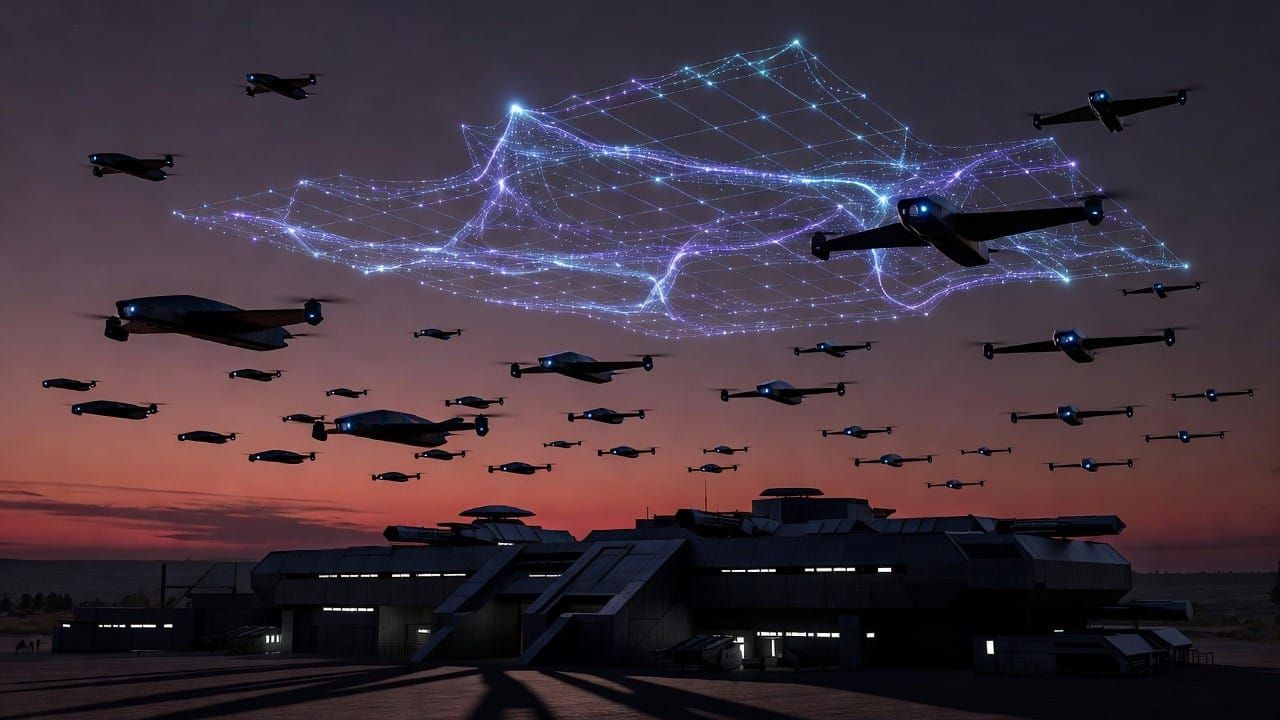
For sixty years, "prime contractor" meant five names: Lockheed, Northrop, Raytheon, Boeing, General Dynamics. They built the planes, the missiles, the ships, the radars. They wrote the software. They consolidated whatever didn't get killed by the budget axe. And when a venture-backed upstart tried to muscle in, the system always found a way to keep them in their lane — subcontractor at best, demonstrator program at worst.
That era ended on March 13, 2026, and almost nobody outside Aberdeen Proving Ground noticed.
On that day, the U.S. Army quietly awarded Anduril Industries a sole-source, firm-fixed-price, indefinite-delivery/indefinite-quantity contract with a ceiling of $20 billion over ten years. Contract number W9128Z-26-D-A001. It's an "enterprise" contract — Pentagon-speak for an umbrella through which the Army, the rest of DoD, the Intelligence Community, and Foreign Military Sales customers can buy Anduril's gear and software on demand, without re-competing each order. The first task order, $87 million for counter-drone command and control, dropped within weeks.
Two months later, on May 13, Anduril closed a $5 billion Series H led by Thrive Capital and Andreessen Horowitz at a $61 billion post-money valuation — the largest private defense raise on record, and roughly double its $30.5 billion mark from June 2025.
Two data points. One story. The Pentagon has selected its sixth prime, and the capital markets are pricing it like one.
Why the Contract Vehicle Matters More Than the Headline Number
The $20 billion number is a ceiling, not a check. Anything Anduril sells the Army for the next decade — Lattice software seats, Ghost drones, Altius loitering munitions, Dive autonomous underwater vehicles, Menace command nodes, Roadrunner interceptors, rocket motors — can be ordered through this one vehicle without the months-long competitive procurement dance that has historically kept defense innovation moving at glacial speed.
That's the part that should make incumbents nervous. The contract is structurally a prime vehicle. Sole-source justification: Anduril was determined to be the only responsible source capable of providing the integrated suite. That language — "only responsible source" — has been used for decades to lock in Lockheed on F-35 sustainment and Northrop on stealth bomber work. It is the Pentagon's way of saying: this vendor is the franchise.
The Army's own release framed it as a way to "streamline procurement" and "reduce administrative costs and pass-through fees." Translation: the Army is tired of paying systems integrators to integrate something Anduril already built integrated.
The Lattice Question
The thing being bought, more than any drone or interceptor, is Lattice — Anduril's open-architecture command-and-control software platform. Lattice ingests sensor feeds, fuses them into a common operating picture, and tasks autonomous and crewed assets against threats in near real time. It is, functionally, the operating system Anduril wants every U.S. and allied force structure to run on.
If the Army standardizes counter-drone, base defense, and eventually broader air defense workflows on Lattice — and the first task order strongly suggests that's the trajectory — then every future drone, every future radar, every future interceptor that wants to play in the U.S. Army's sandbox has to talk to Lattice. That's platform power. That's the Microsoft Windows moment for defense software.
Lockheed and RTX both have analogous in-house C2 stacks. Neither is open architecture in the way Lattice is. Neither was selected as a single-award, $20 billion enterprise vehicle in 2026.
The Revenue Trajectory Makes the Valuation Math Work
Anduril did roughly $1 billion in revenue in 2024. It did $2.1–2.2 billion in 2025, more than doubling. Internal targets and credible third-party estimates put 2026 revenue around $4.3 billion, driven by Arsenal-1 — Anduril's hyperscale autonomous-systems factory in Ohio — coming online and the Army enterprise vehicle starting to obligate task orders.
Two things make this trajectory unusual for a defense contractor:
-
Software-style gross margins. Anduril's estimated gross margin sits in the 40–45% range. Lockheed's segment margins are single-digit on most production programs. The difference is that Lockheed makes money on the bend-metal hardware lifecycle and Anduril makes money on the software-and-sensors layer that sits on top of it. Wall Street values those two business models very differently.
-
Doubling revenue at scale. Going from $1B to $2B is hard. Going from $2B to $4B in a single year, in a regulated industry with classified delivery windows, is borderline unprecedented for a non-public defense firm.
At $61 billion, Anduril trades at roughly 14x trailing revenue and 7x consensus 2026 revenue — a multiple closer to enterprise software than to defense hardware. The bet embedded in that price is exactly the Lattice bet: investors are paying for a platform, not a contractor.
This is where the analysis gets actionable. AlphaBriefing members get the full investment framework — scenarios, positioning, and the bottom line.
Subscribe to AlphaBriefing — Free, Member, and Paid tiers available.