The Missile Shortage Comes Down to Two Factories
The Twelve-Day War proved missile defense works — and emptied America's interceptor magazines roughly 100x faster than its factories can refill them. The real trade isn't the primes. It's the two factories that build what every interceptor flies on.

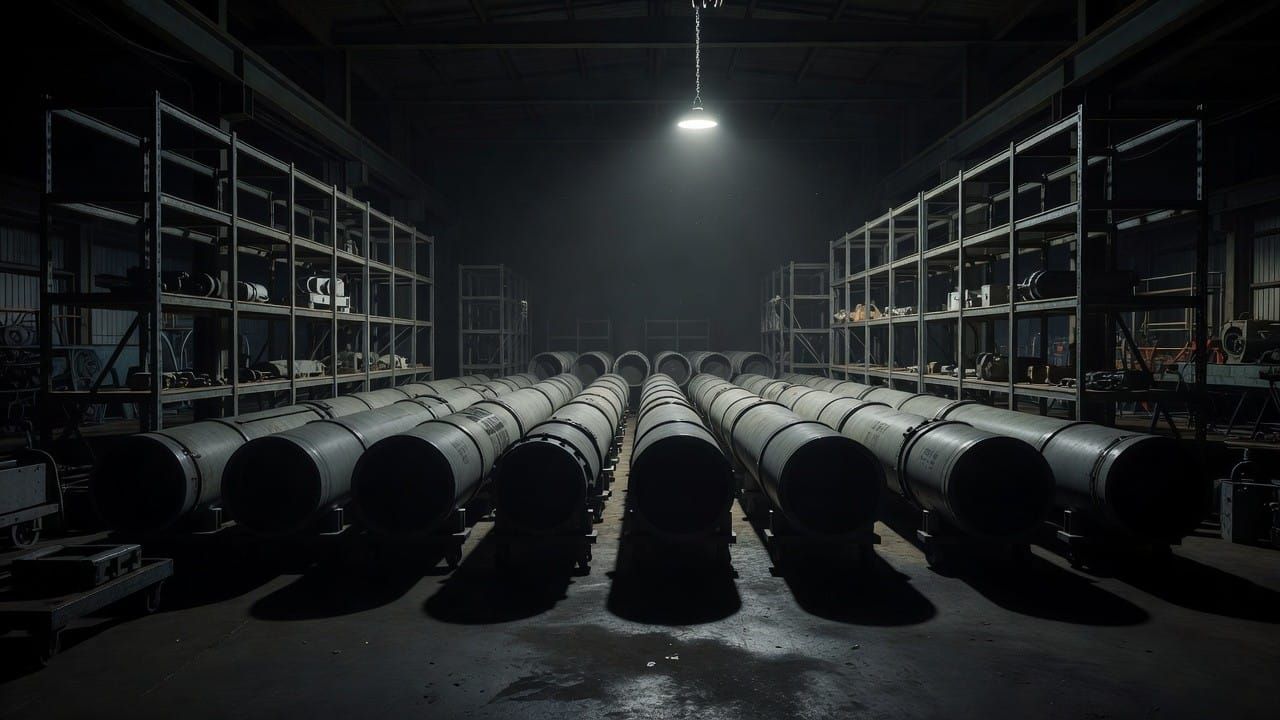
The interceptors worked. That is the part everyone agrees on. When Iranian ballistic missiles arced toward Israel and toward Al Udeid Air Base in Qatar during the Twelve-Day War, the Patriots, the THAAD batteries, and the Navy's SM-3s did almost exactly what their brochures promised. Warheads were knocked down. Bases held. Casualty counts that could have run into the thousands ran into the dozens.
Then the shooting stopped, oil gave back its war premium, and the headlines moved on. The problem the war exposed did not move on. It is sitting in half-empty magazines from Guam to the Gulf, and it is about to become one of the most durable industrial stories in the defense complex.
Because the missiles that worked are not coming back quickly. And the market is still pricing the relief, not the refill.
The math nobody wants on a briefing slide
Air and missile defense is a consumption business disguised as a hardware business. You do not "win" by owning interceptors. You win by firing them — and every one you fire is gone.
During the opening days of the Iran war, the numbers got genuinely alarming. By CSIS estimates, U.S. and coalition forces expended somewhere between 100 and 150 THAAD interceptors supporting Israel — against a total THAAD inventory of roughly 534 at the end of 2025. That is on the order of a quarter to a third of the entire stockpile of America's premier high-altitude interceptor, burned through in under two weeks. Roughly 80 SM-3s went out the tubes too, from a Missile Defense Agency arsenal of about 414.
Patriot was worse. During the most intense phase, coalition batteries were reportedly firing PAC-3 rounds at an estimated 225 missiles per day. Lockheed Martin's Camden, Arkansas facility — the plant that builds them — was producing about 1.7 per day. Run the division: a consumption-to-production ratio near 132 to 1.
You cannot sustain a defense on a 132:1 burn rate. You can only deplete.
The refill takes years, not quarters
Here is the part that turns a news event into an investment thesis: even with unlimited money and political will, the magazines cannot be refilled fast.
Solid-fuel interceptors are not chips you can spin up at a new fab in twelve months. The supply chain is narrow, the propellant is hazardous, the testing is exacting, and the qualified labor is scarce. According to defense-industry analysis circulating this spring, restoring pre-2025 magazine depth runs out to 2028–2029 for the SM-6, mid-2029 for the PAC-3, and late 2029 for THAAD — and that is the optimistic, fully-funded case.
Washington has responded the only way it can: by writing multi-year checks. The Pentagon and Lockheed signed a seven-year framework to lift PAC-3 MSE output from 600 missiles a year toward 2,000 by 2030. THAAD production is slated to quadruple, from 96 toward 400 annually. RTX is under agreement to roughly double-to-quadruple SM-3 output.
Those are not stimulus headlines. They are guaranteed, contracted, multi-year revenue ramps with a national-security mandate behind them — the kind of demand visibility equity investors almost never get handed this cleanly. The interceptor business just went from "lumpy procurement line" to "structural growth platform," and it will stay that way regardless of whether the next ceasefire holds.
The obvious move is to buy the prime contractors whose logos are on the missiles. That is the consensus trade. It is also not where the real scarcity — or the real alpha — lives.
This is where the analysis gets actionable. AlphaBriefing members get the full investment framework — scenarios, positioning, and the bottom line.
Subscribe to AlphaBriefing — Free, Member, and Paid tiers available.