The Iron Paradox: North Korea Is Arming Its Border — and South Korea Is Turning It Into a $24 Billion Export Empire

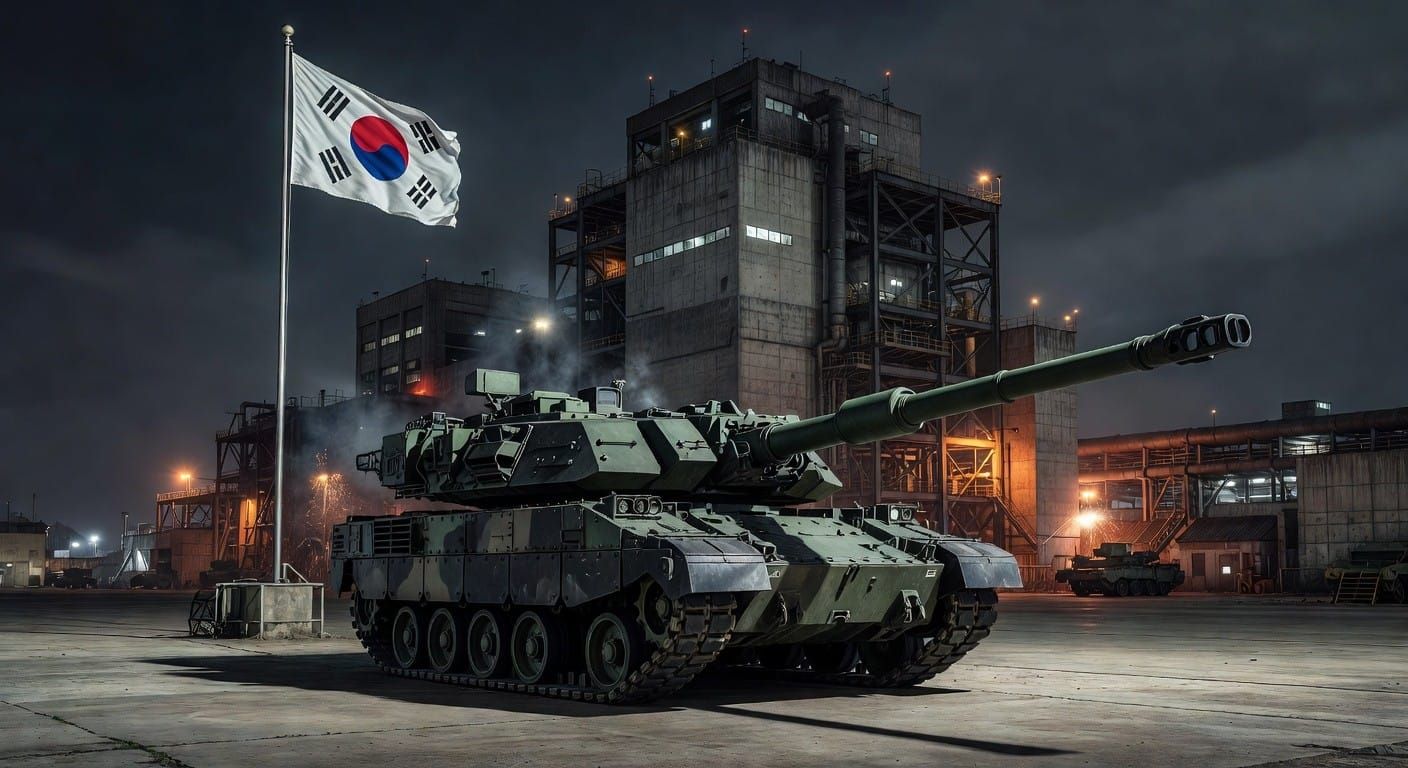
South Korea's defense industry is having its moment. And it's not a coincidence.
On May 8, North Korea announced it will deploy new 155mm self-propelled gun-howitzers along the southern border before year's end — weapons capable of striking Seoul from 37 miles away. Kim Jong Un personally inspected the production line, ordered deployment to three battalions, and revealed that additional missile systems and multiple rocket launchers will follow. The same week, Pyongyang announced it will commission its first naval destroyer in mid-June.
This is the most significant North Korean conventional weapons escalation in years. And it's happening against a backdrop that has turned South Korea from a regional arms buyer into one of the world's most important defense exporters.
The Artillery Threat Nobody Is Pricing
Seoul sits roughly 25 to 30 miles from the North Korean border. The city of 10 million has always lived under the shadow of Pyongyang's forward-deployed artillery — roughly 4,000 guns and rocket systems positioned along the DMZ.
What's different now: North Korea is systematically upgrading the lethality of those systems. In February, Pyongyang handed over 50 KN-25 600mm multiple rocket launchers — nuclear-capable — to frontline units. In March, it tested new five-tube wheeled rocket artillery systems, firing 10-12 rockets over the Sea of Japan in a single salvo.
Now comes the 155mm self-propelled howitzer with extended range. Kim called the improvement a "great change and advantage in the land operations of our army."
Perhaps more telling: North Korea's newly revised constitution has dropped all references to Korean unification. Kim has declared South Korea his country's "permanent and most hostile enemy." The ideological infrastructure for reconciliation is being demolished, piece by piece.
From Buyer to Arsenal
Here's the paradox that makes this story investable: the same threat environment driving North Korea's buildup has turned South Korea into a defense powerhouse.
South Korean defense exports are on track to hit $24 billion in 2026 — a record that would have seemed absurd five years ago. The K9 Thunder self-propelled howitzer, the K2 Black Panther tank, and the Chunmoo multiple rocket launcher system have become some of the most sought-after conventional weapons platforms on the planet.
The driver isn't just Korean engineering. It's timing. Europe's post-Ukraine rearmament created a massive demand signal at exactly the moment South Korea had the industrial capacity, the competitive pricing, and the diplomatic willingness to deliver fast. While traditional Western defense primes wrestled with multi-year backlogs and aging production lines, Korean manufacturers could ship within months.
Norway signed a $2 billion contract for Chunmoo rocket artillery in January 2026. Poland's orders for K2 tanks and K9 howitzers have already begun delivery. Romania, Estonia, and Australia are all in various stages of procurement or negotiation.
The Hanwha Empire
No company embodies South Korea's defense transformation more than Hanwha Group.
Through its three defense subsidiaries — Hanwha Aerospace, Hanwha Systems, and Hanwha Ocean — the conglomerate has built something approaching a full-spectrum defense industrial base. Artillery, missiles, naval vessels, avionics, satellites, and space launch vehicles. Hanwha Aerospace alone posted KRW 5.75 trillion in Q1 2026 sales with KRW 639 billion in operating profit.
The numbers tell one story. The strategic moves tell another.
Hanwha is investing $1.3 billion in a munitions plant at Pine Bluff Arsenal in Arkansas. It's producing K9 howitzers in Alabama. It's building ships at the Philadelphia Shipyard. On May 7 — one day before North Korea's artillery announcement — Hanwha's three defense units hosted former US Pacific Commander Harry Harris and more than 20 US officials for talks on expanded cooperation.
This is not a company selling weapons abroad. This is a company embedding itself into the American defense industrial base.
Hanwha has also raised its stake in Korea Aerospace Industries (KAI) above 5%, with plans to invest another KRW 500 billion by year's end. The strategy is vertical integration across aerospace and defense — engines, satellites, aircraft, and the platforms that tie them together.
Korean defense stocks have surged 20-25% in 2026, with Hanwha Aerospace leading the charge. Rival Korean defense firms have reportedly formed alliances specifically to counter Hanwha's growing dominance in the sector.
The Bigger Picture
South Korea's defense rise is not just a corporate story. It's a geopolitical realignment.
For decades, the global arms market was dominated by a handful of players: the United States, Russia, France, the UK, and — more recently — Israel and China. South Korea barely registered. Now it's the world's fastest-growing major arms exporter, with a product line that spans land, sea, and increasingly air and space.
The strategic implications are significant:
For NATO and Europe: South Korean weapons are filling the gap left by depleted stockpiles and slow Western production. This creates a new dependency — but also a new partnership model where Asian democracies directly underwrite European security.
For the Korean Peninsula: Every K9 howitzer Seoul exports is a K9 howitzer that demonstrates the system's reliability and builds the production base that could surge domestic output in a crisis. Defense exports and national defense readiness are increasingly the same thing.
For the US alliance system: South Korea's defense industrial integration with the US — factories in Arkansas, production in Alabama, joint development programs — creates economic and strategic ties that go far beyond the traditional security alliance. Hanwha's strategy of building inside America makes Korean defense politically durable in Washington regardless of which party holds power.
For investors: South Korea now offers direct exposure to the global rearmament cycle through liquid, publicly traded companies with real earnings growth. This is not speculative defense tech — it's operational hardware being delivered at scale.
The Iron Paradox
There's an uncomfortable symmetry at work on the Korean Peninsula. North Korea is arming its border with new artillery aimed at Seoul. South Korea is turning that threat into a $24 billion export industry. Kim Jong Un's belligerence is, in a sense, the best advertisement South Korean defense companies could ask for.
Every time Pyongyang tests a new rocket system, the K-defense sales pitch writes itself: These are the people we've been designing against for 70 years. Our equipment works because it has to.
The question is whether this equilibrium holds. North Korea's constitutional changes, its artillery modernization, and its rejection of unification aren't signaling a return to diplomacy. They're signaling a permanent adversarial posture. And South Korea's response — arming itself and the world simultaneously — suggests Seoul has reached the same conclusion.
The Korean Peninsula has always been one of the world's most dangerous flashpoints. What's new is that it's also become one of the world's most consequential defense industrial hubs. That combination makes it impossible to ignore.
Get this level of intelligence every day. Subscribe to AlphaBriefing — free, member, and paid tiers available.
Sources & Further Reading
- NBC News — North Korea Says It Will Deploy New Artillery Guns Targeting Seoul
- Yonhap News — North Korea to Deploy New 155mm Self-Propelled Howitzers
- Reuters — Norway Orders $2 Billion Artillery System From South Korea's Hanwha
- Korea Economic Daily — Hanwha Aerospace Q1 2026 Earnings
- Seoul Economic Daily — Hanwha's Three Defense Units Host US Military Delegation
- CNBC — South Korea Defense Stocks Soar
- Army Recognition — North Korea Hands Over 50 KN-25 Rocket Systems
Disclaimer
AlphaBriefing is an independent intelligence publication. The content in this article is produced for informational and educational purposes only. Nothing published by AlphaBriefing constitutes financial, investment, legal, tax, or regulatory advice, nor should it be construed as a solicitation or recommendation to buy, sell, or hold any security, asset, or financial instrument.
All views expressed are those of the author at the time of writing and are subject to change without notice. Markets are volatile and unpredictable; past performance is not indicative of future results. Any investment involves risk, including the possible loss of principal.
AlphaBriefing and its principals, employees, or contributors may hold positions in securities or assets mentioned in this article. This should be considered a potential conflict of interest. No material relationship with any company referenced exists unless explicitly disclosed. Readers should conduct their own due diligence and consult qualified financial, legal, and tax advisors before making any investment decisions.
Information in this article is drawn from public sources believed to be reliable at the time of publication. AlphaBriefing makes no warranty, express or implied, as to the accuracy, completeness, or timeliness of any information herein. AlphaBriefing accepts no liability for any loss or damage arising from reliance on this content.
© AlphaBriefing. All rights reserved. Unauthorized reproduction or distribution is prohibited.