The AI Energy Tax: How Data Centers Are Driving Up Your Electric Bill

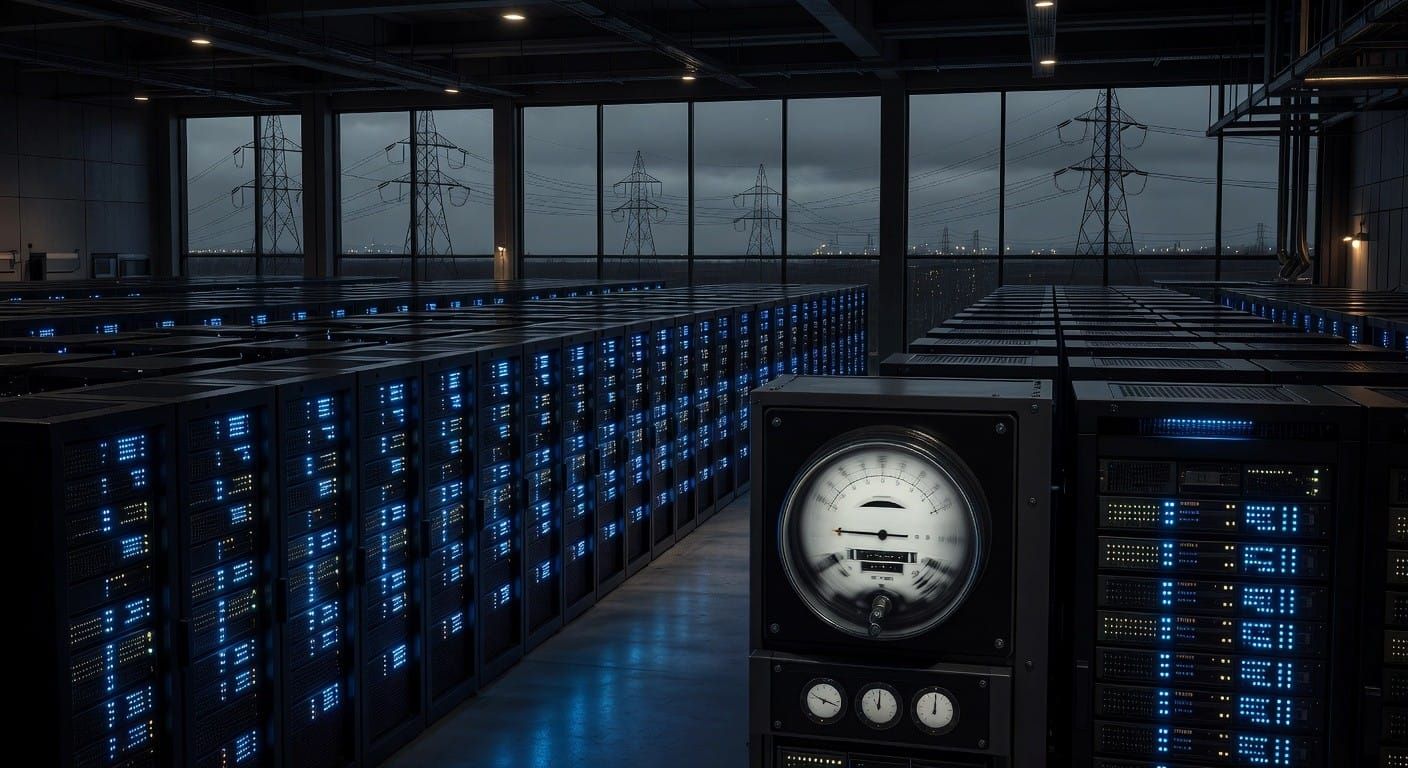
Your electricity bill went up again last month. You probably blamed inflation, or your utility, or the summer heat. But there's a new culprit on the grid — and it's growing faster than anything the American power system has seen since the postwar industrial boom.
AI data centers are devouring electricity at a pace that is rewriting the economics of American energy. And ordinary ratepayers are picking up the tab.
The Numbers Are Staggering
U.S. power consumption is set to hit a record 4,244 billion kilowatt-hours in 2026, according to the Energy Information Administration. Data centers — driven overwhelmingly by AI training and inference workloads — now account for 4.4% of all U.S. electricity consumption, more than double the 1.9% share they held in 2018. By 2028, that figure could reach 12%.
Globally, data center electricity use surged 17% in 2025 alone, reaching approximately 485 terawatt-hours. The International Energy Agency projects that figure will nearly double to 950 TWh by 2030 — roughly equivalent to Japan's entire electricity consumption.
A single frontier AI model training run could require 5 gigawatts of power by 2027. To put that in perspective, that's enough to power about 3.7 million homes.
The Bill Is Coming Due — For You
The infrastructure bill for this buildout isn't landing on Big Tech's balance sheet. It's landing on yours.
In the PJM Interconnection territory — the grid operator serving 65 million people across 13 states and Washington, D.C. — wholesale electricity costs have surged up to 267% over the past five years. In Northern Virginia's "Data Center Alley," where the world's densest concentration of hyperscale facilities operates, household electricity bills have jumped from roughly $100 to $281 per month in some areas.
Nationally, residential electricity prices rose 7.1% in 2025 — double the rate of overall inflation. Utilities requested over $29 billion in rate increases that year to fund grid expansions, new transmission lines, and transformer upgrades that the AI buildout demands. Those costs are socialized across all ratepayers.
A hyperscale data center consumes as much electricity as 100,000 homes. When a utility approves a new one, it's the existing customer base that funds the transmission upgrades, the substation expansions, and the peaker plants needed to keep the lights on for everyone else.
Low-income and disadvantaged communities are hit hardest. They spend a larger share of income on utilities and have the fewest options to offset rising costs with rooftop solar or efficiency upgrades.
The $600 Billion Buildout No One Voted For
Microsoft, Google, Amazon, and Meta have collectively committed over $600 billion in capital expenditure for 2026 alone — the vast majority targeted at AI infrastructure. They are building data centers at a pace that outstrips the grid's ability to connect them.
Nearly half of all planned U.S. data centers for 2026 are delayed or canceled because the grid simply cannot deliver power fast enough. Connection queues have ballooned. PJM's CEO warned in May 2026 that the entire grid architecture needs a fundamental redesign to cope.
The mismatch is structural: a data center can be built in 18 to 24 months. A new transmission line takes 7 to 10 years to permit, approve, and construct. A new power plant, depending on type, takes 5 to 15 years.
The result is a system under extreme stress. In 2024, 60 data centers in Northern Virginia disconnected simultaneously, creating cascading grid instability. Tech firms are now building what insiders call "shadow grids" — private power plants, fuel cells, and "energy islands" designed to bypass the public grid entirely.
The Political Backlash Is Building
The political response is accelerating. Representative Mike Levin introduced federal legislation to block data centers from driving up consumer electricity prices. States from Virginia to California are scrutinizing the tax incentives and subsidies that lured data centers in the first place.
In January 2026, Microsoft pledged to fully cover the power costs of its data centers and reject local tax breaks — a direct response to a growing ratepayer revolt. But one company's pledge doesn't fix a systemic problem.
CalMatters reported in March 2026 that California's Little Hoover Commission launched a formal investigation into data center electricity impacts. Pennsylvania's Spotlight PA documented similar concerns as data center clusters proliferate across the state's cheaper power zones.
The fundamental question emerging in state capitols and utility commission hearings: Should 65 million ratepayers subsidize infrastructure that primarily benefits a handful of trillion-dollar corporations?
What Comes Next
The optimists point to efficiency gains. Newer chips use less power per computation. AI itself can optimize grid management, shifting loads to off-peak hours. On-site renewables, battery storage, and nuclear power agreements — Microsoft's deal to restart Three Mile Island Unit 1, Google's partnerships with small modular reactor startups — could eventually reduce grid dependence.
But "eventually" is doing a lot of work in that sentence. The demand is here now. The solutions are years away.
The EIA forecasts record power consumption continuing through 2027. PJM projects peak supply shortfalls by 2028, with demand reaching 175 gigawatts by 2033. Without massive grid investment — and a political consensus on who pays for it — the strain will only intensify.
The AI revolution is real. Its benefits may prove transformative. But the electricity to power it has to come from somewhere, and right now, the answer is: from the same aging grid that keeps your lights on, your hospital running, and your factory operating. Every megawatt diverted to train the next language model is a megawatt that the rest of the economy has to compete for.
The AI boom's first casualty isn't jobs or privacy. It's your power bill.
Get this level of intelligence every day. Subscribe to AlphaBriefing — free, member, and paid tiers available.
Sources & Further Reading
- Reuters — U.S. Power Use to Beat Record Highs in 2026, 2027 as AI Use Surges
- IEA — Key Questions on Energy and AI
- CNBC — AI Data Centers, Electricity Prices, and Ratepayer Backlash
- Consumer Reports — AI Data Centers' Impact on Electric Bills, Water, and More
- Brookings — Global Energy Demands Within the AI Regulatory Landscape
- EESI — Data Center Power Demands Are Contributing to Higher Energy Bills
- Spotlight PA — Data Centers, Electricity Prices Rising
- Fortune — U.S. Data Center Electricity Demand and Public Opinion
Disclaimer
AlphaBriefing is an independent intelligence publication. The content in this article is produced for informational and educational purposes only. Nothing published by AlphaBriefing constitutes financial, investment, legal, tax, or regulatory advice, nor should it be construed as a solicitation or recommendation to buy, sell, or hold any security, asset, or financial instrument.
All views expressed are those of the author at the time of writing and are subject to change without notice. Markets are volatile and unpredictable; past performance is not indicative of future results. Any investment involves risk, including the possible loss of principal.
AlphaBriefing and its principals, employees, or contributors may hold positions in securities or assets mentioned in this article. This should be considered a potential conflict of interest. No material relationship with any company referenced exists unless explicitly disclosed. Readers should conduct their own due diligence and consult qualified financial, legal, and tax advisors before making any investment decisions.
Information in this article is drawn from public sources believed to be reliable at the time of publication. AlphaBriefing makes no warranty, express or implied, as to the accuracy, completeness, or timeliness of any information herein. AlphaBriefing accepts no liability for any loss or damage arising from reliance on this content.
© AlphaBriefing. All rights reserved. Unauthorized reproduction or distribution is prohibited.