The Internet Runs on 600 Cables. Almost Anyone Can Cut Them.
A handful of state-sponsored sabotage incidents have exposed the most under-protected piece of critical infrastructure in the world — and a small cluster of public companies now own the only fix.

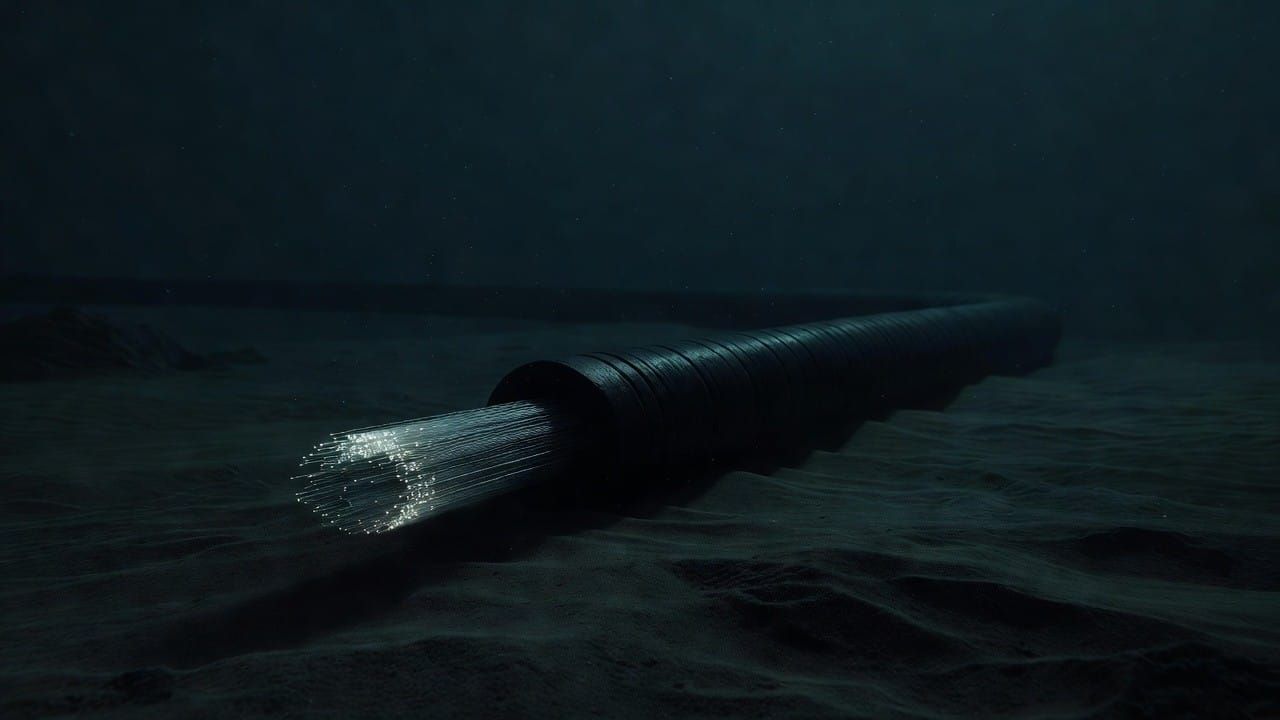
On the day after Christmas 2024, the crew of a battered oil tanker called the Eagle S — registered in the Cook Islands, owned through a shell company in the United Arab Emirates, suspected of carrying Russian crude — dropped its anchor in the Gulf of Finland and dragged it for nearly 100 kilometers along the seabed. By the time Finnish authorities boarded the vessel by helicopter, the anchor had severed one high-voltage power cable linking Finland to Estonia and four data cables carrying internet traffic between the Baltic states. Estonian electricity prices spiked. Finnish authorities described the ship as part of Russia's "shadow fleet." Four people were eventually referred for prosecution.
The Eagle S incident was not isolated. Roughly ten Baltic Sea cables have been cut since 2022, with seven of those between November 2024 and January 2025 alone. In late 2024, the Chinese-flagged Yi Peng 3 dragged its anchor 300 kilometers across two cables connecting Sweden and Lithuania. In the South China Sea, Taiwan's Matsu Islands have lost connectivity more than 20 times in five years — including a 50-day blackout in 2023 that left 13,000 residents isolated. In September 2025, multiple cables were severed near Jeddah in the Red Sea, degrading internet traffic across Pakistan, India, and East Africa.
The world runs on roughly 600 submarine cables carrying more than 95 percent of all intercontinental data — every transatlantic bank transfer, every Pentagon command, every cloud query, every Netflix stream. They are usually no thicker than a garden hose. They sit, largely undefended, on the open seabed. And as multiple state actors have now demonstrated, anyone with a freighter and an anchor can take one out and disappear into international waters before attribution becomes possible.
This is the most asymmetric vulnerability in modern infrastructure, and the markets have only just started to price it.
The Architecture of the Vulnerability
The submarine cable system was built for a peaceful world. Most of the 1.4 million kilometers of cable laid on the global seabed were installed by commercial telecoms consortia between 2000 and 2020 under one operating assumption: that nation-states would not deliberately attack each other's communications infrastructure in peacetime.
That assumption is now dead.
The vulnerability is geometric. The deep-water segments are nearly impossible to reach without specialized equipment, but the chokepoints — the Baltic, the Red Sea, the Taiwan Strait, the English Channel, the Strait of Malacca — are shallow, congested, and trivially accessible to any commercial vessel. A modern anchor dropped at the right coordinates can sever a cable in seconds. The damage is real, but the deniability is near-total: was it sabotage, or an "accident" by a captain who claims he didn't know the cable was there?
The repair side of the equation is worse than most investors realize. Just 60 specialized cable repair vessels exist worldwide to service 600+ active systems. Only five companies own seven or more cable ships. Repair queues already stretch into months when multiple outages stack up. A coordinated attack on three or four major systems simultaneously would create restoration timelines measured in quarters, not weeks.
And the manufacturing capacity is concentrated in a way the energy and bandwidth markets have not yet absorbed. Two companies — France's Alcatel Submarine Networks (ASN) and Cerberus-owned SubCom — built roughly 53 percent of all new subsea systems from 2020 to 2024. China's HMN Tech, which built about 10 percent of new kilometers laid through 2023, has been pushed out by Western export restrictions; its share of systems planned through 2026 has collapsed to 4 percent. The supply of new cable capacity is now bottlenecked through a handful of Western names, and demand is exploding from two directions at once — hyperscaler AI data center buildouts, and offshore wind power transmission.
What Governments Are Finally Doing
The policy response is real and accelerating. In January 2025, NATO Secretary General Mark Rutte launched Baltic Sentry — a permanent mission deploying frigates, maritime patrol aircraft, AI-driven monitoring, and at least 20 uncrewed surface vessels to track suspicious shipping and protect Baltic critical infrastructure. The EU has rolled out a Cable Security Action Plan. The UK has announced the construction of dedicated cable surveillance vessels. Taiwan is contracting Eutelsat OneWeb, SES, and US-based Astranis as satellite backup, and the Taiwan Space Agency plans to launch six dedicated satellites starting in 2026 at a cost of $1.23 billion.
The defense rationale has finally caught up with the commercial one. NATO planners now treat undersea cables and pipelines as a tier-one protected asset class — same category as airports and power plants. That reclassification is what triggers the capital flows.
The combination is unusual: a real and rising threat, a structurally bottlenecked supply chain, an offshore wind boom layered on top of a defense-driven security boom, and a market that still discounts most of the relevant names as boring industrial-cable plays.
This is where the analysis gets actionable. AlphaBriefing members get the full investment framework — scenarios, positioning, and the bottom line.
Subscribe to AlphaBriefing — Free, Member, and Paid tiers available.