The Cybertruck Is Dead. Tesla Just Raised the Price Anyway.
Tesla will end Cybertruck production in mid-2027 after selling roughly a tenth of what the line was built for. The wind-down — and the 32% price jump that followed — says more about where Tesla is going than any earnings call.

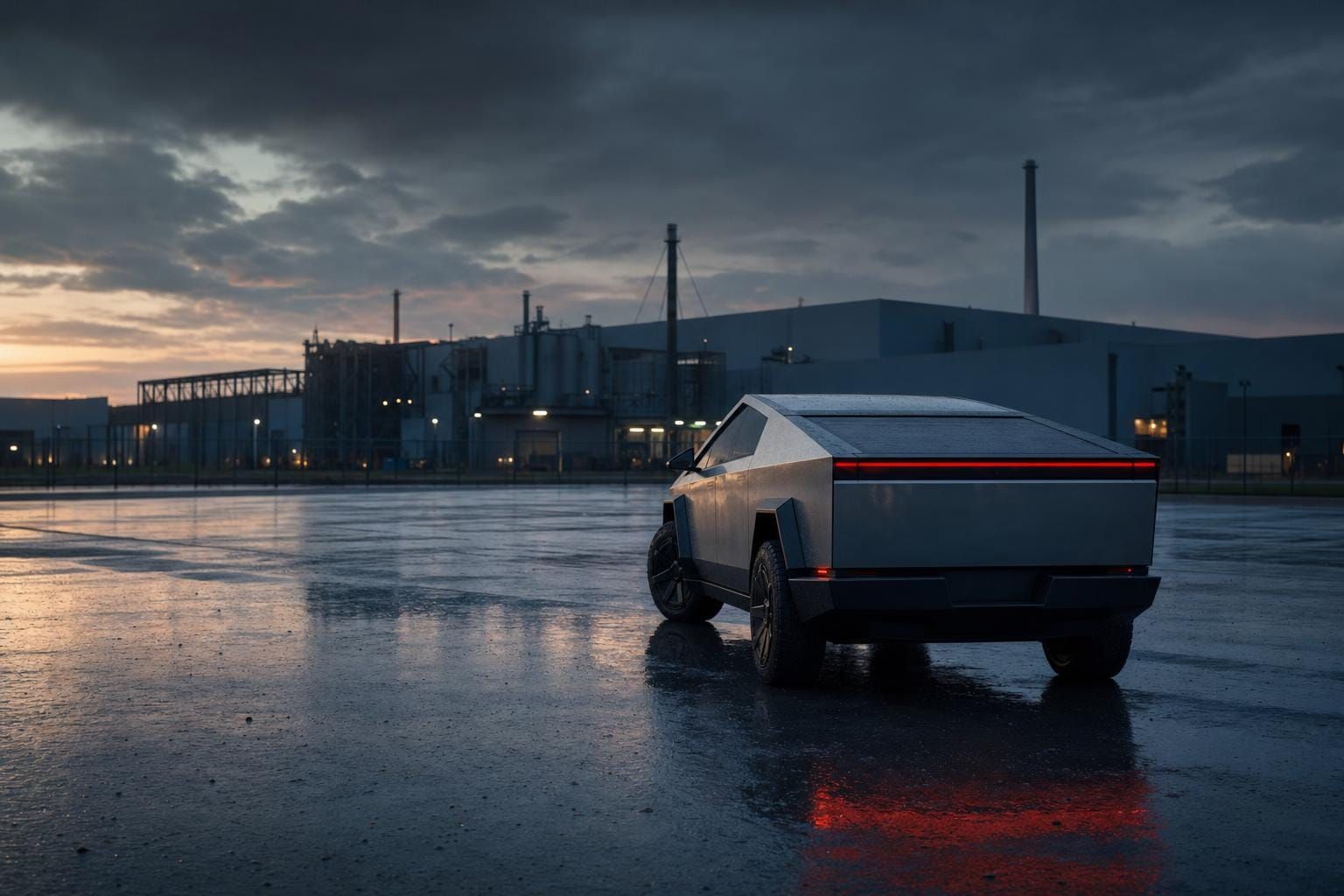
On Friday morning, Elon Musk ended the most hyped vehicle program of the decade in a single sentence. "Tesla will be winding down production of the Cybertruck at Gigafactory Texas around the middle of next year to make room for increased Cybercab production," he posted on X on November 6. That was the entire announcement. No blog post, no investor letter, no word on what happens to parts and service for the people who bought one.
Roughly three and a half years after the first deliveries, the angular stainless-steel pickup that was supposed to sell 250,000 units a year is being quietly retired at about a tenth of that pace. And in the 48 hours since, Tesla's own moves have told the real story better than the official one: the company stopped taking orders for the cheapest version and raised prices on everything else by up to $7,500.
Here is what actually happened — and what the wind-down says about the company Tesla is becoming.
The numbers that killed it
Tesla stopped breaking out Cybertruck deliveries almost immediately after launch, folding them into an "Other Models" bucket alongside the Model S, Model X, and the Semi. But the trajectory is visible anyway, and it is brutal.
According to sales figures compiled by Car and Driver, Tesla sold 38,965 Cybertrucks in the United States in 2024 — the truck's first full year. In 2025, that fell to 20,237. Through the first three quarters of 2026, it is just 11,586. Quarterly Cox Automotive estimates cited by Electrek show the same slope: from 14,416 U.S. sales in Q3 2024 to 3,519 in Q1 2026 and 3,744 in Q2.
In the third quarter of 2026, Tesla's entire "Other Models" category delivered 8,295 vehicles globally — down 48% year over year and the lowest for that bucket since Q2 2021. With Model S and Model X production already ended this past April, Electrek estimates 7,000 to 8,000 of those were Cybertrucks. That is an annualized pace of roughly 30,000 trucks, against a production line Tesla says has more than 125,000 units of installed capacity and was originally planned for 250,000.
Even those weak numbers flattered the truck. S&P Global Mobility registration data reported by Electrek showed that SpaceX bought 1,279 Cybertrucks in Q4 2025, and Musk-affiliated companies took 1,339 in total — about 19% of U.S. Cybertruck registrations that quarter. A meaningful slice of the Cybertruck's remaining demand was Musk's own companies buying Musk's own truck.
Briefings like this are free to read with a free AlphaBriefing membership. Join free →
From a $39,900 promise to a $92,490 exit
When Musk unveiled the Cybertruck in November 2019 — the event where the "unbreakable" window famously cracked on stage — the promised starting price was $39,900. The production truck that arrived in late 2023 never came anywhere near that number, and the pricing history since reads like a company that never figured out who the vehicle was for.
In February 2026, Tesla offered a dual-motor version at $59,990 for "only the next 10 days," then pulled it. A cheaper single-motor rear-wheel-drive trim was discontinued after 173 sales — not 173,000; one hundred seventy-three. In August, Tesla raised prices by $5,000 on its two main trims. Then came Friday's announcement — and almost immediately, Tesla's configurator showed another round of increases: the Premium AWD jumped from $84,990 to $92,490, the top-end Cyberbeast from $99,990 to $102,490, and the base Dual Motor trim was repriced to $82,490 — and simultaneously grayed out, no longer orderable at all.
The cheapest Cybertruck an American can actually order today costs $92,490. In early August, it was $69,990. That is a 32% increase in about ten weeks, applied to a vehicle the company just declared terminal.
This is what a wind-down looks like in practice. Once production has an end date, volume stops mattering; what is left is a fixed number of build slots, a parts inventory to burn down, and a pool of buyers who want one before they are gone. Tesla is pushing those buyers into the highest-margin configurations it has left. It is rational — and it is also a quiet admission that the demand problem was never going to be solved.
The international story ended even earlier. The Cybertruck was never engineered for sale in Europe or most right-hand-drive markets, and just two weeks before Friday's announcement, Tesla formally canceled the truck in Australia and New Zealand, refunding deposits some customers had held for seven years.
"Making room" in a factory that is mostly empty
The official rationale — clearing space for the Cybercab, Tesla's purpose-built robotaxi — deserves scrutiny, because the math does not obviously support it.
Gigafactory Texas spans more than 10 million square feet by Tesla's own count. The Cybertruck line is running at roughly a quarter of its installed capacity, and the Cybercab is built on its own separate line using Tesla's "unboxed" assembly process. As of late October, Electrek reported only 463 Cybercabs registered in Texas. Whatever constraint the Cybercab program faces as it scales, factory floor space in Austin is not an obvious one today.
What the explanation does accomplish is narrative. It frames the retirement of a commercial failure as a reallocation toward the future — the same framing Tesla used in April, when it ended Model S and Model X production and handed their Fremont floor space to the Optimus robot program.
Strip the framing away and the pattern underneath is consistent, and genuinely important for anyone who owns the stock: Tesla is systematically shutting down low-volume human-driven vehicle programs and reallocating capital toward autonomy and robotics. The Cybertruck is the third nameplate retired this year. That is not a product decision anymore. It is a strategy.
What it means
For the roughly 71,000 Americans who bought a Cybertruck, the practical questions — parts availability, service commitments, resale values for a discontinued vehicle with a unique stainless-steel body and its own supply chain — remain unanswered. Musk's post did not address them, and Tesla has published nothing since.
For the market, the announcement landed in an already turbulent week. Tesla shares closed Friday at $358.22, up 4.2% on the day — but down about 10% for the week, caught in a broad repricing of AI-adjacent names. Investors largely shrugged at the truck's death, and that is itself the tell: the market stopped valuing Tesla as a truck maker long ago. The stock now trades almost entirely on the autonomy bet the Cybertruck's factory space is being handed to.
The Cybertruck will likely be remembered as one of the most effective marketing events and least effective products in automotive history: a vehicle that generated years of attention, delivered real engineering — steer-by-wire and rear-wheel steering in a production pickup remain genuine firsts — and still missed its own sales plan by roughly 90%. Tesla built a quarter-million-truck factory for a $75,000-plus vehicle that could not legally be sold in most of the world. The wind-down was not a surprise. The only surprise is that it took a post on X to make it official.
If this analysis was useful, this is what AlphaBriefing does every day — geopolitics and markets, connected to what it means for your money. A free membership gets you access to every free article on AlphaBriefing.com; paid members get the investment frameworks, scenario pricing, and catalyst calendars behind the paywall.
Sign up free → — upgrade whenever it earns it.
Get this level of intelligence every day. Subscribe to AlphaBriefing — free, member, and paid tiers available.
Sources & Further Reading
- Elon Musk — Cybertruck wind-down announcement on X (November 6, 2026)
- Electrek — Tesla to end Cybertruck production as sales stall at ~10% of plan
- Electrek — Tesla hikes Cybertruck prices up to 10% after announcing it will kill production
- Car and Driver — RIP: Tesla Cybertruck Production Ends Next Year
- Ars Technica — The Cybertruck is dead; makes way for Cybercab, says Elon Musk
- Electrek — Tesla cancels Cybertruck in Australia and NZ after 7 years of deposits
- Electrek — Tesla's Cybertruck sales still unimpressive despite cheaper model
Disclaimer
AlphaBriefing is an independent intelligence publication. The content in this article is produced for informational and educational purposes only. Nothing published by AlphaBriefing constitutes financial, investment, legal, tax, or regulatory advice, nor should it be construed as a solicitation or recommendation to buy, sell, or hold any security, asset, or financial instrument.
All views expressed are those of the author at the time of writing and are subject to change without notice. Markets are volatile and unpredictable; past performance is not indicative of future results. Any investment involves risk, including the possible loss of principal.
AlphaBriefing and its principals, employees, or contributors may hold positions in securities or assets mentioned in this article. This should be considered a potential conflict of interest. No material relationship with any company referenced exists unless explicitly disclosed. Readers should conduct their own due diligence and consult qualified financial, legal, and tax advisors before making any investment decisions.
Information in this article is drawn from public sources believed to be reliable at the time of publication. AlphaBriefing makes no warranty, express or implied, as to the accuracy, completeness, or timeliness of any information herein. AlphaBriefing accepts no liability for any loss or damage arising from reliance on this content.
© AlphaBriefing. All rights reserved. Unauthorised reproduction or distribution is prohibited.