The AI Buildout Is Short 130,000 Electricians
The bottleneck in the AI boom isn't chips or capital — it's a 130,000-electrician gap inside a workforce losing 20,000 of them a year to retirement. Here's who gets paid when the constraint is people.

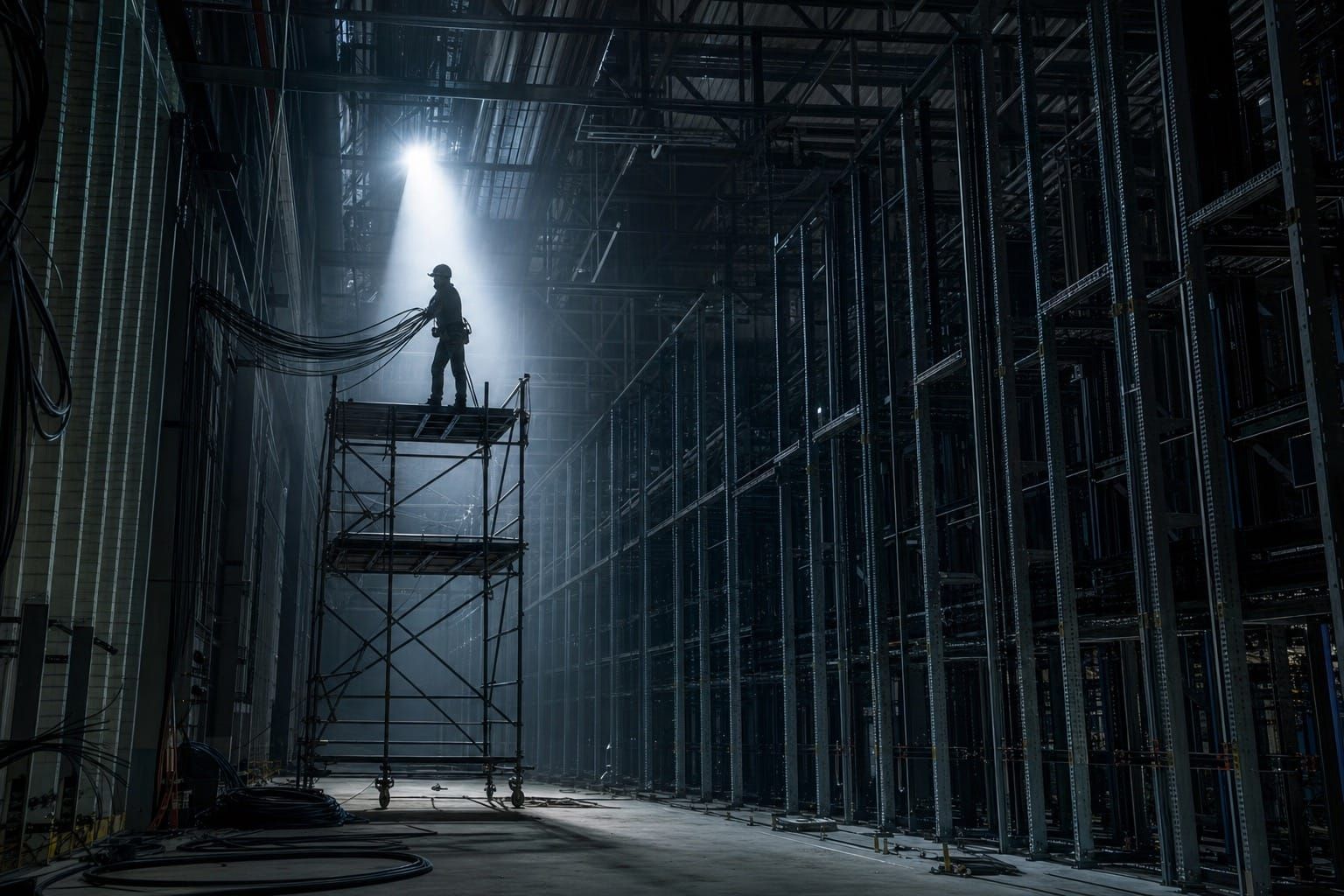
The bottleneck in the artificial intelligence boom is not chips. It is not capital. It is the person standing on a ladder in a half-built warehouse in rural Virginia, pulling cable.
Every forecast for the AI era assumes the data centers get built. The capital is committed — McKinsey estimates cumulative data-center investment could reach $6.7 trillion globally by 2030 to meet AI-driven demand. The chips are being fabricated. The power deals are being signed. But a single hyperscale data center can require up to 1,500 workers at peak construction, and the trades those projects depend on most — electricians above all — are running out of people faster than the industry can replace them.
The numbers are not subtle. The Bureau of Labor Statistics put the median annual wage for electricians at $63,190 as of May 2025, with employment projected to grow 9 percent through 2035 — much faster than the average occupation — and roughly 72,700 openings every year over the decade. That sounds like supply catching demand. It isn't. The National Electrical Contractors Association has estimated that more electricians leave the trade each year than enter it, and the demographics are brutal: Fortune, citing the International Brotherhood of Electrical Workers, reports that nearly 30 percent of union electricians are between 50 and 70, with about 20,000 retiring every year — roughly 200,000 over the coming decade.
Layer the AI buildout on top of a workforce that is already aging out, and the gap becomes structural. McKinsey has estimated the United States will need an additional 130,000 electricians, 240,000 construction laborers, and 150,000 construction supervisors between 2023 and 2030 to meet demand — a shortfall driven in large part by the race to power AI. Associated Builders and Contractors, using its own model, calculated that the construction industry needs to attract roughly 349,000 net new workers in 2026 alone, and about 456,000 in 2027. Those are not pandemic-era anomalies. They are the baseline.
Briefings like this are free to read with a free AlphaBriefing membership. Join free →
The Trade That Became a Chokepoint
For a decade, the cultural script told American teenagers that the path to a stable life ran through a four-year degree and a desk. The trades were what you did if that path failed. The AI boom has quietly inverted that logic.
Consider the economics now facing a 22-year-old. Fortune profiled an IBEW apprentice in Newport News, Virginia, who started earning about $42,000 in his first year while taking classes two nights a week, and expected to make around $71,000 as a newly minted journeyman — no tuition debt, no four years of deferred income. Meanwhile, entry-level white-collar hiring has softened as companies rethink headcount in the wake of AI adoption. The relative math has shifted enough that Gen Z is reconsidering a job it was told not to want.
That cultural shift is real, but it is nowhere near fast enough. An apprenticeship takes years to produce a licensed journeyman; a data center takes 18 to 24 months to build and the hyperscalers want hundreds of them. The IBEW has described the staffing problem for the likes of Amazon, Meta, and Microsoft in near-existential terms. You cannot microwave a skilled electrician. The pipeline that feeds the AI economy's physical layer was designed for a slower world, and it cannot be accelerated by writing a bigger check — which is precisely why this is a market story, not just a labor one.
The uncomfortable truth for every investor long the AI trade is this: the schedule risk on a $6.7 trillion buildout increasingly lives in a labor market that no spreadsheet modeled. When the constraint on growth stops being silicon and starts being headcount, the companies that own the headcount — or the equipment that lets you build with less of it — stop being boring industrials and start being the trade.
So the question is not whether the shortage is real. The data settles that. The question is who gets paid when the bottleneck is people.
The rest of this briefing is free — it just requires a free AlphaBriefing account: the specific contractors whose backlogs are already repricing on this shortage, the equipment names that monetize "build with fewer hands," and the one labor-market signal that tells you when the bottleneck is actually binding.
Create your free account → — 30 seconds, no card.