Starship Works. Now Comes the Catch.
SpaceX put 26 Starlink satellites in orbit and its booster in the Gulf on the same evening. This afternoon it tries to catch a spaceship returning from orbit — with a $1.9 trillion market cap and a 5% float watching.

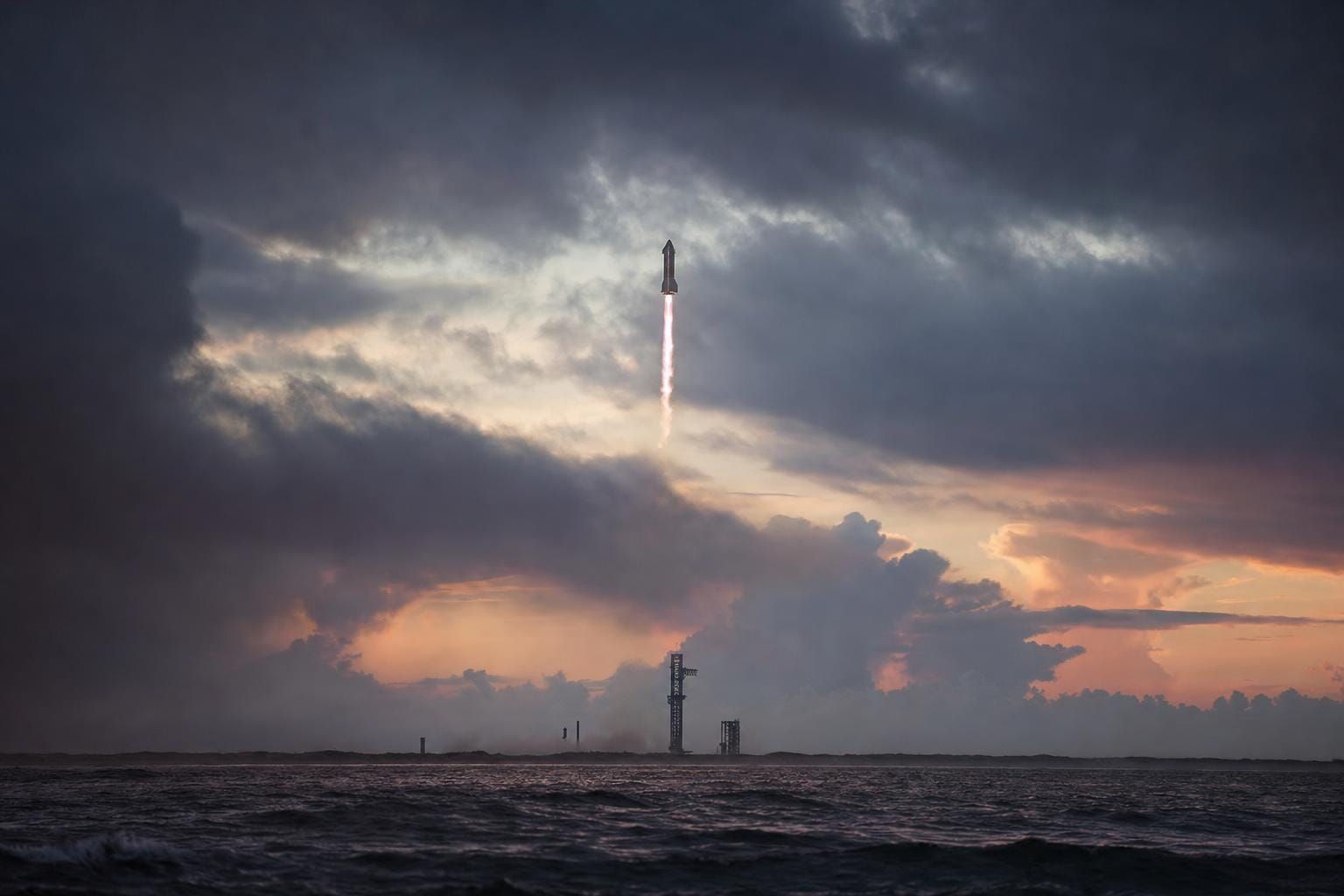
SpaceX launched the fifteenth flight of Starship from Starbase, Texas, at 5:47 p.m. Eastern on Friday evening. By the time most of Wall Street had closed its laptops, SpaceX's two-stage giant had split into its halves and written two very different headlines. The Super Heavy booster, which was supposed to fly back to the launch tower and be caught out of the air by a pair of mechanical arms, instead diverted offshore and came down in the Gulf. The upper stage — Ship 42, with "Don't Panic" painted on its side — reached orbit and released 26 Starlink V3 satellites.
The second act comes this afternoon. At approximately 4:17 p.m. Eastern on Saturday, after 14 orbits and roughly 22 hours in space, Ship 42 is scheduled to return to Starbase and attempt something no spacecraft has ever done: fly back from orbit and be caught by the launch tower it left from.
For most of Starship's history, this was an engineering story. It is now also a market story. SpaceX has been a public company since June 12, when it listed on Nasdaq under the ticker SPCX in the largest IPO in history, at a $1.77 trillion valuation. The stock closed Friday at $139.11 — about 3% above its $135 offer price five months later — and slipped roughly 2% in after-hours trading as the booster news landed. What happens above the Texas coast this afternoon is, among other things, the most literal binary catalyst in public markets this weekend.
A Skyscraper in the Gulf
The booster miss matters more than the webcast made it look. SpaceX has caught Super Heavy boosters out of the sky before — three times, on Flights 5, 7, and 8 — but it had not attempted one since — Friday's was the first try in seven flights. It did not get the chance: according to SpaceX's Dan Huot, the booster was not in the correct position during its return, and the guidance system automatically diverted it to a Gulf splashdown. Why it was out of position is still under investigation.
That means the full promise of the vehicle — both stages flying home, ready to be stacked and flown again — remains undemonstrated at both ends. The ship catch attempt today is the half of that promise nobody has ever seen. SpaceX has been explicit that the attempt only proceeds if the vehicle passes a series of health checks on the way down; a wave-off to a water landing is a built-in option, not a failure mode improvised on the fly.
What is no longer in question is whether Starship can do its day job. Flight 14 in late September was the first to reach orbit. Flight 15 reached orbit carrying paying cargo — 26 of SpaceX's newest, largest Starlink satellites — and delivered it. The vehicle is now, functionally, a freight service whose packages are the growth engine of the company's own revenue line.
The Weekend Nobody in the Launch Business Sleeps
Starship is only half of this weekend's story. A few hundred miles east at Cape Canaveral, United Launch Alliance is attempting its own return: Vulcan, grounded since a booster anomaly in February, is scheduled to fly for the first time in nine months on Saturday after a Friday scrub caused by a power interruption at a nearby nitrogen plant. Its payload is 40 satellites for Amazon's Leo constellation — the broadband network formerly known as Kuiper, whose deployment schedule has been hostage to exactly this rocket.
In other words: within roughly 24 hours, the market will learn whether SpaceX can recover an orbital spaceship intact, and whether its only serious U.S. broadband rival can get back to orbit at all. Launch capacity — not spectrum, not demand — is the binding constraint on the entire low-Earth-orbit economy right now, and both constraints move this weekend.
Which leaves the question the free half of this briefing can pose but not answer: SpaceX now carries a $1.89 trillion market capitalization — sixth-largest in America — on $18.7 billion of 2025 revenue. What, precisely, is a caught spaceship worth to that multiple, and what happens to a 5% free float when the answer arrives?
A free membership gets you access to every free article at AlphaBriefing.com: Join AlphaBriefing
The rest of this briefing is for paid members: the S-1 math behind the $1.9 trillion valuation and what Starlink's $11.4 billion actually needs from Starship, the December lock-up calendar that matters more than tonight's video, the three catch scenarios with the zones from $104.83 to $225.64, and the read-throughs for Rocket Lab, AST SpaceMobile, and Amazon.
AlphaBriefing Paid gets you every investment thesis, scenario framework, and catalyst brief we publish — the analysis private intel clients pay four figures for, at a fraction of that.