The $60 Billion Insurgent: Inside Anduril's Bid to Become America's Next Defense Prime
Anduril just secured a $20 billion Army contract, opened a hyperscale weapons factory, and is building America's first mass-produced combat drone. At a $60 billion valuation, Palmer Luckey's company is no longer a startup — it's a direct threat to the defense establishment.
The defense industrial base is experiencing its most significant disruption since the Cold War. At the center of it stands Anduril Industries — an eight-year-old company founded by Palmer Luckey that just secured a $20 billion Army contract, opened a hyperscale weapons factory ahead of schedule, and is projecting $4.3 billion in revenue for 2026.
This is not a startup story anymore. This is the emergence of a new kind of defense prime.
From Oculus to Arsenal
Palmer Luckey made his first fortune inventing the Oculus Rift and selling it to Facebook for $2 billion. After a messy departure from Meta in 2017, he pivoted to something far more consequential: building the defense company that Silicon Valley's biggest investors had been waiting for.
Anduril's thesis was straightforward but radical in practice. The Pentagon's procurement system is broken — programs take decades, cost overruns are endemic, and the traditional primes (Lockheed Martin, Raytheon, Northrop Grumman, Boeing) have limited incentive to innovate when cost-plus contracts guarantee their margins regardless of efficiency.
Luckey's bet: build a software-first defense company that designs, manufactures, and deploys autonomous systems at commercial speed, using its own capital. Ship product first. Win contracts second.
It worked.
The $20 Billion Turning Point
On March 13, 2026, the U.S. Army awarded Anduril a 10-year enterprise contract valued at up to $20 billion — a firm-fixed-price deal covering software platforms, integrated hardware, data infrastructure, and support services. The contract consolidates over 120 prior procurements into a single streamlined vehicle.
The first task order: $87 million for counter-unmanned command-and-control capabilities. That's Pentagon-speak for building the brain that coordinates how the U.S. military detects, tracks, and destroys enemy drones.
This contract is significant for three reasons. First, it's the largest single award to a venture-backed defense technology company in U.S. history. Second, it's firm-fixed-price — meaning Anduril bears the cost risk, not taxpayers. That's the opposite of how legacy defense contracting works. Third, it treats Anduril as a platform, not a vendor. The Army isn't buying widgets. It's buying an operating system for autonomous warfare.
Lattice: The Software Moat
At the core of everything Anduril builds is Lattice — its AI-powered command-and-control platform. Think of it as the connective tissue between sensors, autonomous systems, human operators, and weapons.
Lattice ingests data from radars, cameras, satellites, and ground sensors, fuses it into a unified operational picture, and enables human commanders to task autonomous systems — drones, interceptors, electronic warfare assets — with minimal latency. It's the software layer that turns individual weapons into a coordinated kill chain.
This is Anduril's deepest competitive advantage. Hardware can be replicated. Manufacturing can be scaled. But a battle-tested software platform that already integrates with Joint and Army systems — and improves with every deployment — creates compounding returns that traditional defense primes struggle to match.
Lattice has been deployed operationally across U.S. Southern Command, Central Command, and Indo-Pacific Command. It's not theoretical. It's running in the field.
Arsenal-1: The Factory That Changes Everything
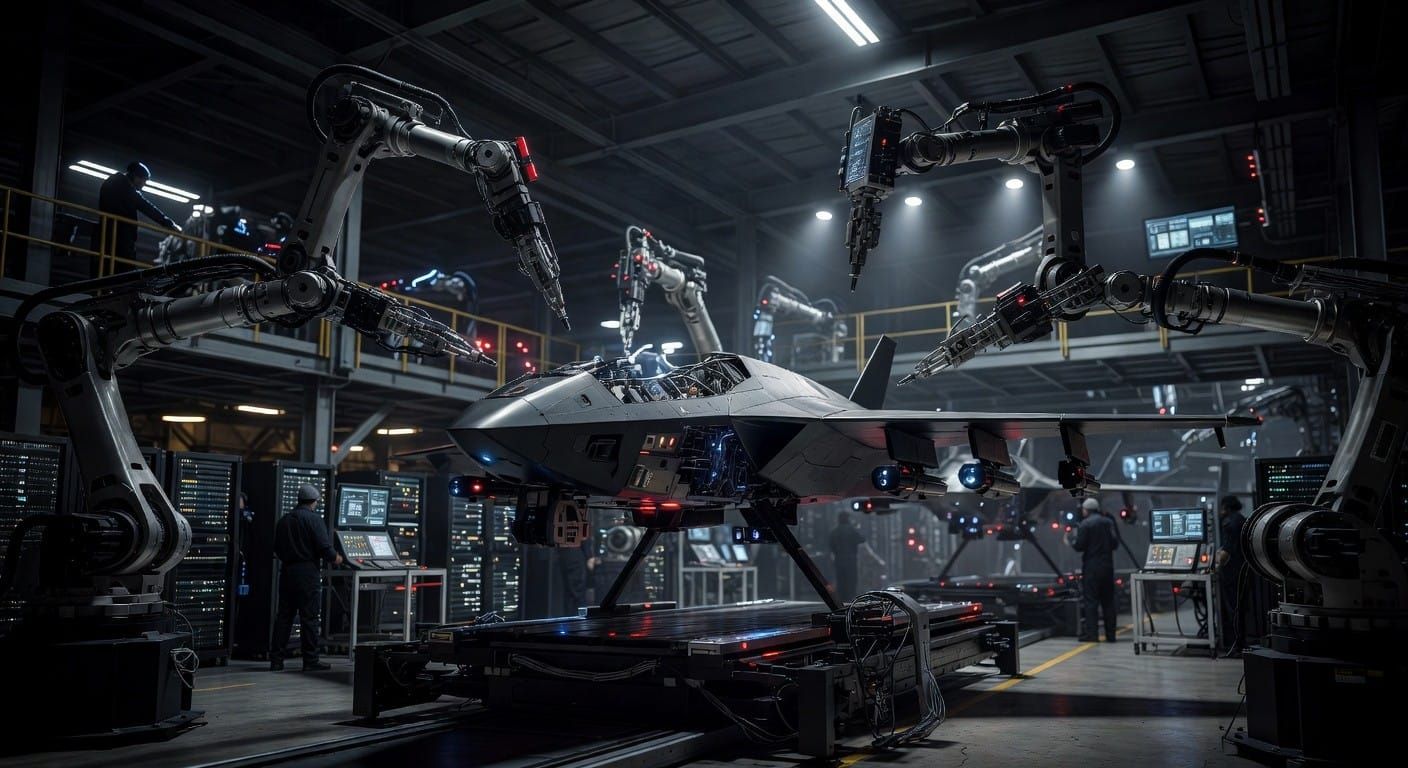
In late March 2026 — ahead of schedule and under budget — Anduril opened Building 1 of its Arsenal-1 manufacturing campus in Pickaway County, Ohio. The $1 billion facility spans 775,000 square feet of production space, with a second building (924,000+ sq ft) already under construction.
Arsenal-1 is designed to produce tens of thousands of autonomous systems annually on a single flexible production floor. The key innovation is Arsenal OS — a digital manufacturing platform that allows the same commercial machinery and production lines to be reconfigured in days or weeks to build entirely different weapons systems.
The first system rolling off the line: the YFQ-44A Fury.
The Fury: America's First Mass-Produced Combat Drone
The Fury is a jet-powered autonomous combat drone — a "loyal wingman" designed to fly alongside crewed fighters like the F-35 and F-22. It's Anduril's entry in the Air Force's Collaborative Combat Aircraft (CCA) program, one of the Pentagon's highest-priority modernization efforts.
Key specifications tell the story:
- Speed: Up to Mach 0.95
- Design-to-first-flight: 556 days from clean sheet
- Parts: ~5,000 total, 94% commercial off-the-shelf
- Weapons integration: Already tested with AIM-120 AMRAAM air-to-air missiles
- Autonomy: Runs on Lattice AI, with demonstrated integration of Shield AI's Hivemind software — including mid-flight autonomy handoffs
Production began in March 2026 at Arsenal-1. Initial rate: 50 units per year, scaling to 150. The Air Force's Experimental Operations Unit at Edwards AFB is already flying and maintaining the aircraft as of April 2026.
The CCA program envisions over 1,000 autonomous wingmen. At unit costs potentially below $20 million each — versus $80+ million for an F-35 — the economics are transformational.
This is where the analysis gets actionable. AlphaBriefing members get the full investment framework — scenarios, positioning, and the bottom line.
Subscribe to AlphaBriefing — Free, Member, and Paid tiers available.