The Quantum Countdown: Three Papers Just Moved Q-Day Forward by Years — and Billions Are at Stake
Three research breakthroughs in three months have compressed the timeline for quantum computers to break today's encryption. The hardware race and the post-quantum cryptography upgrade cycle are creating one of the most asymmetric investment opportunities of the decade.

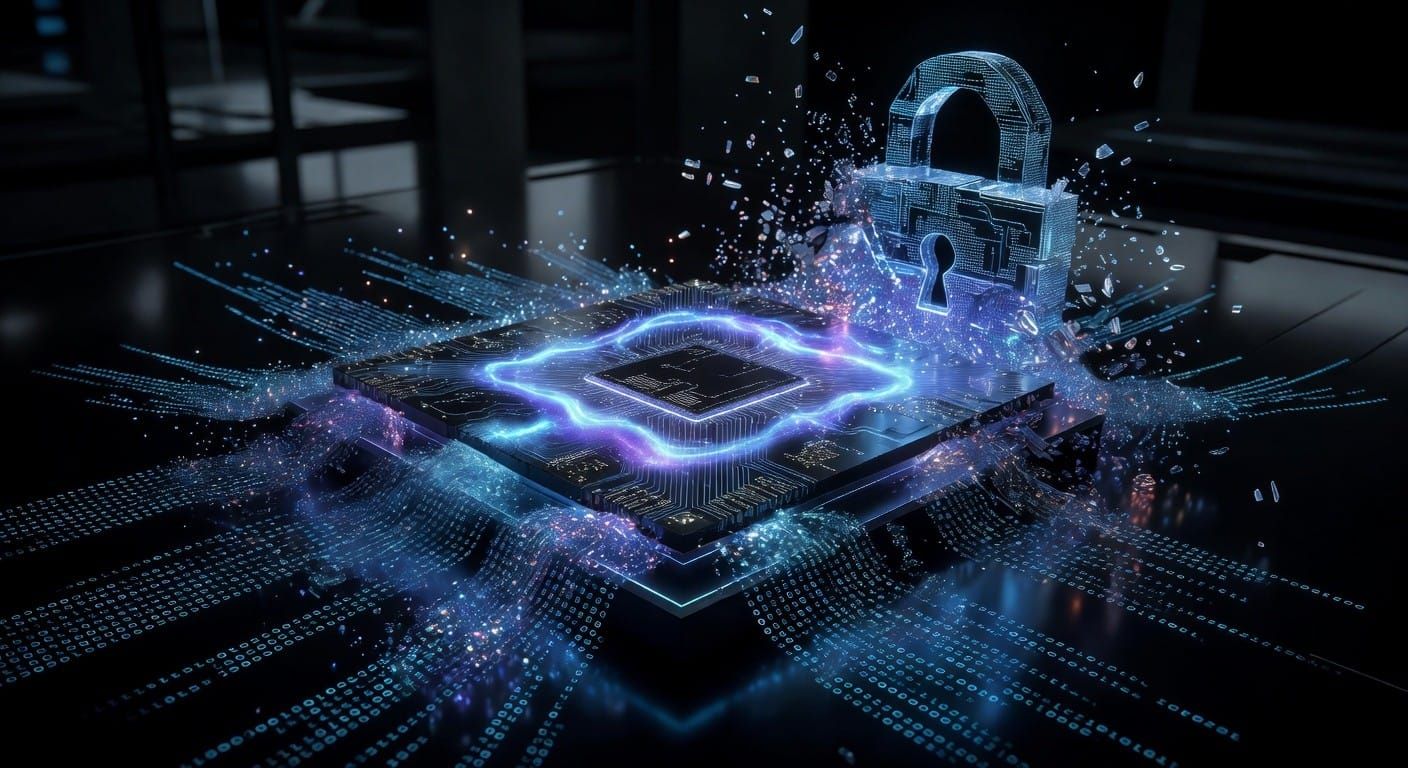
The quantum threat to global encryption just accelerated — dramatically. Three research papers published between January and March 2026 have slashed the estimated resources needed to break today's most widely used encryption standards, pushing the projected "Q-Day" — the moment a quantum computer can crack RSA-2048 and elliptic curve cryptography in real time — from the early 2030s to potentially 2029.
For investors, this isn't an abstract physics problem. It's a $2 billion market in 2026, projected to double to $3 billion by 2028 and potentially reach $50 billion by 2036. The companies building quantum hardware, and those racing to defend against it, represent one of the most asymmetric investment opportunities of the decade.
The Encryption Clock Is Ticking
The core threat is straightforward: Shor's algorithm, running on a sufficiently powerful quantum computer, can factor the large prime numbers that underpin RSA encryption and break the elliptic curve math behind ECC. These two systems secure virtually everything — banking transactions, military communications, medical records, government secrets, cryptocurrency wallets.
Until recently, the consensus held that breaking RSA-2048 would require roughly 20 million physical qubits — a threshold so distant that most organizations treated quantum threats as a 2035-and-beyond problem. That calculus changed in early 2026.
Three separate research teams published optimizations that dramatically reduce the qubit and runtime requirements for cryptanalysis. One paper halved the qubit requirements for attacking ECC. Another streamlined Shor's algorithm itself, making the entire attack chain more efficient. The combined effect: expert estimates for Q-Day moved forward by several years.
"The timeline compression is real," noted a February assessment from the Quantum Economic Development Consortium (QED-C). Their 2026 State of the Global Quantum Industry report projects the market doubling to $3 billion in revenue by 2028, driven largely by defense and national security applications.
"Harvest Now, Decrypt Later" — The Invisible Threat
The most immediate danger isn't a quantum computer cracking encryption in real time. It's what intelligence agencies and state-sponsored hackers are doing right now.
The strategy is called "Harvest Now, Decrypt Later" (HNDL). Nation-state actors — and the intelligence community broadly assumes China, Russia, and others are engaged — are vacuuming up vast quantities of encrypted data today. Government communications, corporate IP, financial transactions, health records. They store it, wait for quantum capabilities to mature, and then decrypt it retroactively.
This means data encrypted with RSA or ECC today has a shelf life. If the information retains strategic or commercial value in 2029–2032, it is effectively already compromised.
CISA issued federal buying guidance in January 2026 prioritizing post-quantum cryptography (PQC)-safe products. NIST's Cryptographic Module Validation Program will stop certifying non-PQC modules after September 21, 2026. The regulatory apparatus is moving — which means the compliance spending cycle is about to begin.
The Hardware Race: Who's Building the Quantum Future
The quantum computing hardware landscape has consolidated around a handful of publicly traded pure-plays and big tech giants, each pursuing different architectures.
IonQ (NYSE: IONQ) — the trapped-ion leader — reported 202% revenue growth in 2025 and guided for $225–245 million in 2026 revenue. Its backlog stands at $370 million. At $43.08 per share, the stock trades well below its consensus analyst target of $68, with a high-end estimate of $100. IonQ's approach — using individual atoms as qubits — offers high fidelity and connectivity, making it a favorite for enterprise and government customers.
D-Wave Quantum (NYSE: QBTS) — the quantum annealing pioneer — posted 179% revenue growth in 2025 and launched its Advantage2 system. At $18.08, analyst consensus targets $35.53 with a high of $45. D-Wave's annealing approach is already generating commercial revenue from optimization problems in logistics, manufacturing, and finance — making it arguably the most commercially mature quantum company.
Rigetti Computing (NASDAQ: RGTI) — pursuing superconducting gate-based quantum processors — trades at $16.47 against analyst targets averaging $30.64. Down over 60% from 2025 peaks, Rigetti represents the highest-risk, highest-reward pure-play, with its modular chip architecture positioning it for scale-up if error correction milestones are met.
Among big tech, Alphabet (GOOG) leads with its "Quantum Echoes" algorithm demonstrating verifiable quantum advantage. Microsoft (MSFT) has partnered with Atom Computing on neutral-atom systems and is integrating quantum into Azure. IBM continues pushing superconducting qubits with its Condor processor. NVIDIA (NVDA) and Amazon (AMZN) are building the classical-quantum hybrid infrastructure layer.
This is where the analysis gets actionable. AlphaBriefing members get the full investment framework — scenarios, positioning, and the bottom line.
Subscribe to AlphaBriefing — Free, Member, and Paid tiers available.