Stagflation Is Back. Here's Why Nobody's Talking About It.

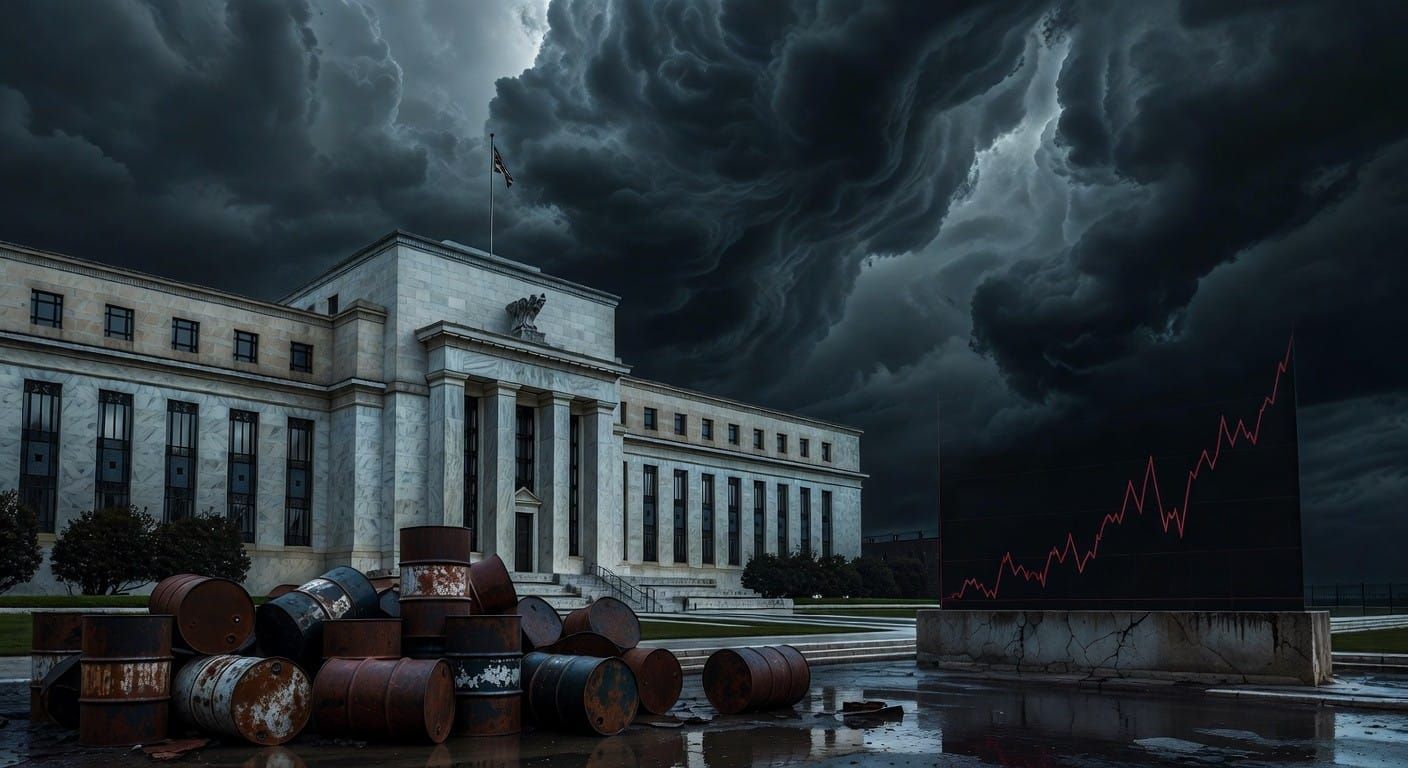
The US economy is walking into a trap that policymakers have spent 50 years trying to avoid. As of April 2026, the conditions for stagflation — that toxic combination of stagnant growth and persistent inflation — are quietly assembling. Oil is near $100 a barrel. Tariffs are adding a tax on nearly everything Americans buy. And tomorrow morning, the March CPI report lands. Nobody's ready for what it might say.
The Perfect Storm You Weren't Supposed to See Coming
It started on February 28, when US and Israeli forces launched strikes on Iranian military targets. Within days, the Strait of Hormuz — the narrow waterway through which roughly 20% of the world's oil and liquefied natural gas flows — was effectively closed. The shock was immediate: Brent crude surged from roughly $61 per barrel at the start of the year to a peak of $113 in early April.
A fragile ceasefire was announced on April 7. Oil prices dipped briefly. Then they climbed again — because almost nothing has actually changed. Iran has warned it will keep the Strait closed. Only a handful of vessels have transited since the deal was announced, against the pre-war average of 130 per day. Maritime tracking firm Windward estimates that even under a best-case scenario, "weeks are required to move stranded gas and oil cargoes, and months for global trade to approach pre-crisis levels."
The energy shock didn't arrive in a vacuum. It landed on top of an economy already running hot with structural inflation pressures — specifically, a tariff regime that has raised effective US import duties from roughly 2% pre-2025 to 11.1% today. Companies have been passing those costs through to consumers. CPI was already sitting at 2.4% YoY in February. The March reading, due tomorrow, is expected to jump sharply — some forecasts project a 1% month-over-month spike as the oil and tariff effects collide.
What Stagflation Actually Means — and Why It's So Hard to Fight
Stagflation is the policymaker's nightmare because the normal tools don't work. In a standard recession, you cut rates: growth returns, problem solved. In a standard inflation burst, you raise rates: demand cools, prices settle. Stagflation gives you both at once — sluggish growth and rising prices — and every tool that fixes one side makes the other worse.
The Federal Reserve is already paralyzed. Rate cuts would provide relief to a slowing economy but would pour fuel on inflation. Rate hikes would hammer prices but risk tipping the economy into outright recession. The Fed's preferred escape route — waiting for "transitory" forces to fade — becomes harder to justify when one of those forces (the Iran conflict) has no clear resolution timeline.
We're not talking about 1970s-style double-digit inflation and unemployment. What analysts are calling "stagflation lite" looks like this: GDP growth running below 2% trend, inflation stuck in the 2.5–3.5% range, a labor market that looks stable on the headline number but is softening underneath. Q4 2025 GDP came in at just 0.7% annualized. Full-year 2026 forecasts sit at 2.2% — and that was before the oil shock's full effects had time to compound through the supply chain.
The unemployment rate sits at 4.3%, down from 4.4% in February, with 178,000 jobs added in March. That sounds fine until you notice that labor force participation has been shrinking, masking underlying weakness. Goldman Sachs and Apollo have both flagged the risk of unemployment rising toward 4.8% by year-end if conditions deteriorate.
Three Forces Compressing the Economy Simultaneously
Force 1: The Energy Tax
Every dollar that oil prices rise functions as a tax on economic activity. It raises the cost of production for manufacturers, increases shipping and logistics costs, and hits consumers directly at the pump. UK drivers are already paying £13.86 more to fill a tank than before the war began. American consumers are seeing similar dynamics at the gas station. This is consumption dollars diverted away from discretionary spending and into energy — exactly the dynamic that preceded the 1973 and 1979 recessions.
Force 2: Tariffs as a Supply-Side Shock
Unlike demand-side inflation (which the Fed can address by cooling the economy), tariff inflation is structural and supply-driven. Raising rates doesn't make Chinese electronics cheaper. It just reduces the economic activity around them. At 11.1% effective tariff rates — up more than fivefold from 2024 levels — the US has essentially imposed a hidden consumption tax on a significant share of its imports. Companies that spent years optimizing supply chains for cost efficiency are now scrambling to absorb or pass on costs they can't restructure overnight.
Force 3: The Fed's Frozen Hand
Markets had priced in two or three rate cuts for 2026 heading into this year. Those are now deeply uncertain. With oil prices elevated, tariffs sticky, and CPI expected to spike, the Fed has almost no room to ease without being accused of fueling inflation. But holding rates high while growth slows and consumers are squeezed by energy and import costs is a recipe for prolonged stagnation. The Fed's credibility is at stake either way. PCE inflation forecasts for 2026 now sit at 2.7% or higher — well above the 2% target — and rising.
What the CPI Report Tomorrow Could Trigger
The March CPI data drops Friday morning, April 10. It will be the first comprehensive snapshot of price conditions since the Iran conflict began. If the headline number comes in significantly hotter than the 2.4% February reading — and most analysts expect it will — it creates a genuine policy crisis.
A sharp upside surprise tomorrow would:
- All but eliminate any near-term path to Fed rate cuts
- Signal that inflation is re-accelerating at the worst possible moment
- Validate the stagflation thesis across Wall Street and beyond
- Increase pressure on the administration over its combined energy and trade policy
Bond markets are already anxious. Equity markets have been whipsawing — a big relief rally Monday, reversals since. Volatility is the price of uncertainty, and right now there's genuine uncertainty across every major economic variable simultaneously.
The Historical Parallel Nobody Wants to Make
The 1973 oil shock — triggered by the Arab oil embargo — sent Brent prices from $3 to $12 per barrel in three months. It combined with existing inflation pressures and Nixon-era wage/price controls to produce a decade of stagnation that defined an era and ultimately cost multiple presidencies.
Today's shock is proportionally similar in magnitude (oil is up roughly 80% from its January level before settling back), though the economic structure is different. The US is a larger domestic energy producer than it was in 1973, which provides some buffer. But tariffs add a layer of structural inflation that has no 1970s parallel. In 1973, the Fed could theoretically fight inflation with rate hikes while waiting for the oil shock to pass. Today, fighting tariff-driven inflation with rate hikes just adds another headwind to growth.
The analogy isn't perfect. It doesn't need to be. The direction is what matters.
The Strait of Hormuz: The Variable Nobody Controls
Everything else — tariff policy, Fed decisions, fiscal stimulus — is knowable and manageable to a degree. The Strait of Hormuz is not. Right now it is partially open, partially closed, and entirely dependent on diplomatic negotiations that involve the US, Iran, Israel, and now Pakistan (where JD Vance is expected to meet Iranian negotiators Saturday).
If those talks fail, or if Israel launches further strikes on Lebanon that Iran interprets as ceasefire violations, the Strait could close again. That scenario sends oil back toward $120 or higher, reignites inflation expectations, and makes every forecast above meaningless.
If the talks succeed — a genuine, verified reopening of the Strait and a clear path for shipping to normalize — oil can fall back toward $80 or below, the energy shock fades, and inflation pressures ease materially over the following months.
The economic outlook for 2026, in other words, runs through a 21-mile-wide stretch of water between Iran and Oman.
What This Means for Investors
This isn't a moment to make confident bets on a single outcome. It's a moment to stress-test portfolios against multiple scenarios:
Scenario A — Ceasefire holds, Strait reopens: Oil corrects to $80–85, inflation pressures ease by Q3, Fed gains room to cut once in 2026. Growth recovers to trend. Risk assets recover; energy outperformers pull back.
Scenario B — Prolonged stalemate: Oil stays elevated at $90–100 through summer. Inflation reaccelerates. Fed holds or hikes. Growth slows toward 1.5%. Classic stagflation environment: commodities and real assets outperform; long-duration bonds and growth equities underperform.
Scenario C — Conflict restarts: Strait closes fully. Oil spikes past $120. Emergency Fed action, potential recession. Risk-off — cash, gold, short-duration credit.
Most portfolios are positioned for something between A and a mild B. Very few are hedged for C. That asymmetry matters.
The smart money right now is watching tomorrow's CPI print very closely. So should you.
Sources & Further Reading
- Fortune — Brent Crude hits $113 on Iran conflict
- Yale Budget Lab — Tracking Economic Effects of Tariffs
- BLS — March 2026 Jobs Report
- Fortune — Recession and Stagflation Risk, March 2026
- Bloomberg — US Inflation Seen Spiking in First Snapshot Since Iran War
- BEA — US GDP Data
- EIA — Energy Market Analysis
- AP News — Iran Ceasefire Live Updates
Disclaimer
AlphaBriefing is an independent intelligence publication. The content in this article is produced for informational and educational purposes only. Nothing published by AlphaBriefing constitutes financial, investment, legal, tax, or regulatory advice, nor should it be construed as a solicitation or recommendation to buy, sell, or hold any security, asset, or financial instrument.
All views expressed are those of the author at the time of writing and are subject to change without notice. Markets are volatile and unpredictable; past performance is not indicative of future results. Any investment involves risk, including the possible loss of principal.
AlphaBriefing and its principals, employees, or contributors may hold positions in securities or assets mentioned in this article. This should be considered a potential conflict of interest. No material relationship with any company referenced exists unless explicitly disclosed. Readers should conduct their own due diligence and consult qualified financial, legal, and tax advisors before making any investment decisions.
Information in this article is drawn from public sources believed to be reliable at the time of publication. AlphaBriefing makes no warranty, express or implied, as to the accuracy, completeness, or timeliness of any information herein. AlphaBriefing accepts no liability for any loss or damage arising from reliance on this content.
© AlphaBriefing. All rights reserved. Unauthorized reproduction or distribution is prohibited.
Get this level of intelligence every day. Subscribe to AlphaBriefing — free, member, and paid tiers available.