The Great Factory Migration: How Southeast Asia's Manufacturing Boom Is Reshaping Global Supply Chains — and Where to Invest
ASEAN manufacturing FDI hit $124 billion as U.S.-China tariffs force the biggest industrial migration in three decades. Vietnam and Indonesia are the epicenters — here's how to position.

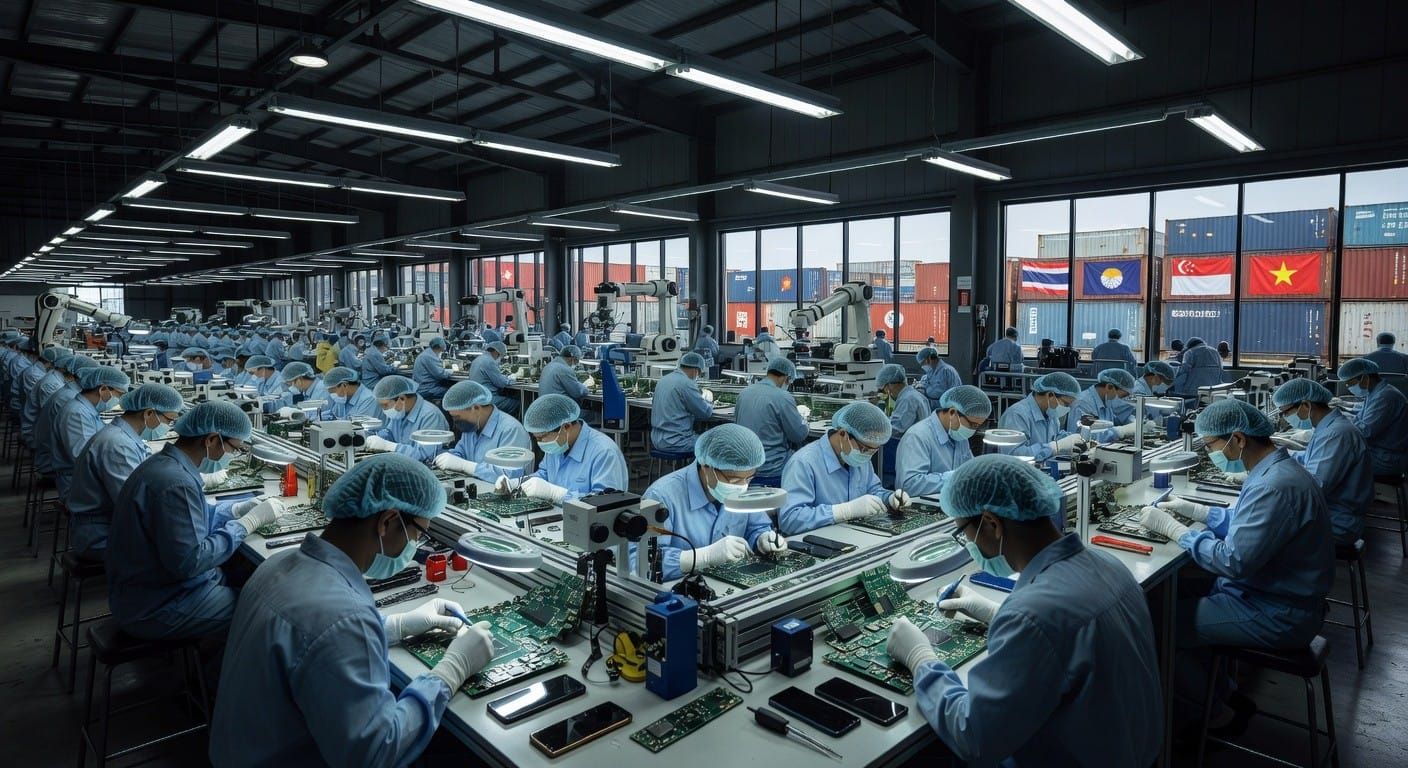
The biggest supply chain migration in modern history isn't happening in a boardroom. It's happening across factory floors from Ho Chi Minh City to Jakarta — and it's accelerating faster than most investors realize.
In Q1 2026 alone, Vietnam registered over $15.2 billion in new foreign direct investment, with manufacturing capturing 60.8% of the total — a 136% year-over-year surge in new project commitments. Samsung just announced a $4 billion phased investment for chip packaging in Thai Nguyen province. Foxconn's Vietnamese operations pumped out 39% more smartphones and 130% more laptops than the year prior. Apple's supplier footprint in the country has doubled in seven years.
This isn't gradual evolution. This is industrial migration at a pace the world hasn't seen since China's own rise in the 1990s.
And the catalyst is unmistakable: U.S. tariffs on Chinese goods have reached averages of 47.5%, bilateral U.S.-China trade has dropped 30%, and every multinational with exposure to Chinese manufacturing is scrambling for alternatives. The "China+1" strategy is no longer a hedge — it's a survival imperative.
The Numbers Behind the Boom
The scale of capital pouring into Southeast Asian manufacturing is staggering.
ASEAN exports surged 14% in 2025, hitting $264 billion, with electronics accounting for 45% of the total. U.S. imports from the region rose $80 billion as China's share declined precipitously. Greenfield manufacturing FDI across Vietnam, Indonesia, Thailand, and Malaysia hit $124 billion between 2022 and 2023, and the trajectory has only steepened.
Vietnam overtook China as the largest supplier of laptops and game consoles to the United States in 2025. That sentence alone should tell investors everything they need to know about the direction of travel.
The country is now projecting 7.5–7.6% GDP growth for 2026 — the fastest in ASEAN+3, according to the ASEAN+3 Macroeconomic Research Office. FDI-driven exports hit $98.4 billion in Q1, up 33% year over year. The top investors: Singapore (41.6% of FDI), South Korea (28.7%), and — perhaps most tellingly — China itself, which led new project registrations at 31.8%.
That last number is the key to understanding this story. Chinese manufacturers aren't losing the game. They're changing where they play it.
Vietnam: The Factory Floor of the Future
Vietnam's advantages read like a checklist designed for this exact moment in history.
Labor costs remain 40–60% below China's coastal manufacturing hubs. The country sits inside 17 free trade agreements, including CPTPP and RCEP, giving it preferential access to virtually every major consumer market on earth. Its proximity to China — both geographically and in terms of supply chain integration — means components can move across the border and into finished goods within days.
Samsung alone has committed over $23 billion to Vietnam, operating six factories that produce roughly 50% of the company's global smartphone output. Its new $4 billion chip packaging facility in Thai Nguyen signals the shift from low-value assembly to higher-margin semiconductor work — a move that could transform Vietnam's position in the global tech supply chain.
Foxconn, the backbone of Apple's hardware empire, has expanded relentlessly. The company's Bac Ninh complex is now one of the most productive electronics facilities in Asia. Apple-related investment in Vietnam exceeds $15.8 billion since 2019, with supplier facilities growing from 18 to 35 plants.
The semiconductor push is real. Vietnam is targeting its first domestic chip fabrication facility by 2026, with Samsung and Intel advancing plans to move higher up the value chain. If Vietnam can graduate from assembly to fabrication, the investment thesis changes dramatically.
Indonesia: The Sleeping Giant Stirs
While Vietnam dominates the electronics narrative, Indonesia is carving its own niche — and it's built on something Vietnam doesn't have: natural resources.
Indonesia controls roughly 50% of the world's nickel processing capacity, the critical metal at the heart of EV battery production. The government's downstream processing mandate — banning raw nickel ore exports to force domestic smelting and refining — has attracted tens of billions in Chinese and Korean investment into nickel processing, battery materials, and EV supply chains.
The country's manufacturing FDI is diversifying beyond commodities. Aerospace, automotive components, and precision manufacturing are all growth sectors. Indonesia invested $1.7 billion into Vietnam in Q1 2026 alone, signaling the emergence of intra-ASEAN capital flows that create a self-reinforcing industrial ecosystem.
With 280 million people, a median age of 30, and an economy projected to become the world's fourth largest by 2030, Indonesia's long-term manufacturing story may ultimately be bigger than Vietnam's. The challenge is execution: bureaucratic complexity, infrastructure gaps, and regulatory unpredictability have historically kept Indonesia below its potential.
The China Shadow: Factory to the Factories
Here's the uncomfortable truth that complicates the bullish ASEAN narrative: China isn't being replaced. It's being restructured.
Chinese intermediate goods exports to ASEAN rose $142 billion in 2025, up 9%. Vietnam's factories are assembling products from Chinese components — in some cases, Vietnamese value-added is less than 8% of the final product. Fukang Technology, a major Vietnamese electronics manufacturer, imports 61% of its inputs from China.
This creates what McKinsey calls the "factory to the factories" model. China exports $142 billion more in components and intermediate goods to ASEAN nations, which then assemble and re-export to the United States. The tariff is avoided. The supply chain appears to have diversified. But the value creation — and the strategic dependency — remains firmly in Beijing.
Washington has noticed. The U.S. has launched trade probes into Southeast Asian "excess capacity" and potential transshipment schemes, with proposed tariffs of 20–40% on Vietnamese and Indonesian goods suspected of being thinly disguised Chinese exports. If those tariffs materialize, the arbitrage that fuels much of the current boom collapses overnight.
This is where the analysis gets actionable. AlphaBriefing members get the full investment framework — scenarios, positioning, and the bottom line.
Subscribe to AlphaBriefing — Free, Member, and Paid tiers available.
Already a member? Keep reading below.
The Investment Map: How to Position
The ASEAN manufacturing boom creates distinct investment opportunities across multiple asset classes and risk profiles.
Pure-Play Vietnam Exposure
The VanEck Vietnam ETF (VNM) is the most liquid U.S.-listed vehicle for Vietnam exposure. As of April 22, 2026, it trades at a NAV of $18.95 with total net assets of $560 million. Its one-year return of approximately 64% reflects the country's explosive growth trajectory. Sector allocation skews toward financials (29%), real estate (25%), and consumer staples (22%), with industrials at roughly 10% — meaning investors get broad economic exposure rather than pure manufacturing plays.
The real estate weighting is actually relevant here: much of Vietnam's industrial park development is driven by listed Vietnamese real estate developers building the factory complexes that Samsung and Foxconn occupy.
The Multinationals Benefiting Most
The companies with the largest operational footprint in ASEAN manufacturing are the most direct beneficiaries:
- Samsung Electronics — 50% of global smartphone production in Vietnam, plus a new $4B chip packaging facility. The Vietnam exposure is a structural cost advantage that compounds over time.
- Foxconn (Hon Hai Precision) — Apple's primary assembler has shifted meaningful capacity to Vietnam, with $551 million in new Quang Ninh investments alone. Listed in Taipei (2317.TW).
- Intel — Advancing semiconductor packaging operations in Vietnam as part of its global foundry strategy.
Broader ASEAN Exposure
For investors who want regional diversification rather than single-country risk:
- iShares MSCI Southeast Asia ETF — Broader ASEAN basket including Singapore, Indonesia, Thailand, Malaysia, and the Philippines.
- Infrastructure and logistics plays — Port operators, industrial REIT equivalents, and shipping companies serving intra-ASEAN trade routes stand to benefit from rising trade volumes.
The Risk Matrix
Investors need to price in several material risks:
- Transshipment crackdowns — U.S. trade probes could impose 20–40% tariffs on ASEAN goods suspected of Chinese-origin content. This is the single biggest threat to the thesis.
- Wage inflation — Vietnam's manufacturing wages are rising 8–12% annually. The cost advantage over China narrows every year.
- Infrastructure bottlenecks — Vietnam's ports, roads, and power grid are straining under the weight of rapid industrialization. Power shortages forced factory shutdowns in 2023 and could recur.
- Currency risk — The Vietnamese dong is managed but not freely convertible. Repatriation risk is real for large institutional investors.
- Concentration risk — Vietnam's manufacturing boom is heavily dependent on a handful of companies (Samsung, Foxconn, Apple suppliers). If any major player shifts strategy, the ripple effects are outsized.
Scenario Analysis
Bull Case (40% probability): U.S.-China tariffs remain elevated but ASEAN avoids secondary tariffs. Vietnam hits 8% GDP growth, semiconductor fabrication launches on schedule, and FDI exceeds $40 billion annually. VNM reaches $25+ within 18 months. Samsung and Foxconn continue aggressive expansion.
Base Case (40% probability): Moderate U.S. scrutiny leads to targeted anti-transshipment measures but stops short of blanket ASEAN tariffs. Vietnam grows 6.5–7.5%, FDI remains strong but faces selective headwinds. The manufacturing migration continues but decelerates. VNM trades $19–22.
Bear Case (20% probability): Washington imposes broad tariffs on ASEAN manufactured goods, collapsing the tariff arbitrage. Chinese FDI into Vietnam slows dramatically. Growth drops to 5–6%. VNM revisits $14–16. Indonesian nickel faces oversupply as EV demand disappoints.
The Bottom Line
The ASEAN manufacturing boom is the most significant industrial migration since China's integration into the global economy three decades ago. The capital flows are real, the infrastructure is being built, and the strategic logic is overwhelming.
But investors should understand what they're actually buying. This isn't ASEAN independence from China — it's the geographic redistribution of Chinese-integrated supply chains. The value creation still flows through Beijing. The tariff arbitrage that powers the boom could be unwound by a single executive order from Washington.
The smart play is measured exposure with eyes wide open. Vietnam is the clear leader for electronics and high-tech manufacturing. Indonesia is the long-term resources-and-scale play. Both carry frontier-market risk that demands position sizing discipline.
The factories are moving. The question for investors isn't whether to pay attention — it's whether you're positioned before the rest of the market catches up.
Sources & Further Reading
- Vietnam Briefing — Vietnam FDI Update: Q1 2026 Performance and Key Trends
- McKinsey Global Institute — Geopolitics and the Geometry of Global Trade: 2026 Update
- Bloomberg — Vietnam's Trump Tariff Supply Chain
- The Diplomat — Major Southeast Asian Economies Targeted by New US Trade Probes
- Vietnam Briefing — Vietnam: Manufacturing Hub in Asia in 2026
- Fortune — China: Factory to the Factories
- Data Center Dynamics — Samsung to Invest $4B in Chip Packaging Fab in Vietnam
Disclaimer
AlphaBriefing is an independent intelligence publication. The content in this article is produced for informational and educational purposes only. Nothing published by AlphaBriefing constitutes financial, investment, legal, tax, or regulatory advice, nor should it be construed as a solicitation or recommendation to buy, sell, or hold any security, asset, or financial instrument.
All views expressed are those of the author at the time of writing and are subject to change without notice. Markets are volatile and unpredictable; past performance is not indicative of future results. Any investment involves risk, including the possible loss of principal.
AlphaBriefing and its principals, employees, or contributors may hold positions in securities or assets mentioned in this article. This should be considered a potential conflict of interest. No material relationship with any company referenced exists unless explicitly disclosed. Readers should conduct their own due diligence and consult qualified financial, legal, and tax advisors before making any investment decisions.
Information in this article is drawn from public sources believed to be reliable at the time of publication. AlphaBriefing makes no warranty, express or implied, as to the accuracy, completeness, or timeliness of any information herein. AlphaBriefing accepts no liability for any loss or damage arising from reliance on this content.
© AlphaBriefing. All rights reserved. Unauthorized reproduction or distribution is prohibited.