The Copper Crunch: Why the World's Most Essential Metal Is Running Out — and How to Position
A structural copper deficit is colliding with AI-driven demand, US tariffs, and mine depletion. The resulting supply crisis is the most important commodity story of the decade — and the market is only beginning to price it in.

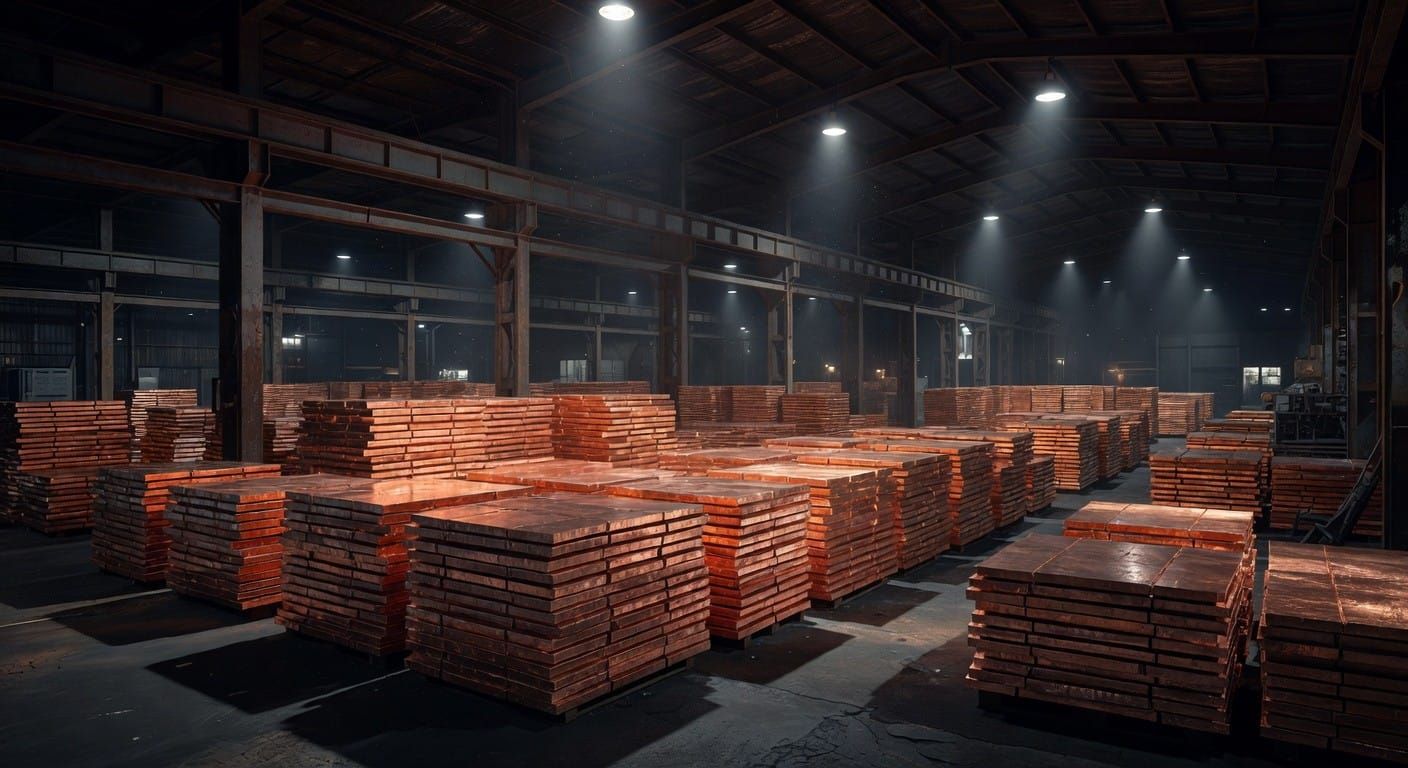
Every AI chip, every data center, every electric vehicle, every missile system, and every mile of upgraded power grid has one thing in common: copper. And right now, the world doesn't have enough of it.
In January 2026, S&P Global published an updated assessment that landed like a thunderclap across commodity desks: the structural shortfall in global copper supply is widening faster than anyone projected, driven by the simultaneous acceleration of AI infrastructure, defense spending, and electrification. The cumulative deficit could reach 10 million metric tons by 2040 — roughly 40% of current annual production.
This isn't a cyclical squeeze. It's a structural crisis unfolding in plain sight.
And the policy response — particularly from Washington — is making it worse. A 50% Section 232 tariff on copper imports, strengthened just weeks ago on April 2, has distorted global flows, drained overseas inventories, and created a two-tier price system that punishes manufacturers everywhere except the United States.
For investors, the copper crunch isn't a speculative thesis. It's the most important supply-demand story in commodities — and the market is only beginning to price it in.
The Deficit Nobody Can Fix
The numbers are stark. J.P. Morgan projects a 330,000-metric-ton refined copper deficit in 2026, approximately 1.4% of global production. ING Group's estimate is far more alarming: 600 kilotons short, with no credible path to balance before 2028.
The problem is geological as much as it is economic. The world's largest copper mines — Escondida in Chile, Grasberg in Indonesia, Kamoa-Kakula in the DRC — are either aging, operating at peak capacity, or grappling with rising stripping ratios (the amount of waste rock that must be moved to reach ore). S&P Global Commodity Insights reported stripping ratios hit 1.79:1 in 2025, the highest on record for major operations.
New mine development takes 12–16 years from discovery to first production. Even with copper prices hovering near $6.00 per pound — more than double the 2020 average — the pipeline of new projects coming online before 2030 is woefully thin. The International Energy Agency estimates the world needs $250 billion in new mine investment just to maintain current output levels, let alone meet surging demand.
The AI Factor: Data Centers Are Eating the Grid
The demand side of the equation has fundamentally shifted. A single hyperscale data center consumes 20,000–40,000 tons of copper in its construction — wiring, busbars, transformers, cooling systems, grid connections. With Microsoft, Google, Amazon, and xAI all racing to build out AI compute capacity, the sector's copper consumption is projected to triple by 2030.
But the real copper demand from AI isn't in the buildings themselves. It's in the power infrastructure required to run them. AI data centers are projected to consume 12–15% of US electricity by 2028, up from roughly 4% today. Every megawatt of new generation capacity — whether gas, nuclear, or renewable — requires copper for transmission lines, substations, transformers, and distribution networks.
S&P Global's January 2026 study identified AI and defense as the two fastest-growing demand sectors, calling them "demand accelerators that existing supply forecasts have not adequately incorporated."
Fortress America: Tariffs, Stockpiles, and the Copper Mountain
Washington's response has been characteristically blunt. The Section 232 tariffs on copper, first imposed in August 2025, were expanded on April 2, 2026 to cover the full customs value of copper-containing products — not just the metal content. The effective rate: 50% on most semi-finished copper imports, with reduced rates for products made primarily from US-smelted material.
The result has been a historic import surge. In 2025 alone, the US imported approximately 1.4 million tons of refined copper — 730,000 tons more than the prior year — as traders front-loaded shipments ahead of tariff deadlines. CME-approved warehouse inventories hit 590,000 tons by February 2026, the highest level in decades.
Reuters dubbed it the "copper mountain." It represents roughly 30 months of US industrial consumption, providing a substantial buffer for American manufacturers. But it came at a cost: draining global inventories, pushing London Metal Exchange stocks to multi-year lows, and creating a persistent $500–800 per ton premium for US-delivered copper over international benchmarks.
Then came "Project Vault" — a $12 billion Trump administration initiative announced in February 2026 to build strategic stockpiles of critical minerals including copper, lithium, and rare earths through an expanded National Defense Stockpile. Copper was added to the USGS critical minerals list in 2025, formalizing what commodity traders already knew: this metal is now a matter of national security.
This is where the analysis gets actionable. AlphaBriefing members get the full investment framework — scenarios, positioning, and the bottom line.
Subscribe to AlphaBriefing — Free, Member, and Paid tiers available.