Six Grids, One Question: Who Pays for AI's Power?
FERC has declared every U.S. regional grid tariff presumptively unjust and unreasonable in the face of data center demand — and all six operators just asked for more time. The answer will decide who pays for the AI buildout, and reprice the power sector.

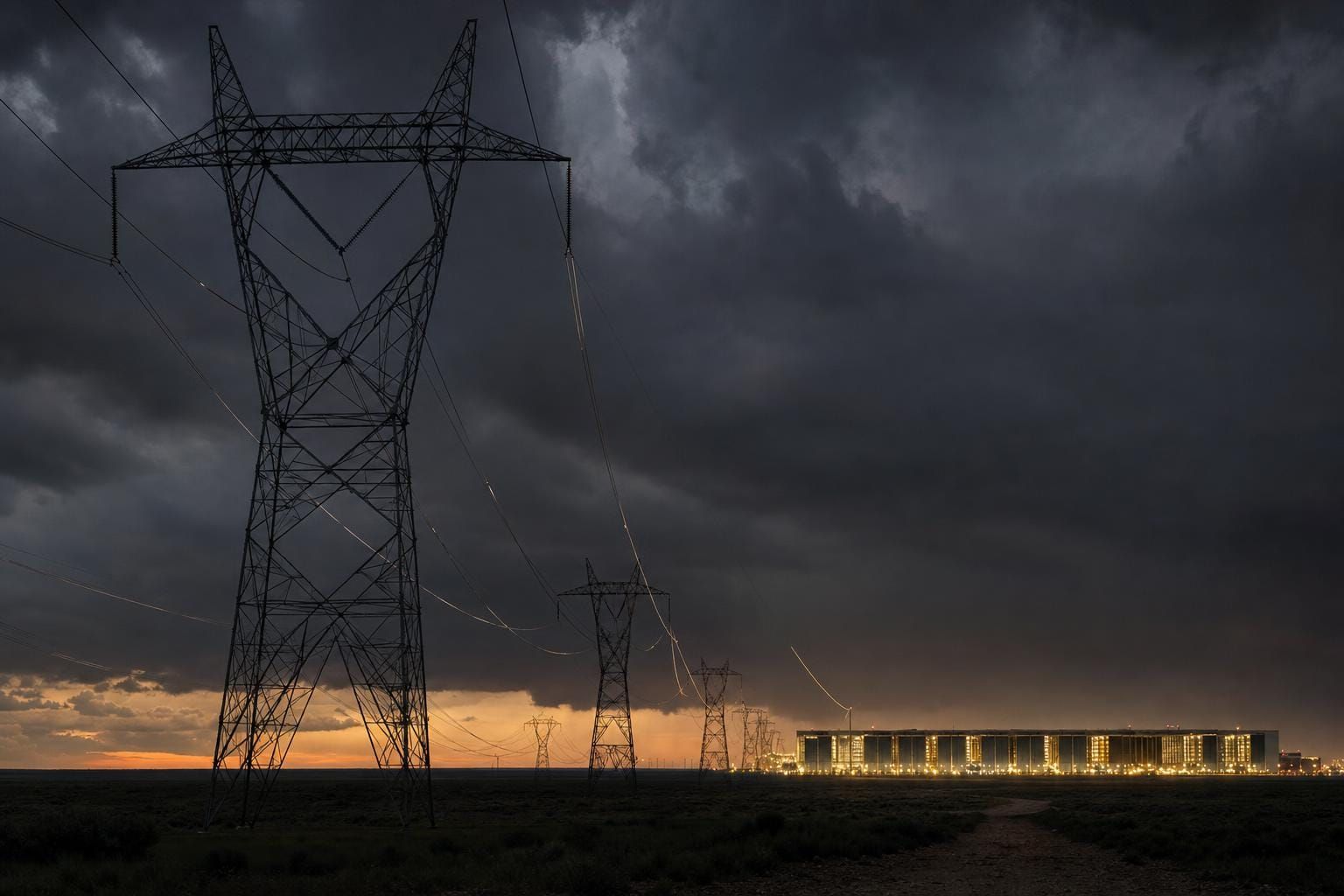
On June 18, the Federal Energy Regulatory Commission did something it had never done in its 49-year history: it issued simultaneous show-cause orders against all six of the regional grid operators it regulates — PJM, MISO, SPP, CAISO, ISO-NE, and NYISO — with a preliminary finding that each operator's tariff "appears to be unjust, unreasonable, unduly discriminatory or preferential." The offense: none of them, in FERC's view, has adequate rules for connecting the wave of giant data centers now hitting the American grid, or for deciding who pays for it.
The operators had 60 days to either defend their rules or propose new ones. That deadline was August 17. All six chose a third option: they asked for more time. Every one of them filed to hold its proceeding in abeyance — a pause of up to 90 days — rather than answer the question. FERC, which had warned in June that it would scrutinize abeyance requests heavily and view extensions "with great disfavor," has not yet ruled on any of them.
This is the quiet story underneath every loud AI-infrastructure headline. The capital expenditure numbers get the attention — the gigawatt campuses, the nuclear deals, the turbine backlogs. The unresolved question is the one FERC just forced onto the docket: when a 1,000-megawatt customer shows up on a grid built for load growth of one percent a year, who pays for the wires, the capacity, and the risk? For two years the honest answer has been "everyone else, by default." Section 206 of the Federal Power Act is the mechanism by which that default gets rewritten.
The numbers that forced FERC's hand
The clearest evidence file comes from PJM, the 13-state mid-Atlantic grid that hosts the world's largest concentration of data centers. Actual and forecast data center demand drove the cost of PJM's capacity auction for the 2025–26 delivery year up by more than $9 billion, an increase that fed through to retail electricity bills at up to 29 percent for some PJM customers, according to reporting by Grist. This June 30, PJM's annual capacity auction cleared at its price cap for the third consecutive year and revealed a shortfall of 6,831 megawatts against its reliability requirement. A month later, PJM filed for a one-time "Reliability Backstop Auction" — an emergency procurement, capped at $555 per megawatt-day, to buy its way out of the gap.
The demand side keeps compounding. The Electric Power Research Institute estimates data centers could consume as much as 17 percent of U.S. generation by 2030. The Union of Concerned Scientists puts the total electricity system costs linked to data centers at $886 billion to $978 billion by 2050. Texas broke its all-time demand record twice in a single week this summer. More than 60 special "large load" tariffs have now been proposed or enacted around the country as utilities and states improvise their own answers — Washington State's utility commission began writing its own data center cost-shifting rules in August after the legislature failed to act.
To be fair to the operators, the record is genuinely mixed — and FERC's preliminary finding is a finding about rules, not yet about outcomes. An Edison Electric Institute-commissioned study found PJM is so far the only regional market where rates have demonstrably risen because of data centers. North Dakota and New Mexico absorbed double-digit load growth from 2019 to 2024 while rates fell relative to other states. PG&E's chief executive has argued that each gigawatt of new large load, properly structured, can cut residential rates by at least one percent by spreading fixed costs over more sales. Load growth is not inherently a cost problem. Unpriced load growth is.
What Section 206 actually does
A show-cause order under Section 206 flips the burden of proof. FERC does not have to demonstrate the tariffs are broken; the operators must demonstrate they are not — or file replacement rules. The June orders grew out of a Department of Energy proceeding launched in October 2025 to speed large-load interconnection, which means the commission is being pushed in two directions at once: connect AI load faster, and shift its costs off ordinary ratepayers. Whatever framework survives that tension will be the operating system of the American power market for the next decade.
That is why the six abeyance filings matter more than they look. The operators are not stalling out of laziness — they are stalling because every serious answer creates winners and losers measured in tens of billions of dollars, and they would rather negotiate the answer with their members than have one imposed. FERC's response to the abeyance requests — grant, deny, or split — is now the single most important pending decision in U.S. power markets, and it can land any week.
There are three broad ways this resolves, and each one reprices a different set of companies — the merchant generators earning capacity prices at the cap, the regulated utilities carrying the capex, the turbine and nuclear names selling hyperscalers their way around the queue, and the hyperscalers themselves.
The rest of this briefing is for paid members: the three resolution scenarios and the specific companies each one reprices, the behind-the-meter trade FERC could supercharge or kill, and the catalyst calendar — docket by docket — through year-end.
AlphaBriefing Paid gets you every investment thesis, scenario framework, and catalyst brief we publish — the analysis private intel clients pay four figures for, at a fraction of that.