A Man Died on a Six Flags Coaster. No Federal Agency Has Jurisdiction.
One death on Goliath sent Six Flags shares sliding and reopened a 45-year-old statutory gap: no federal agency oversees America's fixed-site roller coasters — just as an activist pushes the company toward a sale.

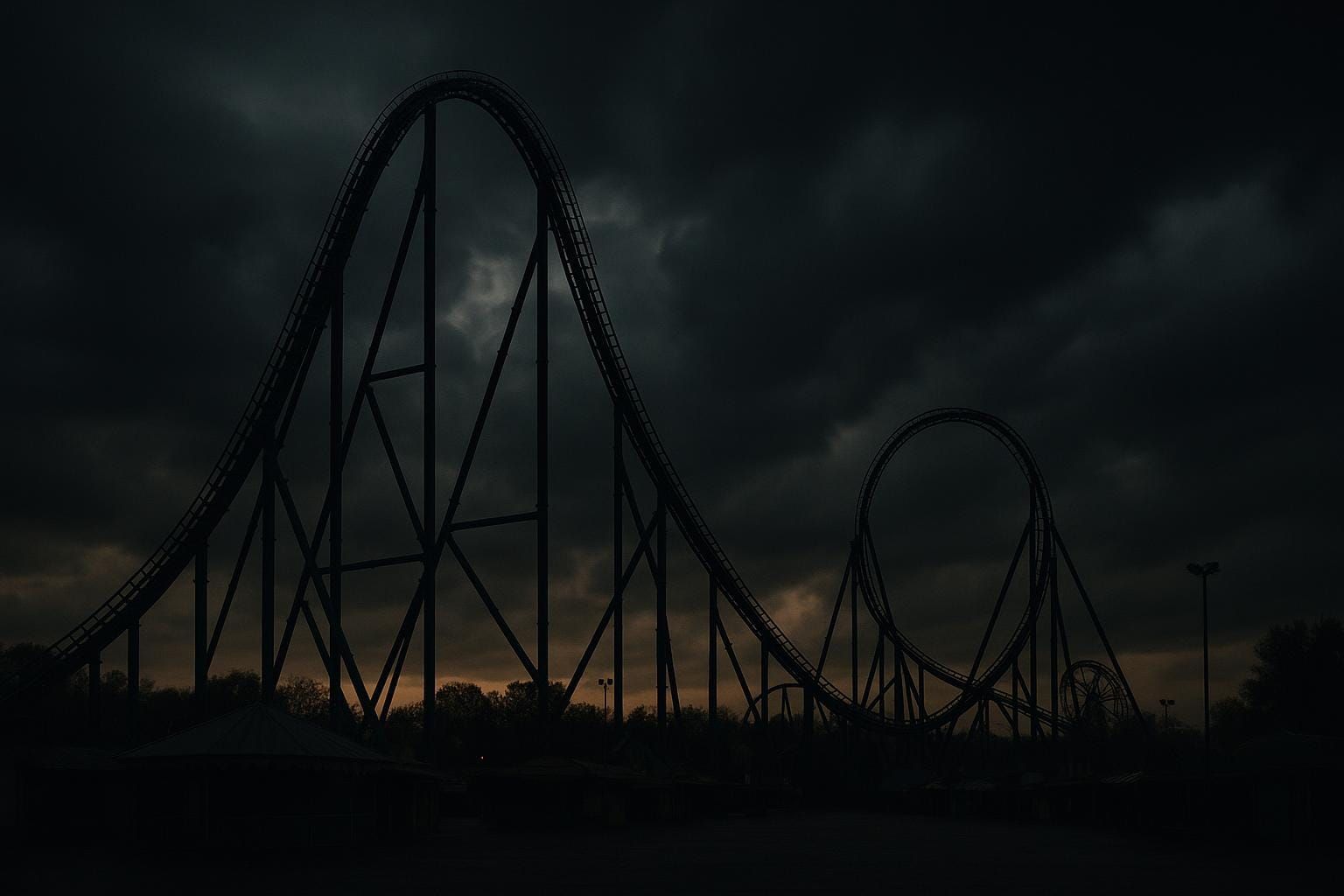
A man died on the Goliath roller coaster at Six Flags Over Georgia on Monday afternoon. By Tuesday morning, the company's stock had given back a month of gains, nine coasters across the country were standing still, and a 45-year-old gap in American safety regulation was back in view: no federal agency has jurisdiction over that ride — or over any fixed-site amusement ride in the United States.
What Happened Monday
The incident occurred shortly before 4 p.m. at Six Flags Over Georgia in Cobb County, west of Atlanta. One person died and several others were injured in what police called an "incident involving a roller coaster," according to ABC News. Witnesses told a local station they saw a man fall from Goliath — a 200-foot, 70-mile-per-hour hypercoaster that has operated at the park since 2006 — and strike the ride structure several times. The train stopped near the top of the ride, and the remaining riders were evacuated.
Cobb County's Major Crimes Unit is investigating. Police have released few details, and Six Flags says it will not share more "out of respect for the family's privacy." The company said its park team and local authorities responded immediately, that it is cooperating fully with the investigation, and that it has "temporarily closed similar attractions" across its parks — nine coasters in total, according to Fox 5 Atlanta.
Everything beyond that — what failed, whether a restraint was involved, whether the ride or the rider was the cause — is unknown as of this writing. That uncertainty matters, because the market is already pricing the answer.
The Market Repriced Before the Facts Arrived
Six Flags Entertainment (NYSE: FUN) closed Monday's regular session up 4.5% at $11.92 — hours before news of the incident spread. In after-hours trading the stock fell more than 10%, according to CNBC. In Tuesday's pre-market it was changing hands around $11, down roughly 8% from Monday's close. The stock had already lost more than 20% of its value this year before any of this happened.
That reaction looks severe for a company with roughly three dozen parks, about 47 million annual guests, and $3.1 billion in 2025 revenue. One tragic incident at one park does not change those numbers. What it changes is the context around a company that was already in the most fragile position in its modern history.
Briefings like this land in members' inboxes before the market prices them in. Join free →
A Company With No Margin for Bad Headlines
Today's Six Flags is the product of the July 2024 merger with Cedar Fair — a deal valued at roughly $8 billion including debt at announcement, which created the largest regional amusement park operator in North America. The merger was supposed to deliver stability. It has delivered churn instead.
CEO Richard Zimmerman, who led the combined company out of the merger, stepped down at the end of 2025. John Reilly, a former SeaWorld and Palace Entertainment executive, took over in December. The executive chairman's seat changed hands in March. And hovering over all of it is Jana Partners, the activist fund holding a roughly 9% economic stake, which wrote to the board in March citing a pattern of "board dysfunction" — and which, according to a Wall Street Journal report on September 22, is now urging Six Flags to hire a bank and formally explore a sale.
That is the overhang that makes Monday's incident a financial story and not just a tragic one. A company exploring a sale is a company being priced on its liabilities. And the safety column was already attracting attention: in late September, CNN reported that attorneys say more than 100 riders allege brain injuries from X2, another of the company's coasters — unproven claims, but claims that now share a news cycle with a fatality.
Six Flags reports third-quarter earnings on November 5. The quarter covers the peak summer season and will now be read almost entirely through one lens: what does Monday cost — in attendance, in litigation reserves, and in the price any acquirer is willing to pay?
The Loophole: Why No Federal Investigator Is Coming
Here is the part most readers find hard to believe. If an elevator fails, a state-licensed inspection regime answers to codified standards. If a plane crashes, the NTSB arrives. If a carnival ride at a county fair injures someone, the U.S. Consumer Product Safety Commission has jurisdiction.
But if someone dies on a roller coaster at a permanent amusement park, no federal agency has the authority to investigate the ride, subpoena maintenance records, or order changes.
That is not an oversight. It is written into the statute. In 1981, Congress amended the Consumer Product Safety Act's definition of "consumer product" to explicitly exclude amusement rides "permanently fixed to a site." Mobile rides — the kind that travel with carnivals — remained under CPSC jurisdiction. Fixed-site rides at permanent parks did not. The text is still on the books at 15 U.S.C. § 2052.
The practical result is a patchwork: oversight of fixed-site rides falls to state and local authorities, and the rigor varies enormously from state to state — different inspection frequencies, different reporting requirements, and in some cases heavy reliance on the parks' own inspection programs. There is no national database of ride incidents with mandatory reporting, no federal standard a park must meet, and no federal investigator who shows up when something goes wrong. In Cobb County this week, the investigating authority is the county police department's Major Crimes Unit.
The industry has long argued that its internal standards and state-level oversight work — and fatal incidents on major-park coasters are, statistically, genuinely rare. But every few years an incident like Monday's revives the question of whether the 1981 carve-out still makes sense for an industry now dominated by two publicly traded giants and a handful of destination operators. If Washington ever reopens that question, compliance costs land on an industry that is already struggling to fund capital expenditure out of a debt-heavy balance sheet.
What to Watch
Three things will determine whether this is a one-week story or a structural one. First, the investigation's finding: a rider-behavior conclusion and a mechanical-failure conclusion imply very different liability and very different regulatory noise. Second, the November 5 earnings call — the first time management will have to put numbers and language around the incident. Third, the Jana process: whether a fatality and its litigation tail cool buyer interest in a sale the market had started to price in, or whether a depressed stock makes the company an easier target.
A man lost his life on Monday, and that is the headline that matters most. But the reason this story belongs in a briefing about markets is simpler and colder: the company he trusted with his safety answers to a patchwork of state regimes and zero federal ones — and as of this morning, the market is deciding, in real time, what that arrangement is worth.
Get the next briefing free in your inbox: Join AlphaBriefing
If this analysis was useful, this is what AlphaBriefing does every day — the news, connected to what it means for your money. Free members get the daily brief in their inbox; paid members get the investment frameworks, scenario pricing, and catalyst calendars behind the paywall.
Sign up free → — upgrade whenever it earns it.
Sources & Further Reading
- ABC News — 1 dead, several injured in roller coaster incident at Six Flags Over Georgia
- CNBC — Six Flags shares plunge after-hours following report of deadly roller coaster incident
- Legal Information Institute (Cornell) — 15 U.S. Code § 2052: the fixed-site amusement ride exclusion
- The Wall Street Journal (via Yahoo Finance) — Activist Jana Partners Urges Six Flags to Explore Sale
- Business Wire — Six Flags to Announce 2026 Third Quarter Results on November 5
- Investing.com — Six Flags shares slide after fatal roller coaster incident in Georgia
- Six Flags Over Georgia — Goliath
Disclaimer
AlphaBriefing is an independent intelligence publication. The content in this article is produced for informational and educational purposes only. Nothing published by AlphaBriefing constitutes financial, investment, legal, tax, or regulatory advice, nor should it be construed as a solicitation or recommendation to buy, sell, or hold any security, asset, or financial instrument.
All views expressed are those of the author at the time of writing and are subject to change without notice. Markets are volatile and unpredictable; past performance is not indicative of future results. Any investment involves risk, including the possible loss of principal.
AlphaBriefing and its principals, employees, or contributors may hold positions in securities or assets mentioned in this article. This should be considered a potential conflict of interest. No material relationship with any company referenced exists unless explicitly disclosed. Readers should conduct their own due diligence and consult qualified financial, legal, and tax advisors before making any investment decisions.
Information in this article is drawn from public sources believed to be reliable at the time of publication. AlphaBriefing makes no warranty, express or implied, as to the accuracy, completeness, or timeliness of any information herein. AlphaBriefing accepts no liability for any loss or damage arising from reliance on this content.
© AlphaBriefing. All rights reserved. Unauthorised reproduction or distribution is prohibited.