Voters Just Rebuked the Data-Center Boom. The Senate's First Response: Build Faster.
The first major vote after the midterm wipeout was a 73-25 move to fast-track the biggest permitting overhaul in a generation. Who wins, who pays, and why the lame-duck clock is the whole story.

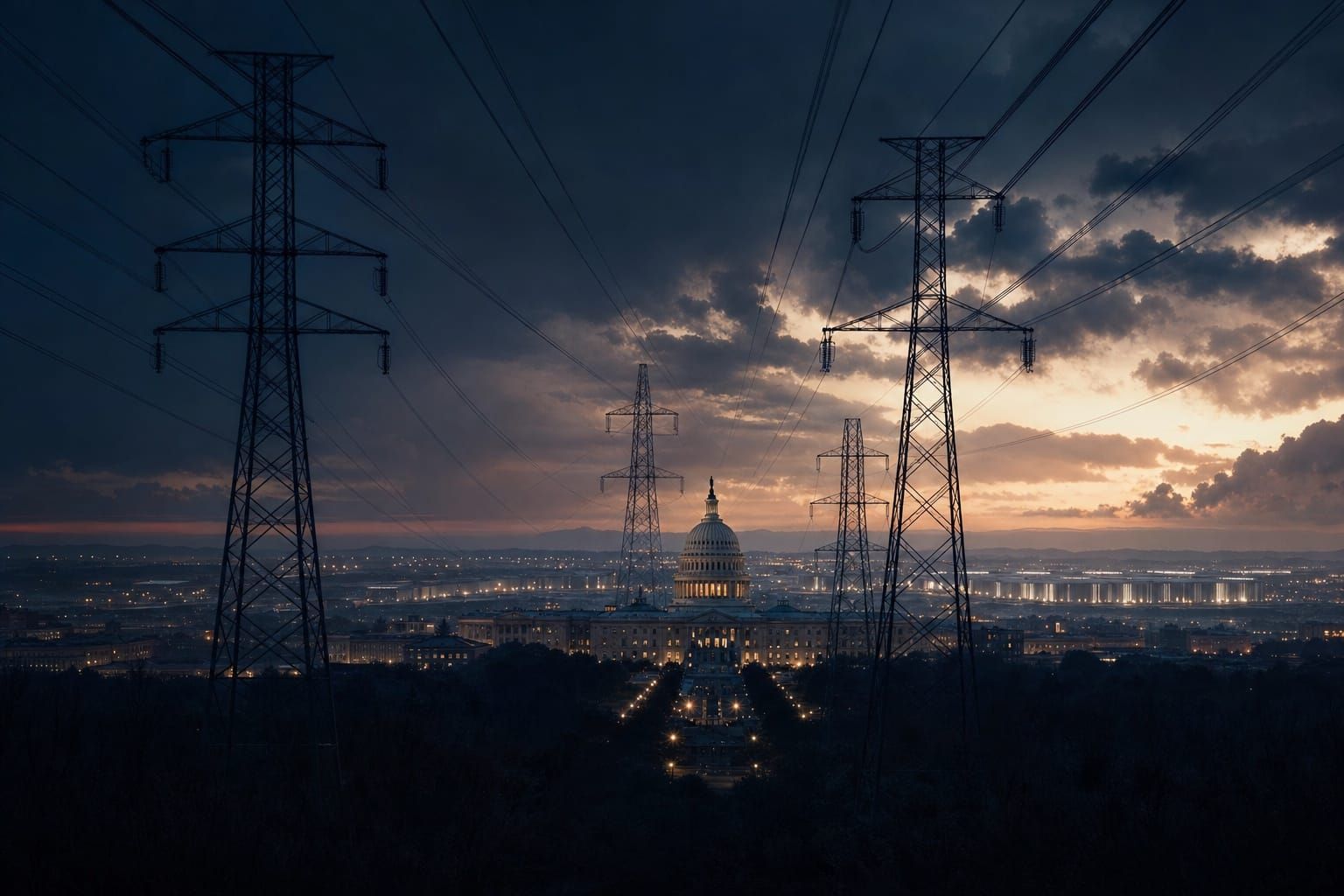
Last Tuesday, American voters delivered what even President Trump's allies called a repudiation — a midterm wipeout that handed Democrats both chambers of Congress, powered in no small part by anger over electricity bills and the data-center construction boom inflating them. On Monday, the Senate took its first major vote since that election.
It voted 73-25 to advance a bill that makes it easier to build data centers.
The Bipartisan American Affordability and Jobs Act — BAAJA, in Washington shorthand — is the most sweeping overhaul of federal permitting law in a generation. Monday's cloture vote did not pass the bill; it opened floor debate, with amendment votes and a final Senate vote expected later this week. But the margin tells you where this is heading. Nearly every Republican and more than a dozen Democrats voted to proceed. The White House supports it. President Trump spent Sunday urging his followers to call their senators in favor. And the two Democrats who co-authored it — Senators Martin Heinrich of New Mexico and Sheldon Whitehouse of Rhode Island — said before the vote that they have the numbers for final passage.
"We don't have to wait for the new Congress to start lowering costs," Heinrich said Monday. "We can do that today."
The bill's environmentalist co-author was blunter about the politics. "It's a bird in the hand," Whitehouse told reporters. "We'd be fools not to take it."
Why the rush? Look at the calendar.
The Democrats elected in last week's wave don't take their seats until January. Until then, the current Congress — the one that negotiated this deal over the past two years — still holds the pen. That creates a narrow window: pass BAAJA through the Senate this week, through the House in the lame-duck session, and onto the president's desk before the new majorities arrive with their own ideas.
That timing is exactly what has opponents furious. Bill McKibben captured the irony: "It would be highly ironic if, having won an election where data-center opposition was at the front and center, the first act of Congress was to make it easier to build data centers."
Hakeem Jeffries, the House minority leader expected to hold the speaker's gavel in January, said the bill "falls short in several areas" — naming tribal sovereignty among them — and warned he would not "rubber-stamp legislation without more constructive involvement" from his caucus. Senator Jeff Merkley of Oregon noted the bill has never had a public hearing in either chamber. Protesters spent Friday outside incoming Senate majority leader Chuck Schumer's building.
Briefings like this are free to read with a free AlphaBriefing membership. Join free →
What the bill actually changes
We covered the architecture of BAAJA in depth when the deal was struck in October. The short version: it is a trade. Environmental review gets narrower and faster; in exchange, the grid gets built.
The bill shortens and limits reviews under the National Environmental Policy Act, including changes to what triggers NEPA review and who has standing to sue. It limits the use of the Clean Water Act in permitting fights and narrows review under the National Historic Preservation Act. It makes issued permits durable — hard to revoke once granted — which addresses the political risk that has haunted developers who watched fully permitted projects receive stop-work orders mid-construction. It expands federal authority to site large interstate transmission lines, reforms the interconnection queue process, and includes provisions aimed at making data centers pay for the grid upgrades they require.
A manager's amendment released over the weekend dialed back some of the most contested provisions and, according to Heinrich, strengthened tribal consultation language. It was not enough for the National Congress of American Indians, whose president, Mark Macarro, called the bill "an existential threat to Indian country" over its weakening of the federal duty to consult tribes. Earthjustice, the Sierra Club, and the ACLU remain opposed. Senator Catherine Cortez Masto of Nevada voted to proceed but says she will oppose final passage unless the tribal provisions are removed — a reminder that the amendment process this week is not theater.
Who's actually backing it
The coalition behind BAAJA is the story of how American energy politics has been rearranged by load growth. The American Petroleum Institute calls it "a historic opportunity" — the gas industry sees a fast track for pipeline capacity feeding LNG exports and power-hungry data centers, including a potential new path for the long-blocked Constitution pipeline through New York. The Edison Electric Institute, the largest utility lobby in the country, is on board. So are labor unions and energy developers across the spectrum.
And so, critically, is a meaningful slice of the clean-energy world. The case, made by analysts like Rhodium Group's Ben King, rests on a single number: roughly 2,060 gigawatts of generation and storage capacity was sitting in grid interconnection queues at the end of 2025, per Lawrence Berkeley National Laboratory. Interstate transmission lines can take a decade to permit and build. Wind and solar are now the cheap option; what they lack is wire. Heinrich's bet is explicit: "If we can create an open, competitive level playing field, clean is cheap, and cheap wins in the marketplace."
Whitehouse's version of the bet is generational: pass the builder's toolkit now, and when Democratic majorities write climate policy next year, the projects they favor can actually get built. "People should just cool their jets and have a little faith that this is not the end of the story," he said.
What it means for investors
Three things are worth internalizing while the amendment votes play out.
The permitting discount is being repriced. Every megawatt of American infrastructure currently carries a political-risk premium: the risk that a permit granted is not a permit kept, that a decade of review precedes a shovel, that a lawsuit arrives at the eleventh hour. Permit durability and shortened review timelines compress that premium. The beneficiaries are whoever holds the longest development pipelines — utilities with big capital plans, transmission developers, pipeline operators with stranded projects, and renewable developers stuck in the queue.
The data-center cost fight moves to the states. BAAJA's cost-allocation provisions push toward large loads paying their own way — the same direction the House's 417-3 Ratepayer Protection Act vote pointed in September. The political message of the midterms was that voters noticed their power bills. Whichever companies can credibly self-fund their grid impact keep building; whichever can't will find state regulators newly emboldened.
Watch the House, not the Senate. The Senate math looks solved. The genuine uncertainty is whether Jeffries's objections harden into a lame-duck blockade — and whether the bill's sponsors would rather pass it now or let the new Congress reopen a negotiation that took years the first time. A bill that dies in December does not come back in the same form, if it comes back at all.
The Senate's amendment votes run this week. The final vote could come within days. Either way, the first legislative act of the post-midterm era is already clarifying: both parties have decided America's binding constraint is that it cannot build — they only disagree about who pays, and who gets consulted, on the way to the pour.
If this analysis was useful, this is what AlphaBriefing does every day — geopolitics and markets, connected to what it means for your money. A free membership gets you access to every free article on AlphaBriefing.com; paid members get the investment frameworks, scenario pricing, and catalyst calendars behind the paywall.
Sign up free → — upgrade whenever it earns it.
Get this level of intelligence every day. Subscribe to AlphaBriefing — free, member, and paid tiers available.
Sources & Further Reading
- AP News — Senate weighs energy legislation amid data center backlash
- The Guardian — Senate votes on bill to speed up projects from gas pipelines to clean energy
- CNBC — Senate advances bill to speed infrastructure projects
- News From The States — Permitting overhaul advances in US Senate with tepid bipartisan support
- Lawrence Berkeley National Laboratory — Queued Up: Characteristics of Power Plants Seeking Transmission Interconnection
- Sierra Club — BAAJA Remains Fundamentally Flawed Despite Manager's Amendment
- American Petroleum Institute — Permitting Reform Is Within Reach
Disclaimer
AlphaBriefing is an independent intelligence publication. The content in this article is produced for informational and educational purposes only. Nothing published by AlphaBriefing constitutes financial, investment, legal, tax, or regulatory advice, nor should it be construed as a solicitation or recommendation to buy, sell, or hold any security, asset, or financial instrument.
All views expressed are those of the author at the time of writing and are subject to change without notice. Markets are volatile and unpredictable; past performance is not indicative of future results. Any investment involves risk, including the possible loss of principal.
AlphaBriefing and its principals, employees, or contributors may hold positions in securities or assets mentioned in this article. This should be considered a potential conflict of interest. No material relationship with any company referenced exists unless explicitly disclosed. Readers should conduct their own due diligence and consult qualified financial, legal, and tax advisors before making any investment decisions.
Information in this article is drawn from public sources believed to be reliable at the time of publication. AlphaBriefing makes no warranty, express or implied, as to the accuracy, completeness, or timeliness of any information herein. AlphaBriefing accepts no liability for any loss or damage arising from reliance on this content.
© AlphaBriefing. All rights reserved. Unauthorised reproduction or distribution is prohibited.