The Trillion-Dollar Breakthrough: Samsung Joins the Elite Club as South Korea's Stock Market Explodes
Samsung just hit $1 trillion. The KOSPI just broke 7,000. South Korea — long the world's most undervalued major market — is undergoing a historic re-rating driven by AI memory demand. Here's what it means.

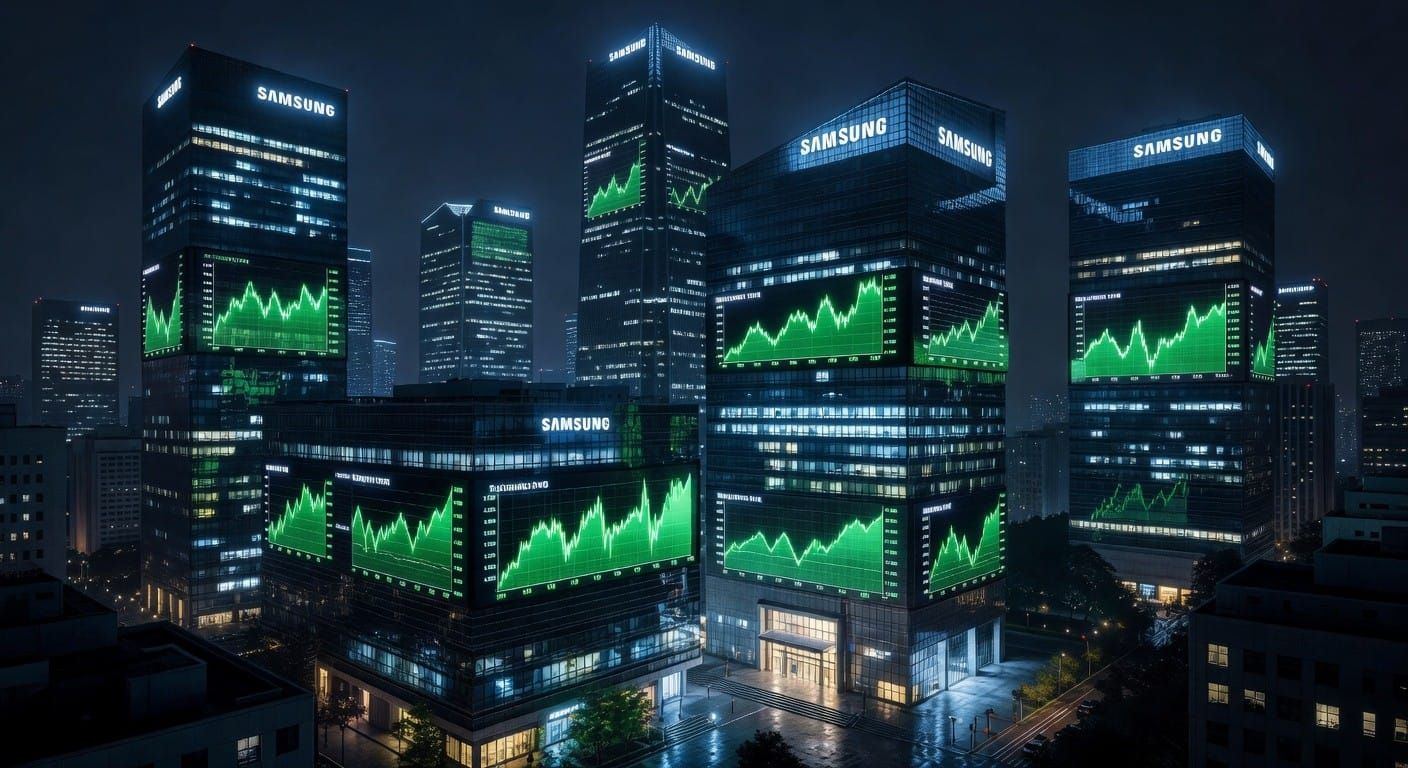
South Korea's stock market just entered a new era — and most Western investors missed the beginning.
On May 6, 2026, Samsung Electronics surpassed $1 trillion in market capitalization for the first time, joining an elite club that includes Apple, Microsoft, Nvidia, and TSMC. Shares surged 13% in a single session. Meanwhile, South Korea's benchmark KOSPI index smashed through 7,000 points — another historic first — before rocketing to an intraday high near 7,400.
The numbers are staggering: KOSPI is up 75% year-to-date. Samsung's stock has quadrupled in the past twelve months. Foreign investors poured $2.5 billion into Korean equities in a single day.
This isn't a meme rally. It's the re-rating of an entire country — driven by AI infrastructure demand, corporate governance reform, and a global scramble for the one component no AI system can function without: memory.
The HBM Bottleneck
Every large language model, every AI data center, every next-generation GPU needs High Bandwidth Memory (HBM). And there are exactly three companies on Earth that can make it: Samsung, SK Hynix, and Micron.
SK Hynix dominates, holding roughly 60% of the global HBM market and 70% of Nvidia's orders for its upcoming Vera Rubin GPU platform. Samsung holds approximately 28%, with Micron at 18%. Between them, these two Korean firms control nearly 90% of the most strategically important semiconductor component in the AI stack.
The latest generation — HBM4 — delivers 3.3 terabytes per second of bandwidth per stack. It is already sold out through the end of 2026, with customers pre-booking capacity three years in advance. Samsung and SK Hynix have both warned that AI-driven memory shortages could persist until 2027 and beyond.
SK Hynix reported record Q1 2026 earnings with a 72% operating margin. Samsung's operating profit soared eightfold to approximately $42 billion on revenue of $99 billion. These are not speculative companies riding a narrative — they are printing money at industrial scale.
The Korea Discount Is Dying
For decades, South Korean equities traded at a persistent valuation gap to global peers — the so-called "Korea discount." The reasons were structural: opaque chaebol governance, low returns on equity, weak minority shareholder protections, and a political system that tolerated all of it.
That discount is now collapsing.
Under President Lee's administration, the government launched the "Value-Up Program" — a comprehensive reform initiative targeting corporate governance, capital allocation, and shareholder returns. Tax incentives are drawing capital home. Activism is rising. Companies are responding with higher dividends and buybacks.
The result: foreign investors are no longer treating Korea as a value trap. They're treating it as a re-rating opportunity. Brokerages have raised Samsung's target price above current levels, with SK Hynix targets reaching 3 million won per share — roughly double the current price.
Forward price-to-earnings ratios remain undemanding relative to global peers, meaning the market has room to run even after a 75% gain this year.
Why This Matters Beyond Seoul
The Samsung trillion-dollar milestone isn't just a Korean story. It's a signal about where global capital is flowing and where strategic leverage lies in the AI era.
The memory supply chain is the new oil. Just as the 20th century was shaped by who controlled hydrocarbons, the 21st century AI economy is being shaped by who controls memory fabrication. South Korea now occupies a position analogous to Saudi Arabia in 1973 — except the commodity is HBM, and the demand curve is steeper.
The AI infrastructure build-out is accelerating, not slowing. U.S. hyperscalers — Amazon, Google, Microsoft, Meta — are all reporting massive capital expenditure increases for AI data centers. That spending flows directly into orders for HBM chips, which flows directly into Samsung and SK Hynix revenue. The feedback loop is self-reinforcing.
Geopolitical risk cuts both ways. South Korea sits in a complicated neighborhood. But unlike Taiwan, which faces existential cross-strait risk, South Korea's geopolitical position is more stable. For investors looking for AI semiconductor exposure without TSMC's concentration risk, Korean memory plays offer a compelling alternative.
The Risks Nobody Is Talking About
The rally is real, but it's not without landmines.
Concentration risk. Samsung and SK Hynix together account for roughly 44% of the KOSPI's total market capitalization. If memory demand softens or a cyclical downturn hits DRAM pricing, the entire index goes with it. This is not a diversified market — it's a leveraged bet on AI memory demand.
Capex pressure. SK Hynix faces a $73 billion capital expenditure cycle to meet demand. Samsung's fab expansions are similarly enormous. If AI spending plateaus before these investments pay off, margins will compress fast.
The China wildcard. Beijing has its own memory ambitions. CXMT and other Chinese DRAM producers are ramping capacity, targeting the lower end of the market today but working toward HBM capability. Any breakthrough — or any geopolitical disruption to Korean supply chains — could reshape the competitive landscape.
Currency dynamics. The Korean won has strengthened amid capital inflows, which helps foreign investors but pressures export competitiveness. A reversal in flows could trigger a sharp correction.
The Bottom Line
Samsung's entry into the trillion-dollar club is more than a corporate milestone. It's a marker of a tectonic shift in global capital allocation toward the companies that build the physical infrastructure of artificial intelligence.
South Korea was the world's most overlooked major equity market for years. It isn't anymore. The KOSPI's 75% year-to-date surge is the market's way of saying the Korea discount is over — or at least, dramatically narrower.
For investors, the question is whether this is the beginning of a sustained re-rating or the peak of a cycle. The answer probably depends on one variable above all others: how long the world's appetite for AI infrastructure remains insatiable.
Right now, every signal says that appetite is growing.
Get this level of intelligence every day. Subscribe to AlphaBriefing — free, member, and paid tiers available.
Sources & Further Reading
- Reuters — Samsung Electronics Market Cap Surpasses $1 Trillion
- CNBC — Samsung Electronics AI Chip Rally Pushes KOSPI to Record
- Reuters — South Korea's KOSPI Share Index Tops 7,000 for First Time
- Korea JoongAng Daily — KOSPI Smashes Through 7,400
- Tom's Hardware — Samsung and SK Hynix Warn AI Memory Shortages Could Last Until 2027
- Franklin Templeton — The Korea Discount Is Shrinking
- Korea JoongAng Daily — Brokerages Raise Target Prices on Samsung, SK Hynix
Disclaimer
AlphaBriefing is an independent intelligence publication. The content in this article is produced for informational and educational purposes only. Nothing published by AlphaBriefing constitutes financial, investment, legal, tax, or regulatory advice, nor should it be construed as a solicitation or recommendation to buy, sell, or hold any security, asset, or financial instrument.
All views expressed are those of the author at the time of writing and are subject to change without notice. Markets are volatile and unpredictable; past performance is not indicative of future results. Any investment involves risk, including the possible loss of principal.
AlphaBriefing and its principals, employees, or contributors may hold positions in securities or assets mentioned in this article. This should be considered a potential conflict of interest. No material relationship with any company referenced exists unless explicitly disclosed. Readers should conduct their own due diligence and consult qualified financial, legal, and tax advisors before making any investment decisions.
Information in this article is drawn from public sources believed to be reliable at the time of publication. AlphaBriefing makes no warranty, express or implied, as to the accuracy, completeness, or timeliness of any information herein. AlphaBriefing accepts no liability for any loss or damage arising from reliance on this content.
© AlphaBriefing. All rights reserved. Unauthorized reproduction or distribution is prohibited.