Russia Still Controls America's Nuclear Fuel
Four years into the war, Russia still controls 44% of global uranium enrichment — and the US ban it nominally faces won't bite until 2028. The trade is what happens between now and then.

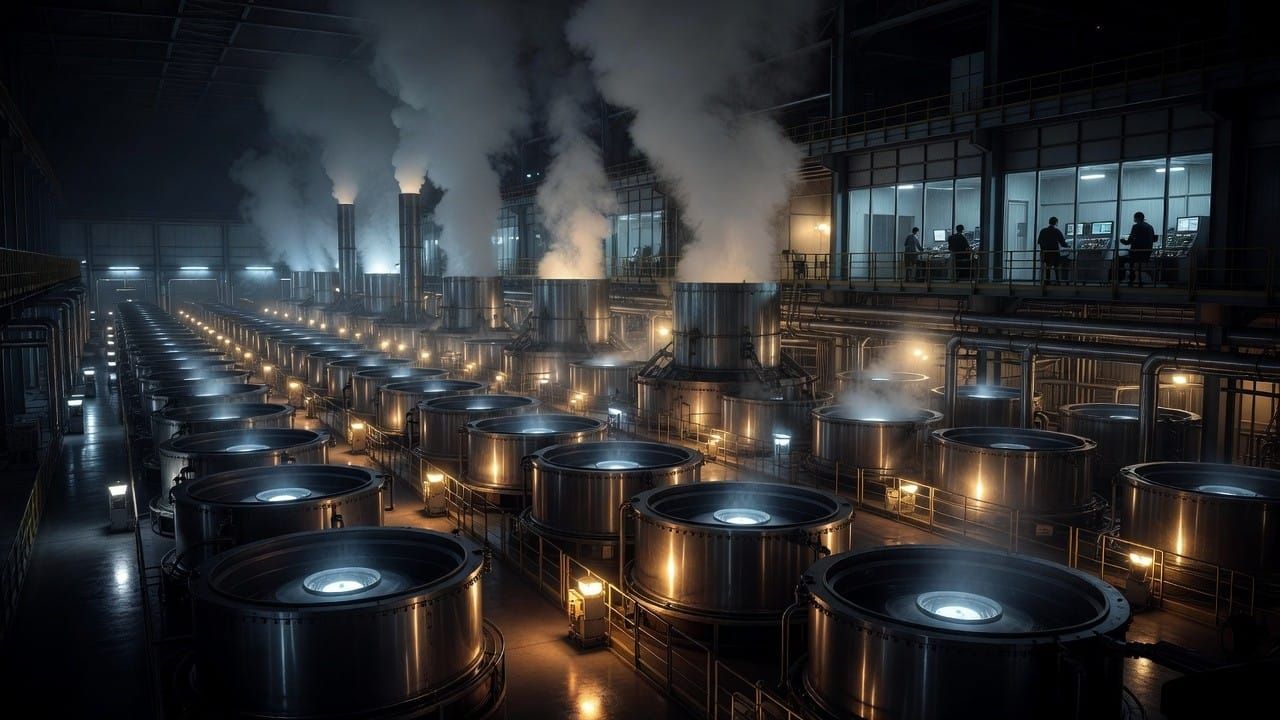
The United States is rebuilding its uranium enrichment industry from scratch. Until it finishes, every American AI data center powered by nuclear electrons depends on a supply chain that runs through Moscow.
Four years into the war in Ukraine, with a US ban on Russian uranium imports nominally in force, Rosatom still controls roughly 44% of global enrichment capacity — about 27.1 million SWU (separative work units) per year. American utilities still depend on Russian enrichment for around a quarter of their needs. And the legislation Congress passed in May 2024 to end that dependence comes wrapped in waivers that keep the door open until early 2028.
That is the strategic backdrop for one of the most consequential commodity stories of the decade — and one that has produced a uranium spot price above $86 per pound, a flurry of nine-figure DOE awards to a single Ohio enrichment plant, and a queue of hyperscalers signing multi-decade power deals with anyone who can deliver firm baseload.
The story everyone is telling about nuclear is about reactors: Microsoft restarting Three Mile Island, Amazon's 1.92 GW Susquehanna deal, Meta signing with Vistra, Google's pursuit of small modular reactors. That is the demand side, and it is real.
The story almost nobody is pricing is the fuel side. Reactors do not run on uranium ore. They run on enriched uranium — specifically, on low-enriched uranium for the existing fleet and high-assay low-enriched uranium (HALEU) for the next generation of SMRs. Enrichment is a capital-intensive, decade-to-build industrial capability. The West largely abandoned it after the Cold War on the assumption that Russia would always be a reliable supplier.
That assumption is gone. The replacement capacity is not yet here.
The Numbers
Three facts frame the trade:
1. Russia still dominates enrichment. Rosatom's roughly 27 million SWU per year of capacity dwarfs the rest of the Western world combined. Urenco, the Anglo-Dutch-German consortium, runs the largest non-Russian operation. Orano (France) is the other major Western player. The United States has effectively one operational enrichment plant — Urenco USA in New Mexico — plus a tiny demonstration cascade at Centrus's facility in Piketon, Ohio.
2. The ban is not really a ban. The Prohibiting Russian Uranium Imports Act, signed in May 2024, allows the Secretary of Energy to waive the prohibition through 2028 if no alternative source is available or if importation is "in the national interest." Utilities have used those waivers aggressively. The hard cutoff arrives in 2028, by which point Western enrichment capacity is still projected to fall short of demand.
3. Supply discipline is intact upstream. Kazatomprom, the world's largest uranium miner, has guided 2026 production roughly 10% below its earlier target — from about 32,800 tonnes of U₃O₈ down to about 29,700 tonnes — explicitly stating that current prices do not justify a return to 100% capacity. Cameco has cut guidance too, citing expansion delays at McArthur River. Sprott Physical Uranium Trust added 4 million pounds in early 2026 and now holds roughly 79 million pounds — a structural sink that the spot market has to work around.
Uranium spot pierced $100/lb in January 2026 before settling into the mid-$80s. The producers are not adding pounds to that market. The buyers — utilities, governments rebuilding strategic stockpiles, and an emerging class of hyperscaler off-takers — are accelerating.
Why This Is Different From the 2007 Bull Market
The previous uranium cycle was a leverage-and-speculation story that ended in 2011 with Fukushima. This one is a structural reindustrialization story driven by three forces that have nothing to do with sentiment:
- AI power demand is forcing hyperscalers into 20-year off-take agreements for firm, carbon-free electricity. Nuclear is the only commercially available technology that fits.
- Geopolitical de-risking is forcing Western governments to fund domestic enrichment capacity as a national security priority. The DOE awarded Centrus $900 million in January 2026 to expand commercial HALEU production at Piketon, with options bringing the total task order to $1.07 billion. More awards are coming.
- SMR fuel chemistry requires HALEU (enriched to just under 20% U-235) that essentially does not exist outside of Russia at scale. Every SMR design from X-energy to TerraPower to Oklo needs it. The first commercial reactors begin pulling fuel in the late 2020s.
This is not a price spike waiting to revert. It is a multi-year capital cycle being written in DOE contracts, utility long-term supply agreements, and SMR fuel commitments.
This is where the analysis gets actionable. AlphaBriefing members get the full investment framework — scenarios, positioning, and the bottom line.
Subscribe to AlphaBriefing — Free, Member, and Paid tiers available.