Oil Found a Way Around the Strait. Helium Didn't.
Qatar's helium — a third of world supply — has been locked behind the Strait of Hormuz since March, and the industry now concedes it won't return before 2027. The winners aren't the stocks you'd expect.

This week, the global helium industry gathered in Houston for gasworld's Helium Super Summit — the first since the war closed the Strait of Hormuz — and quietly buried its last optimistic scenario. Even if a ceasefire were signed tomorrow and a firm agreement reopened the strait, Qatari helium exports are unlikely to resume in the fourth quarter of 2026 or even the first quarter of 2027, Sibylline principal analyst Megan Sutcliffe told the summit's opening session.
That is a remarkable thing to say about a commodity that lost roughly a third of its global supply seven months ago. It is the equivalent of OPEC's Gulf producers going offline and the market being told: next year, maybe.
Oil absorbed this war. Brent trades near $108 — elevated, up sharply this year, but nowhere near the apocalyptic forecasts, because crude found workarounds: new routes, released reserves, spare capacity. We asked the pointed question last week, when a missile hit Aramco's own headquarters: why isn't oil at $150?
Helium is the opposite story, and almost nobody is telling it. There are no workarounds. There is no strategic reserve left to release. And the one chokepoint that matters is the same one that has now seen, by one regional outlet's count, 18 attacks on shipping in two weeks.
The commodity that physically cannot reroute
Helium's fragility is built into its physics and its economics.
It cannot be manufactured. It is captured as a byproduct of natural gas processing — helium output is a passenger on someone else's production decisions. If LNG trains stop, helium stops, regardless of how high the helium price goes.
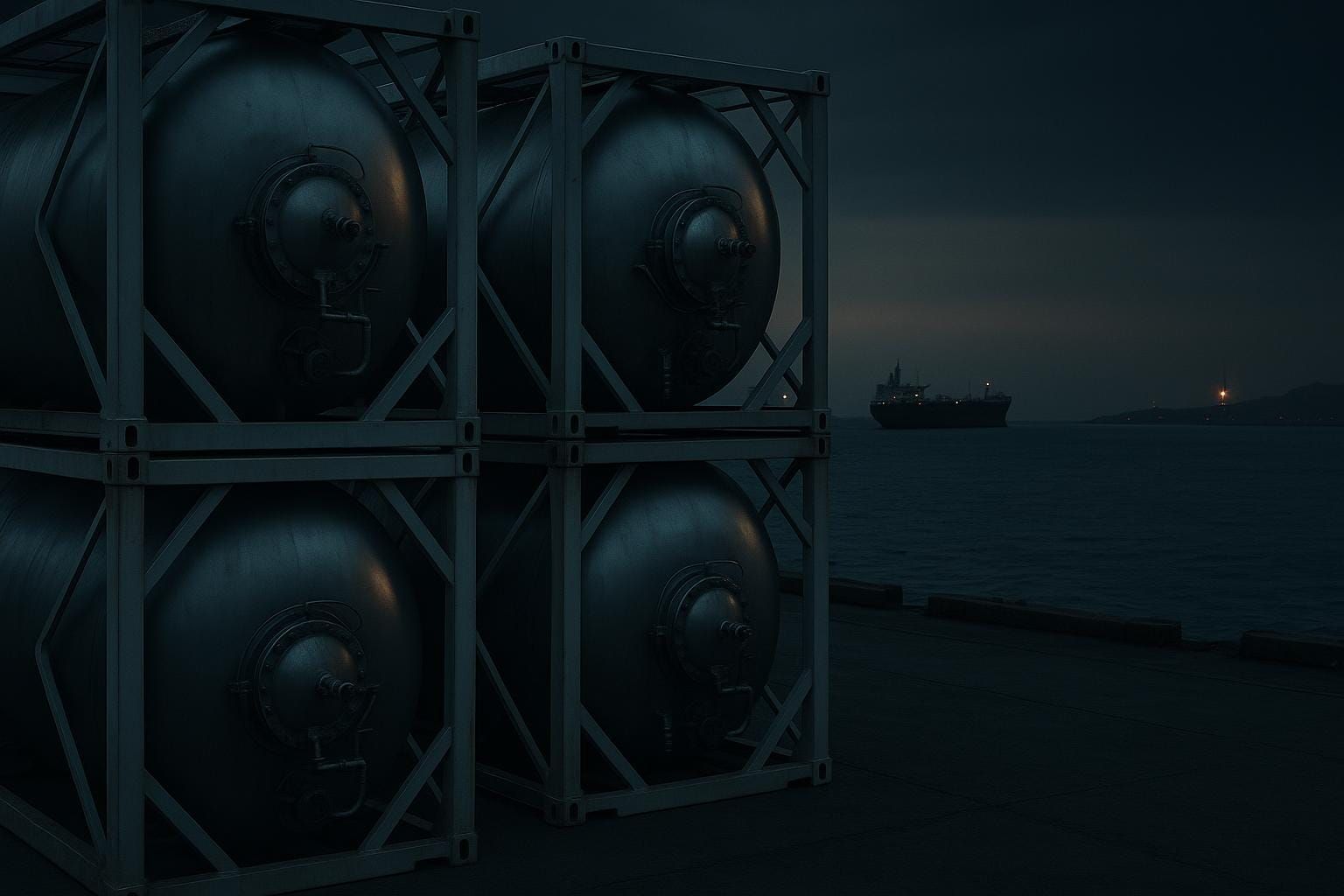
It moves by sea in specialized cryogenic ISO containers held at −268.9°C, a few degrees above absolute zero. There is no pipeline. There is no air-freight alternative at volume. And the cargo evaporates in transit: boil-off means every extra day at sea is product lost. Rerouting around the Cape of Good Hope — the standard workaround for Gulf cargo since March — adds 10 to 14 days. For most commodities that is a cost. For liquid helium it is attrition.
Storage barely exists. Chipmakers can hold roughly six weeks of liquid helium before it starts warming and escaping, according to helium consultancy Garrison Ventures. The global supply chain runs on about 45 days of inventory. There is no helium equivalent of filling salt caverns with crude.
And since June 2024, there is no government backstop. The U.S. Federal Helium Reserve — which once supplied close to a third of world demand and acted as the market's shock absorber through every previous squeeze — was sold to German industrial gas group Messer and is now just another private asset.
Briefings like this land in members' inboxes before the market prices them in. Join free →
Seven months of cascading failure
The sequence, briefly. Iran's blockade of the Strait of Hormuz in early March closed the only sea route out for Qatari helium — roughly 35% of global supply, all of it processed at the Ras Laffan industrial complex. A drone strike halted the facility in early March; ballistic missile strikes on March 18–19 then damaged two LNG production trains and the Pearl GTL plant. QatarEnergy declared force majeure and later extended it. Around 200 of the specialized ISO containers that carry the world's liquid helium were stranded near the strait when the war began, industry consultant Phil Kornbluth told The New York Times.
Qatar has been trying to claw back. A restart attempt in June ended with an explosion that killed 13 people, per Al Jazeera's reporting. By August, gasworld reported the Helium2 plant running at roughly 25% of capacity — one fill bay out of four — with nowhere for the product to go while the strait stays shut. QatarEnergy's CEO has reportedly put full repairs at three to five years; the binding constraint is specialized gas turbines that only three manufacturers in the world build, with two-to-four-year delivery times.
The price signal is exactly what you would expect from a market with no elasticity. Long-term contracts that ran $500–600 per thousand cubic feet in early 2026 now coexist with spot prices of $1,000–1,200 in shortage-hit regions, according to Epignosis Insights' pricing tracker — with Asia-Pacific, home of the world's memory fabs, paying a 20–25% premium over North America. Helium is not exchange-traded; these are privately negotiated prices, which is precisely why the squeeze has stayed off most investors' screens.
Where it bites: chips first, hospitals next
Semiconductors consume roughly 24% of the world's helium, per IDTechEx, and the share is rising. Fabs blow helium across the back of silicon wafers to hold thermal stability at advanced nodes; it is the standard for leak detection in vacuum systems; there is no industrial-scale substitute. Scarcity rarely stops a fab — it degrades it. Yields fall, defect rates rise, cost per good die climbs. The damage shows up in allocation letters, not shutdown announcements.
The exposure is brutally concentrated. South Korea imported 64.7% of its helium from Qatar in 2025, according to The Korea Times — making Samsung and SK Hynix the largest single concentration of helium risk in the electronics supply chain, right as the AI buildout has already stripped memory inventories bare. TSMC, the biggest and best-prepared buyer, told investors in April it expected no near-term operational impact but warned input prices could hit profitability. Every hard drive of 10TB or more is helium-sealed. Behind the fabs wait the MRI machines, rocket programs, and research labs that get outbid whenever chipmakers panic-buy.
All of which raises the question the Houston summit was really about: if Qatari helium is locked away into 2027, who captures the windfall — and why have most "helium stocks" conspicuously failed to?
Get the next briefing free in your inbox: Join AlphaBriefing
The rest of this briefing is free — it just requires a free AlphaBriefing account: the redrawn global supply map and who now controls the swing barrel of helium, the year-to-date scoreboard of every listed helium name and why most juniors fell during the worst shortage on record, and the three signals that will mark the next leg of the trade.
Create your free account → — 30 seconds, no card.