NATO's Hidden Fault Line: The Turkey-Greece Aegean Crisis Is Heating Up — and Billions Are at Stake
Fighter jets intercepted, F-16s deployed to Cyprus, Chevron drilling in disputed waters, and a €25 billion arms race between NATO allies. The Aegean confrontation is producing real investment consequences — here's what's at stake.

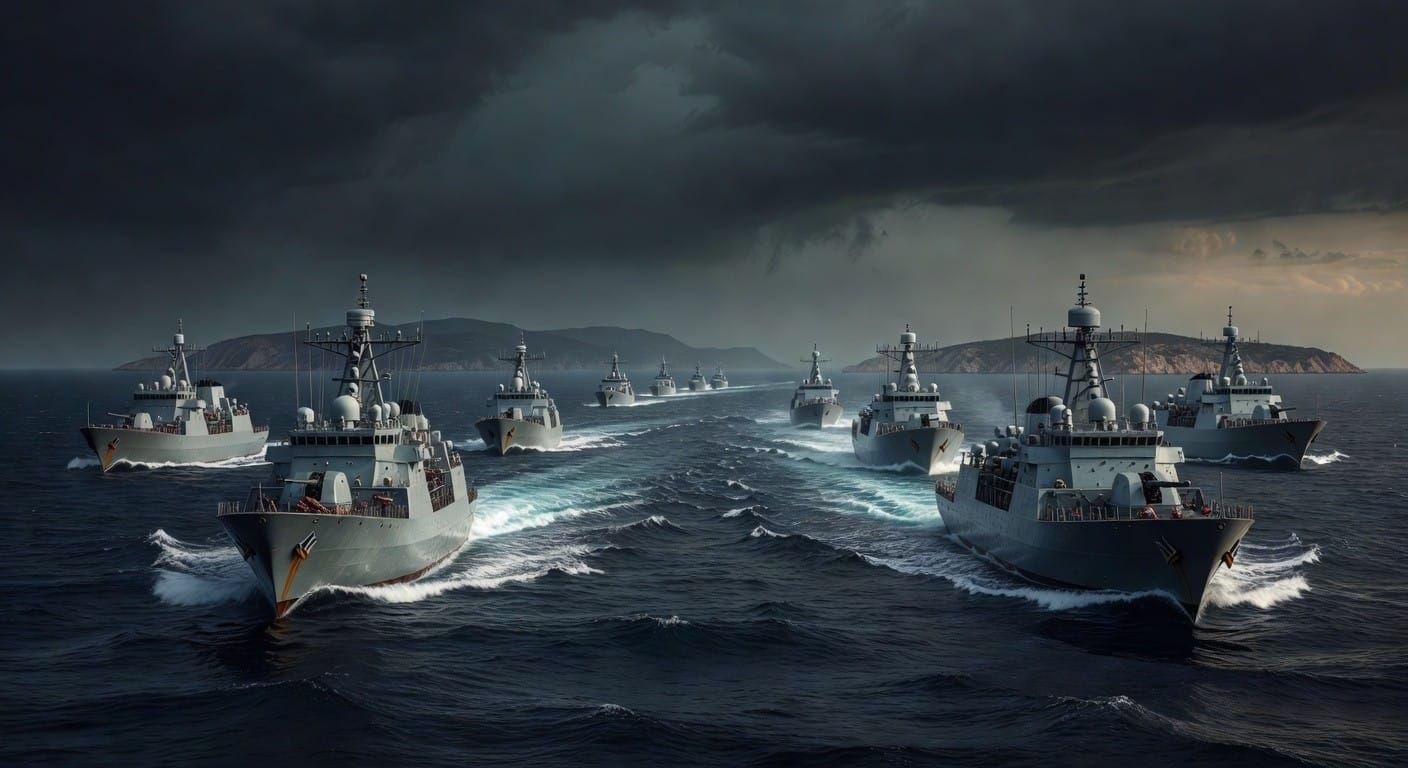
The Aegean Sea — 25 million years old, 2,000 islands deep, and one of NATO's most dangerous fault lines — is entering what Greek analysts now call a "new phase" of tension. And this time, it started with fishing maps.
On April 21, Turkey's Foreign Ministry denounced Greece's newly published fishing restriction zones as "imaginary maritime borders," declaring them null and void. A day earlier, Ekathimerini — Greece's paper of record — warned that eastern Mediterranean tensions had entered uncharted territory. Greek F-16s intercepted a Turkish patrol aircraft over the southeastern Aegean on April 10. And in March, Turkey deployed six F-16 fighter jets and air defense systems to northern Cyprus, drawing sharp condemnation from Athens, Nicosia, and Washington.
This isn't a frozen conflict thawing. It's a slow boil that investors need to watch — because the stakes now include some of the largest offshore energy concessions in European history, a €25 billion Greek arms buildup, and the operational credibility of NATO's southeastern flank.
What's Actually Happening
The Turkey-Greece rivalry is older than NATO itself — rooted in competing claims over continental shelf boundaries, exclusive economic zones (EEZs), territorial waters, airspace, and the militarization of Aegean islands.
But 2026 has seen a sharp escalation in the tempo and intensity of disputes:
-
January: Greece signaled plans to extend its territorial waters from 6 to 12 nautical miles. Turkey responded by threatening war — a position Ankara has maintained since the 1990s.
-
February: An Erdogan-Mitsotakis summit in Ankara produced diplomatic language about "good faith" and "not insurmountable" differences. Markets briefly relaxed.
-
March: Turkey deployed F-16s to northern Cyprus, protested Greek Patriot missile batteries on the island of Karpathos to NATO, the EU, and the United States, and accused Athens of exploiting the Iran war to advance "fait accompli" changes in the Aegean.
-
April: Turkey issued formal objections to Chevron's offshore gas exploration deal with Greece. Athens fired back with a UN letter rejecting Turkish maritime claims entirely. Then came the fishing maps — and Ankara's most aggressive rhetorical salvo yet.
Each step follows the same pattern: one side tests a boundary, the other escalates in response, and diplomats issue calming statements that buy a few weeks of quiet before the next provocation.
The Energy Prize Nobody Can Ignore
The eastern Mediterranean isn't just a sovereignty dispute. It's an energy frontier.
In February 2026, Chevron signed contracts to explore four ultra-deepwater blocks south of Crete and the Peloponnese — a 70/30 joint venture with Greece's HELLENiQ Energy. These blocks could hold significant natural gas reserves at a time when Europe is desperate for non-Russian supply.
Turkey immediately objected, calling the concessions a violation of its claimed continental shelf. Ankara has consistently argued that Greek islands should not generate full EEZ rights — a position rejected by Athens and most international maritime law experts.
The stakes are enormous. If Chevron finds what geologists suspect is there, Greece becomes a gas-producing state. Europe gets a new pipeline-accessible supply source. And Turkey's negotiating position on maritime boundaries weakens dramatically.
That's precisely why Ankara can't let it happen quietly.
The Arms Buildup
Both sides are spending at levels not seen since the 1990s Aegean crises.
Greece has committed over €25 billion in defense procurement through 2036 — submarines, armed drones, F-35 fighters, and an ambitious integrated air defense system dubbed "Achilles Shield." Athens now spends over 3% of GDP on defense, making it one of NATO's top contributors by that metric. The shopping list reads like a who's who of Western defense contractors: Lockheed Martin, Elbit Systems, Naval Group, and ThyssenKrupp Marine.
Turkey has taken a different path — building a domestic defense industry that now places five firms in the global top 100. ASELSAN, Turkey's flagship defense electronics company, hit a $30 billion market cap in January 2026 (a first for any Turkish firm) and has since surged past $40 billion. The stock is up roughly 178% over the past year. Turkish defense exports are booming, with sales to Pakistan, Poland, and multiple African and Gulf states.
The dynamic is striking: Greece is a buyer fueling Western defense stocks. Turkey is a builder creating its own defense champions. Both trends accelerate when Aegean tensions rise.
Why This Matters for Markets
The Turkey-Greece rivalry creates a distinct set of investment signals:
Defense spending tailwinds. Greece's €25 billion procurement pipeline directly benefits Lockheed Martin (LMT), which stands to gain from F-35 sales and the Achilles Shield program — Citi recently raised its price target to $675. Elbit Systems (ESLT) has cleared buy points on Greek rocket and MLRS contracts. European defense majors like Rheinmetall and BAE Systems ride the broader NATO spending wave.
Energy exploration upside. Chevron's Greek concessions are early-stage but high-potential. HELLENiQ Energy (ELPE on the Athens Exchange, ~€9.37/share) offers direct exposure to Greek offshore discoveries. If exploration results are positive, this becomes one of Europe's most significant energy stories.
Turkish defense as an emerging market play. ASELSAN (ASELS.IS on the Istanbul Stock Exchange) has been one of the world's best-performing defense stocks, but carries Turkish lira volatility risk. The broader Turkish defense sector returned roughly 197% in 2025.
Risk premium on the region. Every escalation cycle adds geopolitical risk premium to eastern Mediterranean energy assets while boosting defense names. The pattern is self-reinforcing: tension drives spending, spending drives stocks, and stocks attract capital that funds more capability.
The NATO Problem
Here's the uncomfortable truth: this is a dispute between two NATO allies, and the alliance has no mechanism to resolve it.
NATO's Article 5 guarantees mutual defense against external threats. It says nothing about what happens when Turkey and Greece — the alliance's second and fifth largest armies, respectively — point weapons at each other.
Washington has historically played mediator, but the current US administration is consumed by the Iran conflict and Strait of Hormuz crisis. Europe is focused on Russia. Nobody has bandwidth for the Aegean — which is exactly when miscalculations happen.
The April 10 aerial intercept — Greek F-16s escorting out a Turkish patrol aircraft after six airspace violations — was routine by Aegean standards. But "routine" military incidents between nuclear-armed alliance members in contested airspace is itself the problem.
The Bottom Line
The Turkey-Greece confrontation isn't going to produce a shooting war tomorrow. But it is producing real, investable consequences today: accelerating defense budgets, major energy concessions in disputed waters, a booming Turkish defense sector, and a structural tension that makes the eastern Mediterranean one of the most strategically complex regions on earth.
For investors, the playbook is straightforward. Greek defense procurement benefits Western contractors. Turkish defense industrialization benefits ASELSAN and the Istanbul exchange. Chevron's Greek gas blocks are a long-duration energy bet. And the region's risk premium isn't going away — because this isn't a crisis with a resolution. It's a condition.
The Aegean has been contested for millennia. The difference now is that there's oil under it, fighter jets above it, and billions of dollars riding on who controls it.
Get this level of intelligence every day. Subscribe to AlphaBriefing — free, member, and paid tiers available.
Sources & Further Reading
- Ekathimerini — East Med Tensions Enter New Phase
- Reuters — Turkish, Greek Leaders Set Talks on Migration, Maritime Borders
- Reuters — Chevron-Led Consortium Signs Contracts for Gas Exploration Off Greece
- Reuters — Turkey to Deploy Six F-16 Fighter Jets to Northern Cyprus
- Greek City Times — Turkey Rejects Greek Fishing Zones in the Aegean
- Motley Fool — Will Greece's New Air Defense Plan Boost Lockheed Martin?
- CNBC — Greece Is One of NATO's Top Defense Spenders
Disclaimer
AlphaBriefing is an independent intelligence publication. The content in this article is produced for informational and educational purposes only. Nothing published by AlphaBriefing constitutes financial, investment, legal, tax, or regulatory advice, nor should it be construed as a solicitation or recommendation to buy, sell, or hold any security, asset, or financial instrument.
All views expressed are those of the author at the time of writing and are subject to change without notice. Markets are volatile and unpredictable; past performance is not indicative of future results. Any investment involves risk, including the possible loss of principal.
AlphaBriefing and its principals, employees, or contributors may hold positions in securities or assets mentioned in this article. This should be considered a potential conflict of interest. No material relationship with any company referenced exists unless explicitly disclosed. Readers should conduct their own due diligence and consult qualified financial, legal, and tax advisors before making any investment decisions.
Information in this article is drawn from public sources believed to be reliable at the time of publication. AlphaBriefing makes no warranty, express or implied, as to the accuracy, completeness, or timeliness of any information herein. AlphaBriefing accepts no liability for any loss or damage arising from reliance on this content.
© AlphaBriefing. All rights reserved. Unauthorized reproduction or distribution is prohibited.