Why Korea's Defense Stocks Crashed the Year Everything Went Right
South Korea just flight-tested its first hypersonic glide vehicle, capping a year of record profits and export validations — while its defense stocks sit 44-63% below their spring peaks. The order book explains the gap, and what could refill it.

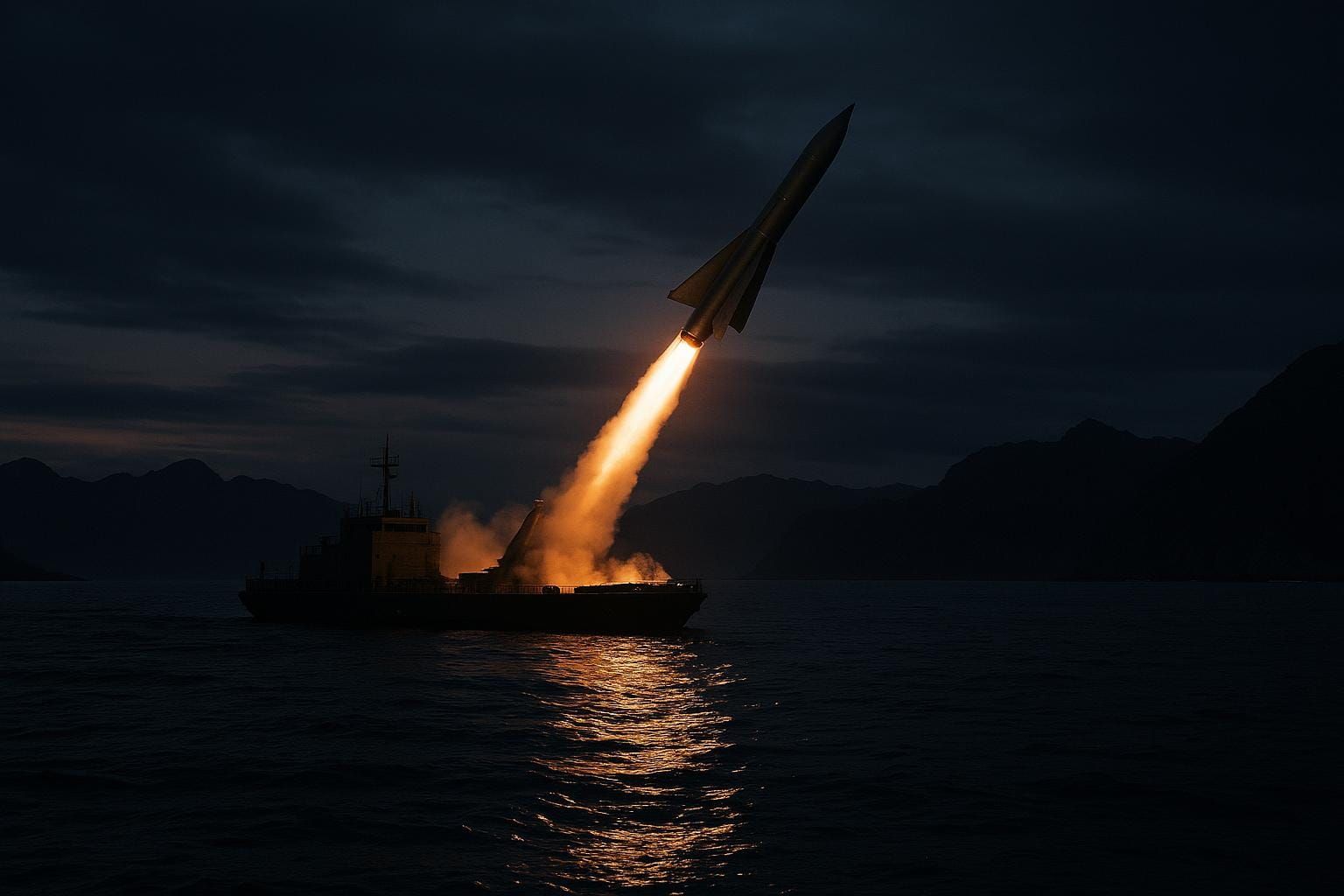
On Thursday — from a barge at the Agency for Defense Development's test site in Taean county, according to Yonhap reporting — South Korea flight-tested its first domestically developed hypersonic glide vehicle — with President Lee Jae Myung standing there to watch it fly. According to the presidential office, the vehicle separated cleanly from its booster, maneuvered both vertically and horizontally at hypersonic speed, and reached its designated target, validating the ultra-high-temperature thermal protection, guidance, and low-altitude maneuvering technologies that make glide vehicles so difficult to build — and so difficult to shoot down.
Hypersonic glide vehicles remain the preserve of a few major militaries — the United States, China, and Russia foremost among them, with North Korea claiming its own. South Korea just demonstrated one, five days after Pyongyang launched a ballistic missile on October 3 (per Reuters), and with a sitting president attending a strike-weapon test in a rare public endorsement. Lee's message afterward was explicit: national security should be secured through South Korea's own strength, with government support pledged for continued development and deployment.
Here is what should have been a victory lap for the most celebrated defense-industrial story of the decade. Instead, on Monday, Hyundai Rotem — maker of the K2 tank, the single most successful Korean defense export of the 2020s — closed at 100,000 won, within half a percent of its 52-week low, down 47% this year and 63% below its May peak.
It is not alone. Hanwha Aerospace, which just posted its first-ever trillion-won quarterly operating profit, trades 44% below its April 7 peak. Korea Aerospace Industries sits 46% below its 52-week high in the same year it rolled out the first mass-produced KF-21 fighter. LIG Defense & Aerospace — whose Cheongung-II interceptor became a Middle East export franchise — is still up 41% in 2026, but roughly half its 52-week high. All of this while the KOSPI, even after a brutal correction from its record highs, remains up 51% for the year.
A sector that delivered record revenue, record profits, a new fighter jet, a new hypersonic capability, and a string of export validations got repriced like a broken story. That deserves an explanation better than "momentum unwound."
The Boom That Built the Crash
The explanation starts with what the market was actually paying for. It was never earnings. It was the slope of the order book.
Korea's defense export machine was built on speed: when Poland signed its landmark framework agreements in 2022 for K2 tanks, K9 howitzers, FA-50 jets, and Chunmoo rocket artillery, Korean firms delivered first units within months, not years. Export orders hit $13.5 billion in 2023, dipped to $9.6 billion in 2024, then rebounded to a record $15.4 billion in 2025, according to figures compiled by the Seoul Economic Daily. The stocks became the purest momentum trade in Asia outside AI — Hanwha Aerospace peaked in April, Hyundai Rotem in early May.
Then the order flow stalled. Through the end of July 2026, new export orders stood at roughly $8 billion — about half the level of a year earlier. Hyundai Rotem, KAI, and LIG D&A had yet to post a notable overseas order win this year as of mid-August. Three of the Big 4's backlogs shrank in the second quarter, and the combined backlog slipped below the symbolic 100 trillion won mark, to 98.5 trillion.
Here is the uncomfortable mechanics of it: every record quarter is the backlog converting into revenue. Hanwha Aerospace grew second-quarter revenue 47% to 9.29 trillion won with operating profit up 59% to 1.37 trillion. KAI grew revenue 41%. LIG 17%. Rotem 13%. For a market that was valuing these companies on order momentum, record revenue without new orders isn't good news — it's the sound of the gas gauge falling.
So the crash is not mysterious. The market front-ran a second Poland that hasn't arrived yet, then repriced violently when it didn't show up on schedule.
The real question — the one Thursday's hypersonic test sharpens — is whether the order book is actually done refilling, or whether the market just repriced the sector at precisely the moment its product line got more credible. The deal pipeline says those are two very different bets.
Get the next briefing in your inbox before the market reads it: Join AlphaBriefing free.
The rest of this briefing is free — it just requires a free AlphaBriefing account: the company-by-company damage report (including which stock sits at a 52-week low with two live export decisions pending), the four deals that could rebuild the order book, and what the hypersonic test is actually worth to investors.
Create your free account → — 30 seconds, no card.