Is America About to Stop Building Houses?
Builder confidence just hit 34, a third of builders are cutting prices, and unsold new-home supply is at post-2008 highs. The only part of the housing market that still worked is shutting down — and that makes the affordability crisis worse, not better.

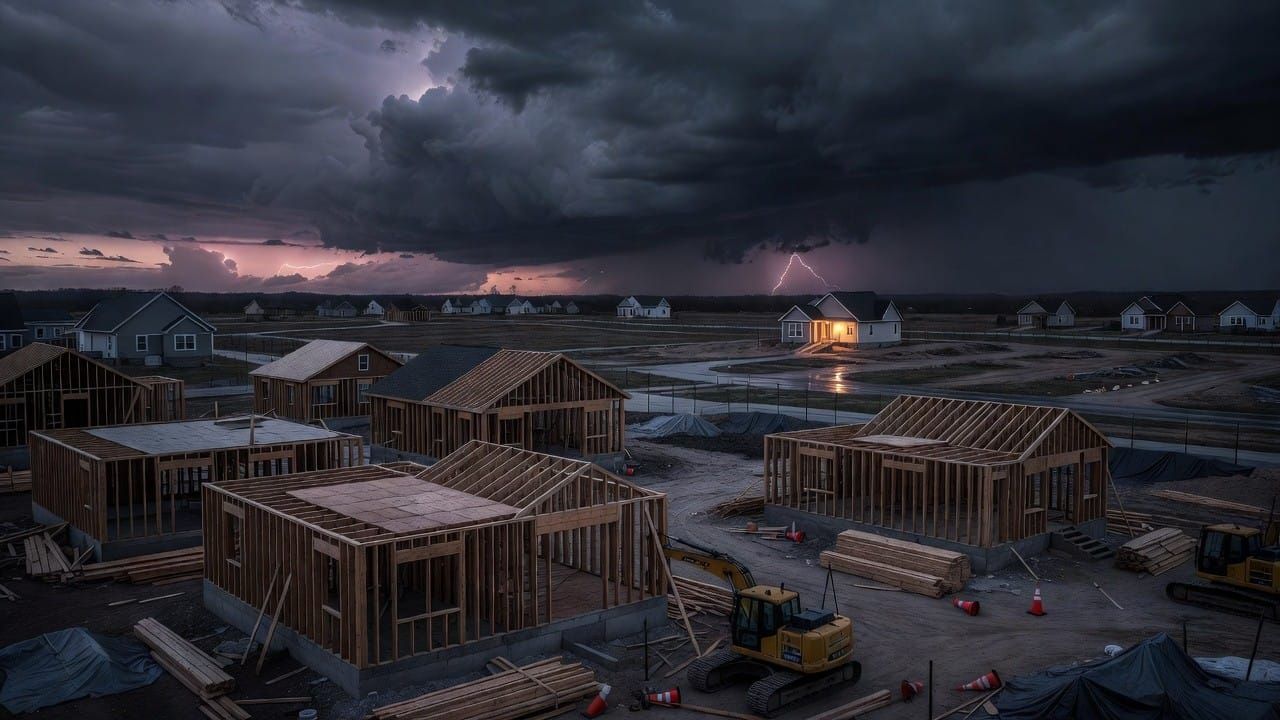
For three years, the American housing market has run on a strange arrangement. The resale market — normally about 85% of all transactions — froze solid, locked in place by homeowners who refuse to trade a 3% pandemic-era mortgage for a 6.5% one. The companies that build new houses stepped into the gap. They bought down mortgage rates, ate the cost as a sales incentive, and became the only functioning supply channel in the country.
This week brought the clearest evidence yet that the arrangement is breaking.
The NAHB/Wells Fargo Housing Market Index — the industry's benchmark confidence gauge — fell to 34 in July. That is the 15th consecutive month below 40 and the 27th straight month below 50, the line separating builders who think conditions are good from builders who think they are bad. More telling than the headline: 37% of builders reported cutting prices this month, up from 35% in June and 32% in May, with an average reduction around 6%. Roughly two-thirds are throwing in incentives — rate buydowns, closing-cost coverage — worth about 7% of the asking price, roughly double pre-pandemic norms.
Read that against the resale market, where the median existing-home price just set another record at $440,600, and you get the central paradox of American housing in 2026: the houses that exist keep getting more expensive, while the people who make new ones are discounting like a struggling retailer.
Markets tend to treat weak builder sentiment as a housing story. It is bigger than that. When the builders retreat, the last working part of the supply machine shuts down — and the affordability crisis that is already reshaping American politics gets worse, not better.
How the builders became the housing market
The mechanics of the last three years are worth restating, because they explain why this moment matters.
When mortgage rates jumped from 3% to over 7% in 2022–2023, existing homeowners simply stopped selling. Why would you? Selling meant surrendering the cheapest debt an American household has ever carried. Existing-home sales fell to annualized rates around 4 million — levels last seen in the mid-1990s, when the country had 70 million fewer people.
Builders had something individual sellers didn't: a financing arm and a margin to spend. They used both. By buying the buyer's mortgage rate down to 5% or lower, a builder could manufacture affordability that the resale market couldn't match. New construction — historically 10–15% of for-sale inventory — swelled to roughly a third of it. Wall Street noticed: builder stocks massively outperformed, and the industry was praised for having finally learned, after 2008, how to manage supply with discipline.
That discipline is precisely what should worry you now.
Briefings like this land in members' inboxes before the market prices them in. Join free →
The machine is stalling
Look at what the builders themselves are reporting.
Lennar, the country's second-largest builder, delivered its fiscal second quarter in June with a gross margin of 15.6% — against the mid-20s it earned at the 2022 peak. Sales incentives ran at 12.9% of the average selling price. On a $371,500 average home, that is nearly $48,000 spent to close each sale. The company also trimmed its full-year delivery guidance. D.R. Horton, the largest builder, is holding up better — a roughly 19.7% gross margin — but only by carrying incentives around 10% and aggressively working down its stock of completed, unsold homes. It reports fiscal third-quarter earnings on July 21, the next hard data point for the sector.
The inventory picture explains the discounting. There are now about 496,000 new homes for sale — the most since the aftermath of the 2008 crash — representing 10.3 months of supply at the current sales pace. Anything above six months has historically signaled a buyer's market in new construction; double digits are recession-era territory.
And builders are responding exactly the way post-2008 discipline taught them to: by building less. Housing starts fell 15.4% in May to a 1.18 million annualized rate, with single-family starts at just 882,000. June's numbers land today, and permits — the cleanest forward indicator in the sector — have been drifting down for months. Builders don't cut prices to clear inventory forever. The big public builders, who now account for roughly half of new-home sales, throttle production, protect margins, and wait.
Why a builder retreat makes everything worse
Here is where the story stops being about builder stocks and starts being about the country.
The United States is short somewhere between 3 and 4 million housing units, depending on whose estimate you use — a gap built up over a decade of underbuilding after the financial crisis. That shortage is the reason home prices set records with sales volumes at generational lows. It is the reason the median first-time buyer is now pushing 40. Every serious path out of it runs through one variable: starts.
A market where builders are cutting production into a structural shortage has a predictable endgame. The homes not started in 2026 are the homes not delivered in 2027 and 2028. If single-family starts stay below 900,000 while the country forms well over a million households a year, the shortage compounds — and the next leg of the affordability crisis is already scheduled.
There is a labor dimension too. Residential construction employs several million Americans, and it is one of the most reliable early-warning systems in US macro: builders shed workers before recessions, not after. A sustained slide in starts would hit employment in exactly the sector that has quietly absorbed a large share of blue-collar job growth this decade — at a moment when payroll growth has already slowed to 57,000 a month and the labor market has no cushion to spare.
And for the Federal Reserve, the irony is acute. Shelter is the stickiest component of inflation. The one force that durably brings rent and home-price inflation down is supply. High rates, meant to fight inflation, are now choking off the supply that would fight it structurally. The longer the freeze lasts, the more embedded the shelter problem becomes.
What to watch — and what it means for money
Three things matter from here.
The July 21 tell. D.R. Horton's earnings will show whether the strongest operator in the industry can hold margins without stepping up incentives into a 10-month supply glut. If Horton joins Lennar in guiding volumes down, the sector-wide production cut is confirmed.
Permits, not prices. Everyone watches home prices; they are the lagging indicator. Single-family permits are the leading one. A stabilization above 900,000 says the builders see rate relief coming. A slide toward 800,000 says the supply machine is genuinely shutting down.
The rate trigger. The entire equation changes if mortgage rates break decisively below 6% — buydowns get cheap, sidelined buyers return, and builders flip from margin defense to volume. With the Fed boxed in by 4%-plus inflation, that is a 2027 story at the earliest absent a recession. Which is the uncomfortable part: the fastest route to cheaper mortgages is the one nobody should root for.
For investors, the sector is now a discipline test. Builder equities have been resilient because buybacks and land-light models flatter returns even as volumes shrink — but shrinking volumes into a shortage is a melting franchise dressed up as capital efficiency. The more durable exposure sits with whoever benefits from scarcity itself: owners of existing single-family rental stock, and — when the cycle finally turns — the building-products suppliers leveraged to a starts recovery that has to come eventually, because the shortage guarantees it.
The bottom line
America's housing market has spent three years running on a single engine, and that engine is now sputtering. Builder confidence at 34, price cuts spreading, 10 months of unsold supply, and starts sliding toward levels that would have been considered crisis readings a decade ago — all against a backdrop of record resale prices and a 3–4 million home shortage.
The intuitive read is that a builder slump means housing is about to get cheaper. The correct read is the opposite: it means the supply relief everyone is waiting for is being canceled in real time. The houses America doesn't start this year are the affordability crisis of 2028.
If this analysis was useful, this is what AlphaBriefing does every day — geopolitics and markets, connected to what it means for your money. Free members get the daily brief in their inbox; paid members get the investment frameworks, scenario pricing, and catalyst calendars behind the paywall.
Get this level of intelligence every day. Subscribe to AlphaBriefing — free, member, and paid tiers available.
Sources & Further Reading
- NAHB — Housing Market Index (builder confidence)
- ABA Banking Journal — Home builder confidence edged down to 34 in July
- US Census Bureau — New Residential Construction (housing starts & permits)
- US Census Bureau — New Residential Sales (inventory & months' supply)
- FRED — Monthly Supply of New Houses in the United States
- Lennar Newsroom — Second Quarter 2026 Results
- D.R. Horton — Investor Relations, Quarterly Results
- NAR — Existing-Home Sales Statistics
Disclaimer
AlphaBriefing is an independent intelligence publication. The content in this article is produced for informational and educational purposes only. Nothing published by AlphaBriefing constitutes financial, investment, legal, tax, or regulatory advice, nor should it be construed as a solicitation or recommendation to buy, sell, or hold any security, asset, or financial instrument.
All views expressed are those of the author at the time of writing and are subject to change without notice. Markets are volatile and unpredictable; past performance is not indicative of future results. Any investment involves risk, including the possible loss of principal.
AlphaBriefing and its principals, employees, or contributors may hold positions in securities or assets mentioned in this article. This should be considered a potential conflict of interest. No material relationship with any company referenced exists unless explicitly disclosed. Readers should conduct their own due diligence and consult qualified financial, legal, and tax advisors before making any investment decisions.
Information in this article is drawn from public sources believed to be reliable at the time of publication. AlphaBriefing makes no warranty, express or implied, as to the accuracy, completeness, or timeliness of any information herein. AlphaBriefing accepts no liability for any loss or damage arising from reliance on this content.
© AlphaBriefing. All rights reserved. Unauthorised reproduction or distribution is prohibited.