Inside the Quiet War Over the World's Undersea Cables
A handful of fragile pipes on the seabed carry 95% of intercontinental data — and $10 trillion in daily financial transactions. Russia, China, and Yemen's Houthis have figured this out. The fleet that fixes them hasn't.

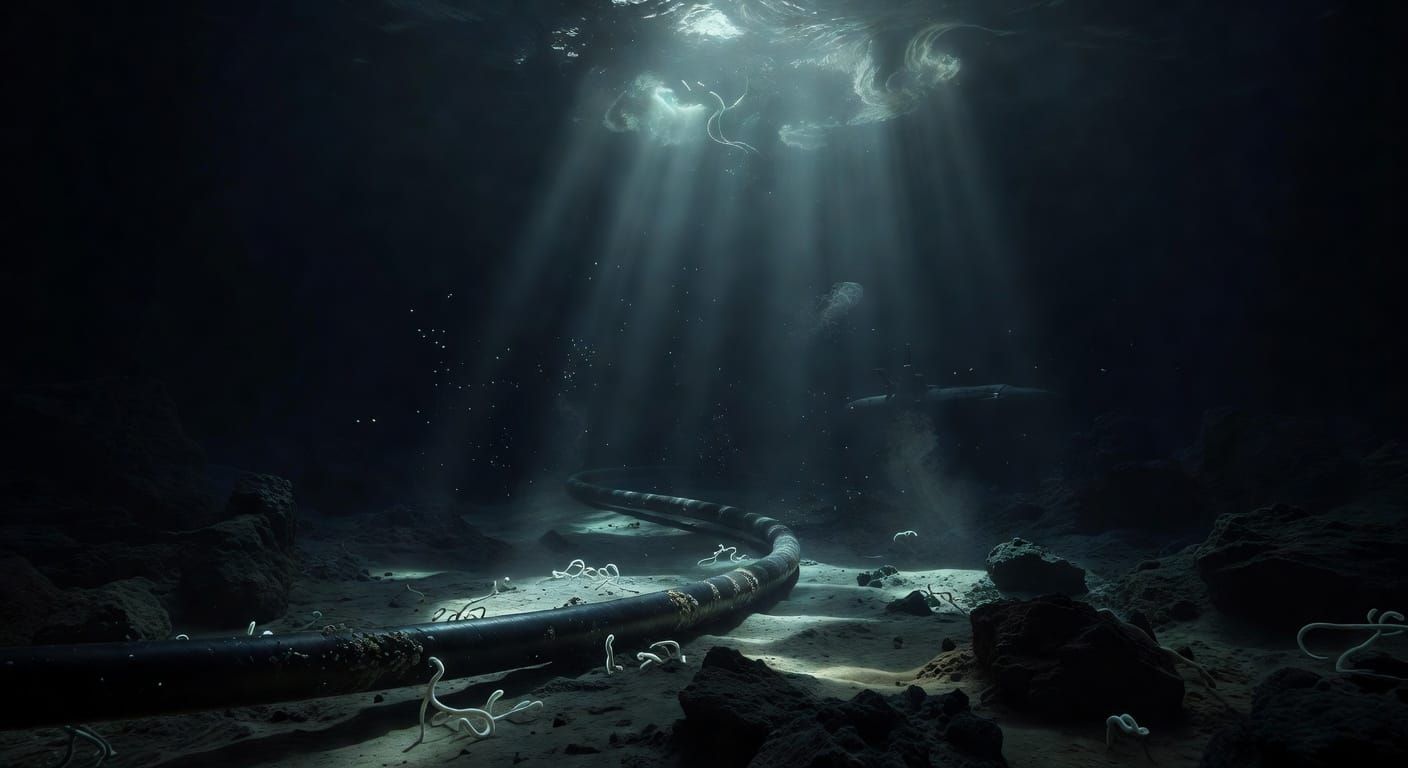
On the last night of 2025, a 25-year-old cargo ship called the Fitburg slipped out of St. Petersburg and steamed west into the Gulf of Finland. By the time Finnish authorities boarded her — anchor chain still dragging — a fiber-optic line connecting Helsinki to Tallinn had gone dark.
It was not the first cable severed in the Baltic this decade. It was at least the tenth. Seven of those cuts happened between November 2024 and January 2025 alone.
The pattern is no longer deniable. Since Russia's invasion of Ukraine, a slow, attritional campaign has been unfolding on the seabed of Europe's most strategic waters — and now in the Red Sea, the Taiwan Strait, and the eastern Mediterranean. The targets are unglamorous: black pipes about the width of a garden hose, lying in mud, carrying the entire nervous system of the global economy.
Roughly 500 active undersea cables route 95% of intercontinental data — including roughly $10 trillion in daily financial transactions cleared via SWIFT, CHIPS, and the dollar-denominated correspondent banking system. There is no functional backup. Satellites move a rounding error of total bandwidth. If the wrong cables go down at the wrong time, markets do not slow down — they stop pricing.
This is what investors should understand: the seabed is now a contested domain on the same plane as space, cyberspace, and the South China Sea. And unlike those, it is structurally underdefended, underinsured, and under-built.
The Slow-Burn Campaign
The Baltic incidents share an unsettling choreography. A flagged-of-convenience cargo vessel — Cook Islands, Comoros, Marshall Islands — wanders off a normal commercial track. An anchor "drops." A cable parts. The crew claims navigation error. The vessel slips back into international waters before any state can act.
In late 2025, the UK Defense Ministry took the unusual step of publicly outing the activity of Yantar, a Russian intelligence-gathering vessel formally registered to the Northern Fleet but operated by the General Staff Main Directorate for Deep Sea Research (GUGI) — a parallel undersea command that has spent decades mapping NATO seabed infrastructure. GUGI fields the world's largest fleet of nuclear-powered "research" submarines and dedicated subsea engineering platforms. Its peacetime work is reconnaissance. Its wartime work is plumbing sabotage.
The Houthis have been less subtle. In early 2024, attacks in the Bab el-Mandeb sank the Rubymar — and as it went down, it dragged anchor across three of the most important cables linking Europe to Asia: AAE-1, EIG, and Seacom. Repairs took months. In September 2025, more Red Sea cables were cut. Insurance premiums for cable-repair vessels willing to enter the area surged as much as 50%, and several ship operators simply refused to go in without naval escort.
In the Taiwan Strait, Chinese-flagged trawlers and bulk carriers have severed the two cables servicing the Matsu Islands more than 30 times since 2017. Taipei now treats the question of cable resilience as a Tier-1 national security problem and is laying its own redundant cables under government subsidy.
The Repair Problem Nobody Talks About
Here is the number that should keep telecom CFOs awake: there are fewer than 60 specialized cable-repair vessels in the world. That count has not meaningfully changed in twenty years.
In the same period, cable kilometers in service have roughly tripled, and AI build-out is accelerating new construction. Industry analysts project a 48% increase in cable kilometers by 2040 — and nearly 50% of the existing repair fleet will reach end-of-life in that same window.
Most of those repair ships are owned and operated by a handful of consortia — Global Marine, ASN Marine, S.B. Submarine Systems (largely Chinese-flagged), and Orange Marine. The repair contracts are governed by "club" arrangements that date to the 1950s. Average time-to-repair has historically been measured in weeks; in contested waters, it now stretches into quarters. There is no spare capacity. There is no national fleet held in reserve. There is no analog to the strategic petroleum reserve for seabed infrastructure.
This is the asymmetry. The offensive side of seabed warfare is cheap — an anchor, a fishing trawler, a willing crew. The defensive side is structurally constrained by a tiny global pool of aging specialized ships that take 18–24 months to build and are crewed by an ever-shrinking pool of trained marine engineers.
Why Investors Should Be Paying Attention
The seabed-cable system is being rewritten in real time across three axes:
-
Capital flows. Hyperscalers — Meta, Google, Microsoft, Amazon — are no longer renting capacity. They are building, owning, and operating their own cables. Meta's $10 billion Project Waterworth, announced earlier this year, is a 24-pair, 50,000-kilometer system designed to route entirely around Eurasia. Google has its name on more than 33 cable projects globally. The shift in ownership is structural and irreversible.
-
Defense priorities. Seabed security has been formalized as a domain across NATO (Critical Undersea Infrastructure Cell, 2024), AUKUS Pillar 2 (advanced undersea capabilities), and the EU (the Cable Security Toolbox, 2025). The dollars are following — slowly, but they are following.
-
Risk repricing. Lloyd's syndicates have started repricing cable insurance for the first time since the 1990s. Some categories — Red Sea transit, Baltic eastern routes — are bordering on uninsurable at any rational price. That alone will reshape who can lay and operate cables in the next cycle.
The takeaway is straightforward. A piece of infrastructure that the financial system has quietly assumed to be free, reliable, and ubiquitous is none of those things — and a small, identifiable group of public and private companies stands to benefit from the rebuild. We've identified the names that matter, the capital flows to track, and the specific risks paid subscribers should be hedging.
This is where the analysis gets actionable. AlphaBriefing members get the full investment framework — scenarios, positioning, and the bottom line.
Subscribe to AlphaBriefing — Free, Member, and Paid tiers available.