How Washington Regulated America's Freight Onto the Rails
While the market watches the $85 billion UP–NS merger clock, federal trucking rules have already pushed the largest truck-to-rail freight shift in a decade — and the window to profit from it closes before the regulators rule.

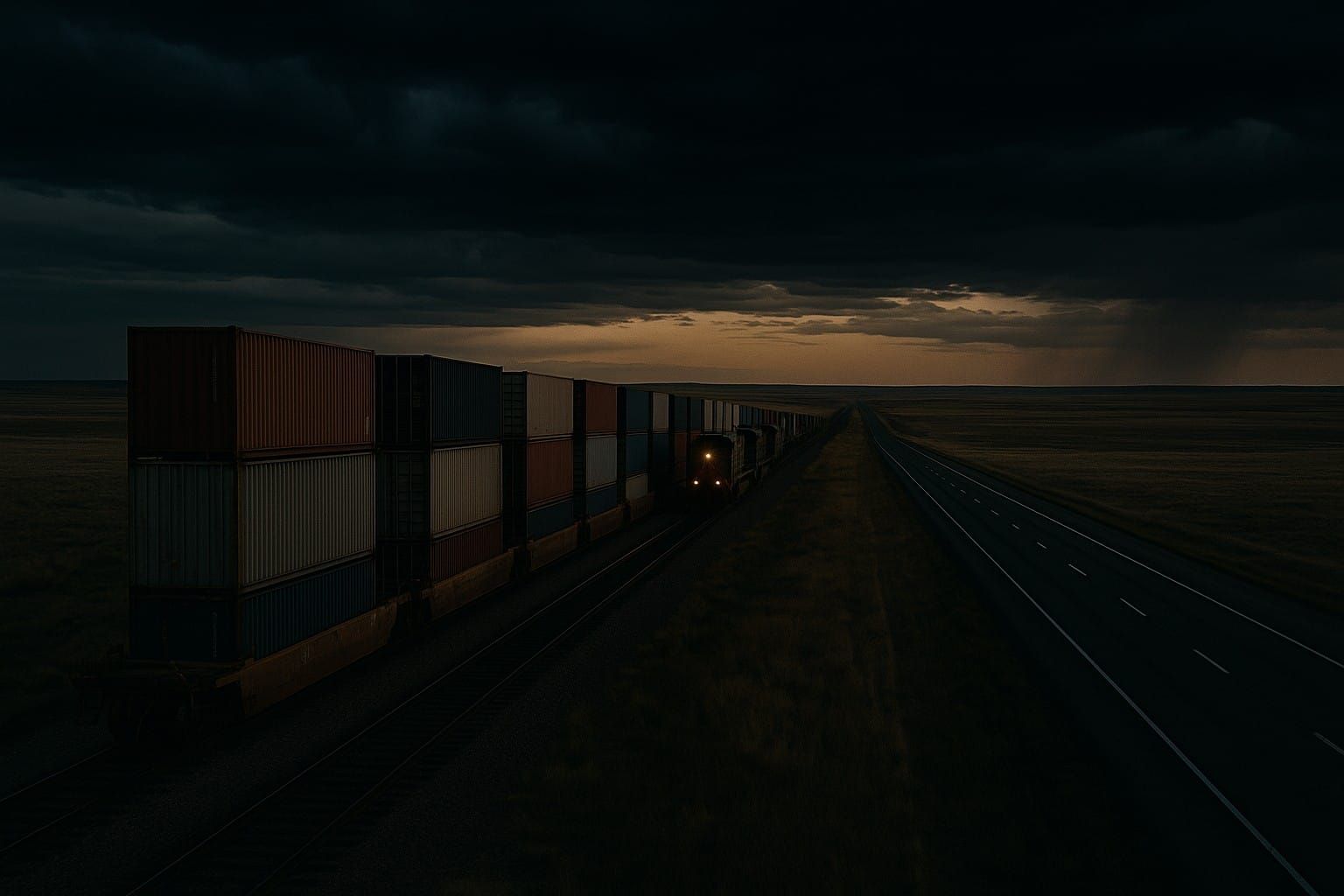
Last Tuesday, the Surface Transportation Board restarted the clock on the largest railroad deal ever proposed. Its August 18 decision took the $85 billion Union Pacific–Norfolk Southern merger out of abeyance, adopted a review schedule, and set the first hard deadline: anyone who wants to participate as a party of record must file by September 4. Final briefs are due May 28, 2027. A final decision lands, at the earliest, deep in the second half of 2027.
The entire freight industry is now organized around that calendar. BNSF and CSX have motions pending to kill the application outright. Shipper groups are lawyering up. State attorneys general are trading letters with the applicants.
And while everyone argues about who will own America's railroads in 2027, the more consequential story is what is already running on them in 2026. The freight market is not waiting for the Board. It has spent this year executing the largest shift of cargo from highway to rail in over a decade — and the networks are starting to strain under the load.
The Numbers: A Modal Shift in Progress
The Association of American Railroads' weekly data has been telling the same story all summer. Through the first 32 weeks of 2026, U.S. railroads have moved just over 9 million intermodal containers and trailers — up 3.8% on last year, against 2.7% growth in traditional carloads. Total combined traffic is up 3.3%, a meaningful acceleration for an industry whose volumes normally track GDP.
The weekly cadence is more telling than the cumulative number. In early August, intermodal growth ran above 4% for four consecutive weeks. In the second quarter, intermodal volume across the four major U.S. systems grew roughly 7% — led by BNSF at roughly 9.5% and CSX at 8.3%, with Norfolk Southern around 5.1% and Union Pacific at 3.3%, according to industry data. North of the border it is the same picture: for the week ending August 15, Canadian carloads rose 11.6% and Mexican intermodal jumped 53%.
This is not an economic boom showing up in freight. It is freight changing modes. And the reason lives in Washington, not in the shipping data.
How Regulation Emptied the Highway
Three forces are pushing cargo onto trains, and the largest one is regulatory.
In February, the Federal Motor Carrier Safety Administration finalized its rule on non-domiciled commercial driver's licenses — the credentials held by foreign drivers operating on U.S. work authorization. The rule caps license validity at one year or the driver's immigration-document expiry, whichever comes first, and requires the non-domiciled designation to be printed on the license itself. Combined with stepped-up enforcement of English-language proficiency requirements and a wave of carrier exits after three years of freight recession, the effect has been a structural contraction of the truckload driver pool. Capacity that left is not coming back at previous wage levels — industry observers describe driver compensation as having ratcheted up in a lasting way.
The market evidence is unambiguous. Truckload rates climbed through 2026 as capacity left the market, with the sharpest move in contract rates — which have now reverted to trading above spot for the first time in years. DAT's dry van load-to-truck ratio held above 10 loads per available truck in July even as it eased off its peak. Shippers renewing annual contracts are discovering that the trucking overcapacity that subsidized their logistics budgets from 2022 through 2025 is gone.
Second: fuel. With the Strait of Hormuz still closed and diesel elevated, rail's fuel-efficiency advantage — moving a ton of freight several times farther per gallon — translates into intermodal savings of 20–30% on many long-haul lanes. At current diesel prices, that spread pays for the transit-time penalty many times over.
Third: imports. U.S. ports projected record July volumes approaching 2.47 million TEU as shippers front-run the fall season, and those inland container moves flow disproportionately through rail ramps.
Briefings like this land in members' inboxes before the market prices them in. Join free →
The Strain: Volume Is Not Free
Railroads have wanted this freight back for twenty years. Now that it is arriving, the operational cost is showing up in the one metric that decides whether they keep it: speed.
Average intermodal train speeds at BNSF and Union Pacific have fallen to roughly ten-month lows. Norfolk Southern is within about 2% of a twenty-month low. CSX — the fastest-growing eastern intermodal franchise this quarter — is running its intermodal trains at approximately a seven-year low. The railroads are hiring against the problem: Norfolk Southern is adding train and engine crews at roughly half its terminals, and CSX is recruiting conductors at around 40 locations.
None of this is mysterious. Volume and velocity move in opposite directions on a fixed network. But it frames the question that will decide where the money lands: freight that moved to rail on price gets kept — or lost — on service. The last time railroads won a volume windfall and fumbled the service, in 2021–22, the cargo went straight back to the highway the moment trucking rates broke.
Whether this shift sticks — and which companies convert it into durable earnings before trucking capacity normalizes — is the part that matters for positioning.
The rest of this briefing is for paid members: the durability math behind the surge (and the one comparison that cuts the growth rate in half), the four railroads ranked by how much of the windfall they can actually keep, the two asset-light names that win regardless of which railroad wins, why the truckload survivors are a separate trade entirely, and the full merger-calendar overlay through 2027 with the dates that matter.
AlphaBriefing Paid gets you every investment thesis, scenario framework, and catalyst brief we publish — the analysis private intel clients pay four figures for, at a fraction of that.