How America's Refineries Became the World's Single Point of Failure
US refineries have run above 95% capacity for 11 straight weeks — the longest stretch since 1998 — holding the global fuel market together after war took Iran and Russia offline. History says runs like this end suddenly. What breaks, and how to position for it.

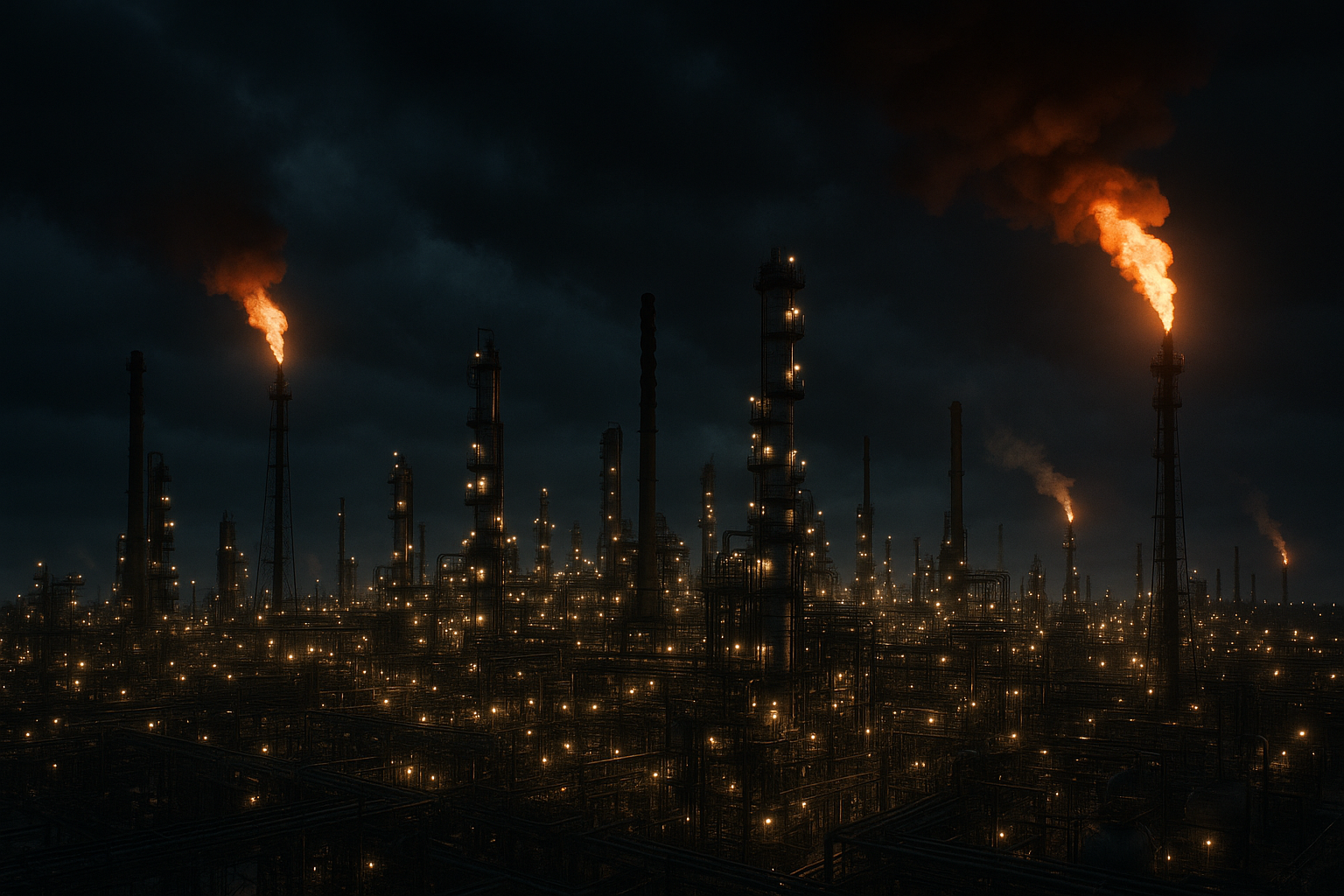
For six months, the world's fuel supply has been held together by roughly 130 American refineries running harder, for longer, than at any point in the last quarter century.
Since a U.S.-Israeli air campaign against Iran closed the Strait of Hormuz in late February — taking a fifth of global oil supply offline and crippling refining operations across Asia — and Ukrainian strikes forced Moscow to suspend diesel exports in July, the United States has become the world's supplier of last resort for refined fuel. Global refinery throughput fell to 81 million barrels per day in July, according to the International Energy Agency — nearly 5 million barrels per day below the same point last year. American plants filled the gap, pushing exports of gasoline, diesel, and jet fuel to record levels.
That is the good news. The bad news is what it is doing to the machine.
The Machine Is Running Hot
U.S. refinery utilization has now held above 95% for eleven consecutive weeks — a sustained rate the American refining fleet has managed only three times since EIA records began in 1990. Throughput has averaged roughly 17 million barrels per day since the war began, well above the five-year average. Benchmark margins for converting crude into transportation fuel have averaged more than $50 a barrel over the same stretch — more than double their ten-year average.
The result has been the most profitable six months in the history of American refining. Valero, Phillips 66, Marathon Petroleum, and ExxonMobil all posted record or near-record second-quarter earnings. And to keep collecting those margins, many of them made the same decision: postpone the maintenance that was scheduled for the second quarter, and keep running flat out.
We covered the structural version of this story on August 2 — the world is not short of crude, it is short of refineries, and whoever owns working refining capacity collects the spread. Three weeks later, the story has evolved into something more dangerous. The question is no longer who collects the windfall. It is how long the equipment can take it.
Party Like It's 1998
The historical record on "super-refining" runs is short, and it is not comforting.
Since 1990, the U.S. fleet has sustained utilization above 95% for a prolonged period exactly three times before now. In 1997, refineries ran a 24-week stretch from May to October. In 1998, they did it again from April to September — briefly exceeding 100% utilization, the only time that has ever happened in EIA data. In 2000, they managed 13 consecutive weeks.
What matters is how those episodes ended. The 1998 run ended with utilization plunging from roughly 95% in late September to 86% by mid-October, as refineries that had run flat out for months were forced into emergency maintenance almost simultaneously. In 2018, an eight-week stretch above 95% was followed by a drop to 89% within weeks. Only the 2000 episode unwound gradually — and that one ended because crude got too expensive, not because the plants held up.
Every prior super-refining run happened in a well-supplied world, where a wave of emergency outages meant higher margins for everyone else. This one is happening in a world already short nearly 2 million barrels per day of refining output against demand, by the IEA's arithmetic — with the lost capacity in Iran and Russia unlikely to return for years. The buffer that absorbed 1998's reckoning does not exist in 2026.
That is the setup: the entire global fuel market is now leveraged to the mechanical endurance of an American refining fleet running past its design tempo, operated by companies with a nine-figure daily incentive to keep deferring the maintenance that would relieve the strain. Something has to give — the margins, or the machines. History says which one usually breaks first, and there is a way to be positioned on the right side of it.
The rest of this briefing is for paid members: the deferred-maintenance math and the window when the reckoning most likely lands, what a 1998-style utilization break would remove from the market in barrels per day, the three trades on refining fragility — including the one that gets paid because of the breakdown, not despite it — and the weekly data signal that will flag the turn before the headlines do.
AlphaBriefing Paid gets you every investment thesis, scenario framework, and catalyst brief we publish — the analysis private intel clients pay four figures for, at a fraction of that.