Dubai Sold the World a Safe Haven. The War Keeps Breaking In.
Aviation and tourism equal roughly 27% of Dubai's GDP. After the flydubai cockpit attack and record tanker strikes in Hormuz, the emirate's safe-haven premium is the war's newest casualty.

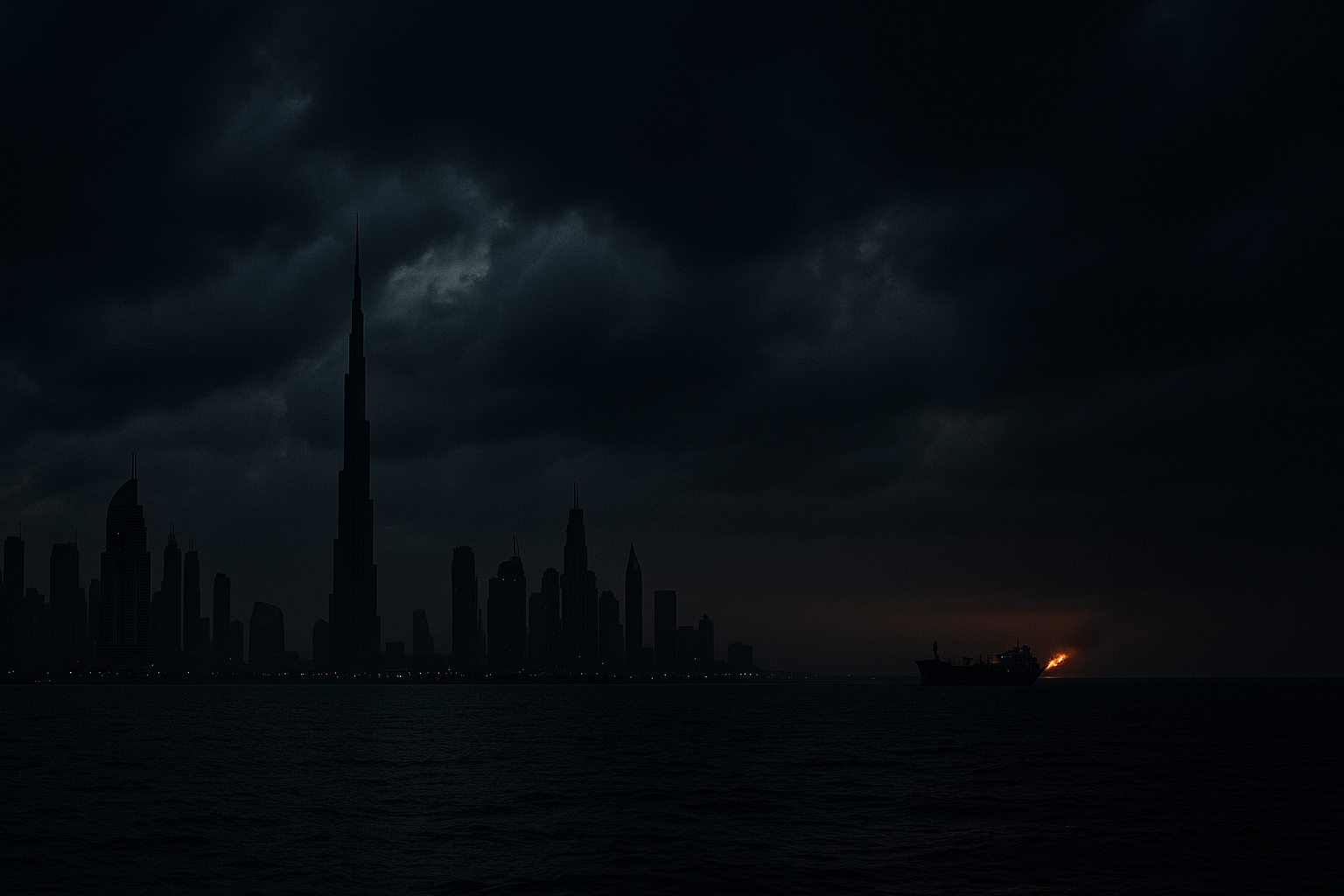
Eight days ago, flydubai Flight 1073 left Dubai for Tel Aviv with a co-pilot who, investigators now say, never intended to land it. Somewhere over the Gulf, he attacked the captain with the aircraft's onboard emergency ax. The plane went into a steep dive before passengers and the remaining crew overpowered him and diverted to Saudi Arabia. The captain, Indian national Smit Machchhar, survived. The UAE's attorney general has formally labeled the incident a terrorist attack, and Israeli investigators believe the co-pilot intended a 9/11-style strike on Ben Gurion Airport, according to multiple reports citing officials familiar with the probe. CBS News, citing sources familiar with the response, reported Israel was prepared to shoot the aircraft down.
Aviation security people will spend years on what went wrong in that cockpit. Investors should spend a few minutes on what it means for the city the plane took off from — because Dubai is not just where the story starts. Dubai is the story.
The Product Dubai Sells Is Safety
Every economy exports something. Saudi Arabia exports oil. Taiwan exports chips. Dubai exports the absence of fear: a place in the world's most volatile region where capital, tourists, and trade routes are supposed to be untouchable. That premise built the world's busiest international airport, a luxury tourism machine, and a financial hub that absorbed capital flight from Russia, Lebanon, and everywhere else things went wrong.
The numbers show how literal that business model is. Aviation and the tourism it feeds generated economic activity equivalent to roughly 27% of Dubai's GDP in 2023, according to an Oxford Economics study cited by The Wall Street Journal. The emirate is building a $35 billion expansion of Al Maktoum International Airport — first new phase due in 2032 — that it says will eventually be the world's largest aviation hub, with capacity for more than 260 million passengers a year.
That is a very large bet on one proposition: that people will always feel safe flying to Dubai. This year, the war between Israel and Iran has been stress-testing that proposition from the outside. The flydubai attack just stress-tested it from the inside.
Briefings like this land in members' inboxes before the market prices them in. Join free →
The War Already Took a Bite
Dubai's war damage is usually invisible in headlines because missiles mostly didn't land there. The economic data is less forgiving. According to Dubai government figures reported by the Journal:
- Dubai International Airport traffic fell by nearly a third year over year in the first half of 2026. The airport now expects about 70 million passengers this year, against a prewar forecast of 99.5 million.
- International overnight visitors totaled 6.97 million in the first eight months of 2026, down from 12.54 million in the same period last year — a roughly 44% collapse.
- Hotel occupancy bottomed at 36% in March before recovering to 66% in August, still below prewar norms.
Capital Economics forecasts the UAE's GDP will shrink 1.5% this year, with the war disrupting oil exports and crushing tourism. Many international carriers suspended Dubai flights in the spring; Cathay Pacific extended its suspension through the end of January, per the Journal. Even the Burj Al Arab — the sail-shaped hotel that is Dubai's postcard — is closed for renovations.
The recovery was real but fragile: occupancy climbing, flights returning, the government-owned carriers — Emirates, Etihad, flydubai — flying through conditions that grounded everyone else. During the worst weeks of the war, dozens of aircraft landed at or departed Dubai International within five minutes of missile and drone warnings, by the Journal's earlier reporting. That is either reassuring or alarming depending on whether you are a shareholder or a passenger.
The Strait Next Door Is Getting Worse, Not Better
The timing of the flydubai attack is what makes it economically dangerous, because the neighborhood's other risk dial is turning the wrong way at the same moment.
Nearly 20 commercial ships, mostly tankers, were attacked in the past month transiting the Strait of Hormuz, the Persian Gulf, or waters off Oman, according to the Joint Maritime Information Center. Windward, a maritime intelligence firm, estimates Iran attacked roughly two ships for every 100 that crossed the strait in the third quarter. Since July, at least nine sailors have been killed, 18 injured, and three are missing, per the International Maritime Organization.
Oil is still getting out — about 10.3 million barrels per day moved through Hormuz in the week ended Saturday, per Kpler, versus a prewar baseline of 13.5 million — but only behind a US naval escort corridor along Oman's coast and a costly ship-to-ship shuttle system. Moving a tanker of crude from the Gulf to China now runs as high as $1 million per day. Brent crude traded just under $105 a barrel on Thursday morning, up sharply this week as attacks hit records; WTI sat near $92.50.
The market read is simple: the Gulf's maritime insurance, freight, and risk premiums are being repriced upward at the exact moment Dubai needs the world to believe the region is calming down.
The Israel Corridor Was the Growth Story. Now It's the Fault Line.
Since normalization in 2020, Israelis became one of Dubai's fastest-growing visitor sources — roughly 1.2 million Israeli tourists had visited the UAE by the end of 2023, according to the Israeli Embassy there. The Dubai–Tel Aviv route was one of the most durable commercial artifacts of the Abraham Accords, surviving pressures that killed weaker links.
That corridor is now suspended. flydubai halted all Israel service after the attack. El Al's attempted repatriation flights for stranded Israelis were initially canceled when Emirati landing permissions didn't come through — during Sukkot, one of Israel's heaviest travel weeks — with regular El Al service slated to resume within days, every seat booked. Israeli ministers have pushed for the co-pilot's extradition while the UAE asserts jurisdiction over the investigation, per Israeli media reports. Saudi Arabia has opened its own air-safety probe, and investigators in Australia and New Zealand, where the co-pilot did part of his flight training, are examining his past. The Journal reports the co-pilot, an Omani national, had previously been banned from flying by Oman over concerns about radical views — which, if confirmed, turns this from a tragedy into an indictment of UAE vetting.
"Any questioning of security arrangements concerning flights out of Dubai could be a blow to confidence in the emirate, especially after the shocks of the Iran war," Kristian Coates Ulrichsen of Rice University's Baker Institute told the Journal. Security analyst Michael Horowitz put the stakes more bluntly: if Israel publicly points to security lapses or keeps flights shut for an extended period, "this will be read by other airlines as signs that Dubai airport isn't safe."
What to Watch
- The investigation's findings on vetting. If the Oman flight ban is confirmed and flydubai's hiring process is shown to have missed it, expect scrutiny of the airline's rapid pilot-hiring spree — and possibly of UAE aviation oversight broadly.
- When (and whether) the Dubai–Tel Aviv route reopens. This is the cleanest single indicator of whether the Abraham Accords' commercial layer holds.
- Winter season bookings. October–March is Dubai's high season. The emirate was counting on this winter to pull occupancy and airport traffic back toward prewar levels.
- Hormuz attack tempo and Brent. Oil near $105 with a shrinking UAE economy is a squeeze from both ends: the war premium raises Dubai's costs while suppressing exactly the travel demand it needs.
- Foreign carrier decisions. Cathay's January timeline is the benchmark. Extensions beyond it from major Asian and European carriers would signal the risk reassessment is sticking.
The Bottom Line
Dubai has rebuilt from shocks before — the 2009 debt crisis, the pandemic — and its tourism machine was genuinely recovering through the summer. But this shock is different in kind. The pandemic grounded everyone equally; this war is specifically eroding the thing Dubai sells at a premium: the belief that the region's chaos stops at its border. An ax in a cockpit, record tanker attacks in the strait next door, and a 44% drop in visitors are all the same story told three ways. The safe haven is still standing. The premium it charges for safety is what's under attack.
If this analysis was useful, this is what AlphaBriefing does every day — geopolitics and markets, connected to what it means for your money. Free members get the daily brief in their inbox; paid members get the investment frameworks, scenario pricing, and catalyst calendars behind the paywall.
Get the next briefing free in your inbox: Join AlphaBriefing →
Get this level of intelligence every day. Subscribe to AlphaBriefing — free, member, and paid tiers available.
Sources & Further Reading
- The Wall Street Journal (via MSN) — FlyDubai Attack Adds New Risks to Dubai's War-Battered Economy
- Reuters — Flydubai co-pilot attacked pilot with axe in attempted 'terrorist attack', UAE says
- CNBC — Rebounding oil exports through Strait of Hormuz are vulnerable to stepped-up Iranian tanker attacks
- CNN Business — Oil prices jump amid record tanker attacks in Hormuz
- Hindustan Times (AFP/Reuters) — El Al cancels flights for Israelis from Dubai after flydubai incident
- International Maritime Organization — Middle East highlighted incidents
Disclaimer
AlphaBriefing is an independent intelligence publication. The content in this article is produced for informational and educational purposes only. Nothing published by AlphaBriefing constitutes financial, investment, legal, tax, or regulatory advice, nor should it be construed as a solicitation or recommendation to buy, sell, or hold any security, asset, or financial instrument.
All views expressed are those of the author at the time of writing and are subject to change without notice. Markets are volatile and unpredictable; past performance is not indicative of future results. Any investment involves risk, including the possible loss of principal.
AlphaBriefing and its principals, employees, or contributors may hold positions in securities or assets mentioned in this article. This should be considered a potential conflict of interest. No material relationship with any company referenced exists unless explicitly disclosed. Readers should conduct their own due diligence and consult qualified financial, legal, and tax advisors before making any investment decisions.
Information in this article is drawn from public sources believed to be reliable at the time of publication. AlphaBriefing makes no warranty, express or implied, as to the accuracy, completeness, or timeliness of any information herein. AlphaBriefing accepts no liability for any loss or damage arising from reliance on this content.
© AlphaBriefing. All rights reserved. Unauthorised reproduction or distribution is prohibited.