America's Sky Runs on 1980s Radar. The Rebuild Has Started.
Congress put down $12.5 billion, Washington hired a prime integrator, and the first radar contracts are signed. Inside the largest federal infrastructure program almost nobody is trading — and the names positioned to capture it.

At 8:47 on a January evening in 2025, a regional jet on final approach to Ronald Reagan Washington National Airport collided midair with an Army Black Hawk helicopter. Sixty-seven people died. It was the deadliest U.S. aviation accident in more than two decades — and it happened inside some of the most closely monitored airspace on earth.
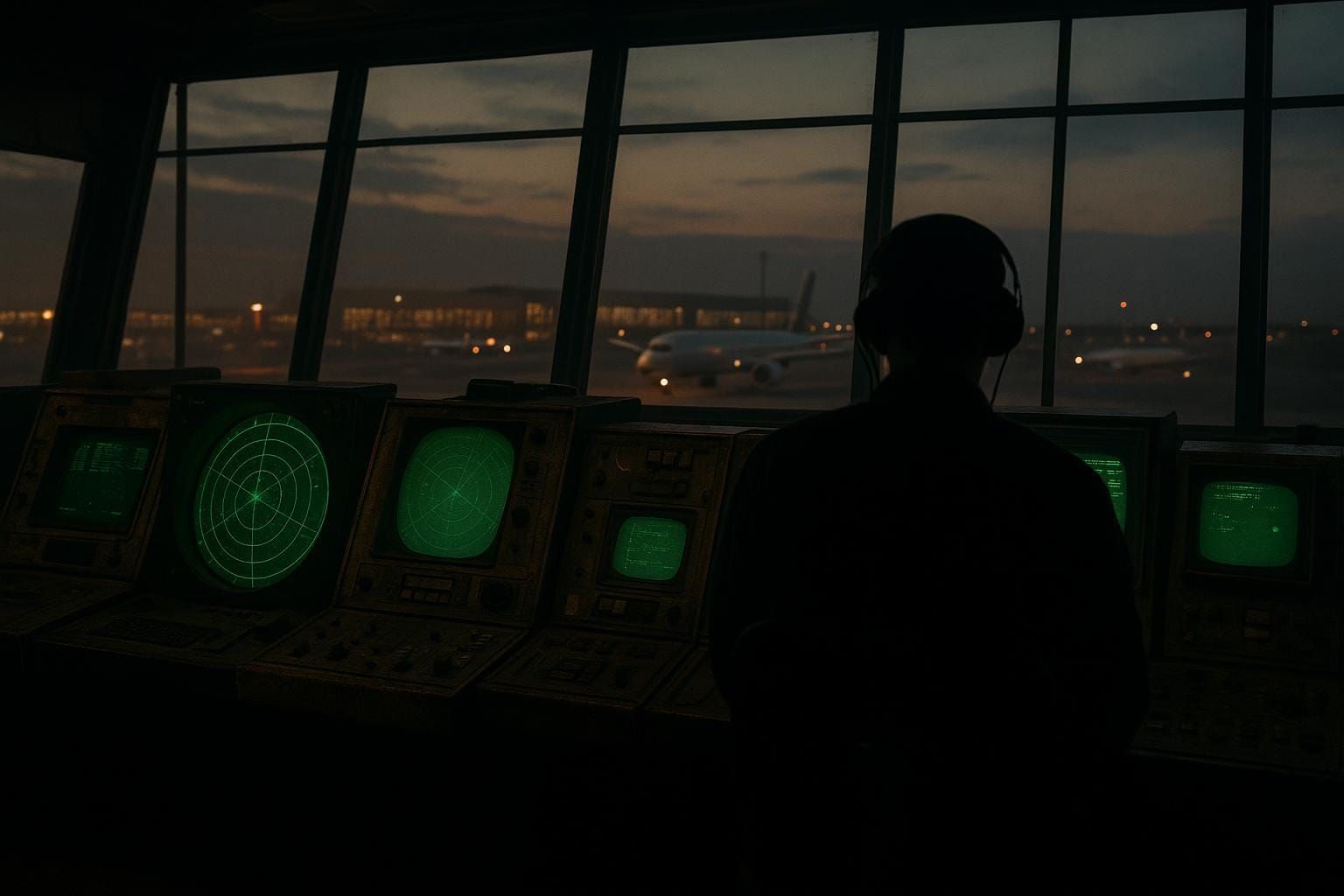
The crash did what twenty years of inspector-general reports could not: it turned the condition of American air traffic control into a political emergency with a budget attached. The system that manages roughly 45,000 flights a day still runs, in places, on floppy disks, paper strips, and copper wiring. Many of its ground radars date to the 1980s and have exceeded their intended service lives. The Government Accountability Office's own assessment found that of 138 air traffic control systems, 51 were unsustainable and another 54 potentially unsustainable. This is not a system with a modernization backlog. It is a system running past the end of its design life, held together by maintenance contracts and controller overtime.
What happened next is the part most investors have not priced.
The money is real this time
Congress appropriated $12.5 billion as a down payment on a full rebuild — new radars, new telecommunications, new facilities, new software. Transportation Secretary Sean Duffy has since told lawmakers the true cost estimate stands at $31.5 billion, and FAA Administrator Bryan Bedford is asking Congress for roughly $10 billion more to keep the program moving.
The structure is unusual for Washington. In December 2025, the FAA named Peraton — a national-security contractor owned by Veritas Capital — as prime integrator for the entire program, under a contract worth $1.5 billion. The deal includes what the FAA calls a "No Excuses" clause: fees are earned or lost against schedule, quality, and cost-control metrics. The White House personally negotiated $200 million off the initial price. Whatever one thinks of the politics, this is not the diffuse, decades-long procurement model that produced NextGen's famously modest returns.
The timeline has been compressed to match. Radar and telecom modernization — originally sketched as a 15-year effort — has been squeezed into roughly three years. Over half of the FAA's copper infrastructure has already been replaced. In January, the agency hired RTX's Collins Aerospace and Spain's Indra Group to replace up to 612 ground-based surveillance radars nationwide by June 2028, with installations prioritized in high-traffic corridors and Collins's initial tranche alone worth $438 million.
And this month, the software goes live
The nearest catalyst is now days away. The FAA intends to launch SMART — Strategic Management of Airspace Routing Trajectories — in September. The system ingests airline schedules, weather, airport capacity, and airspace constraints, then recommends small pre-departure adjustments — shifting a flight five or ten minutes — that, across thousands of daily flights, are meant to dissolve bottlenecks before they form. It is the first genuinely new piece of national airspace software in years, and its performance through the fall will be the first public evidence of whether this rebuild is different.
The engineering question is whether Washington can actually rewire the sky in three years. The investment question is narrower and more interesting: tens of billions of dollars are going to be spent either way. Who captures them — and what has the market already noticed?
The rest of this briefing is for paid members: the full contractor map including the two listed names already booking radar dollars, the funding-gap math that decides whether this is a $12.5 billion program or a $31.5 billion one, the staffing numbers the FAA itself publishes that constitute the program's biggest execution risk, and the catalyst calendar through June 2028.
AlphaBriefing Paid gets you every investment thesis, scenario framework, and catalyst brief we publish — the analysis private intel clients pay four figures for, at a fraction of that.