Cheap Ozempic Changes Everything
Obesity drugs went from $1,350 a month to a $50 Medicare copay in under two years — the fastest price collapse in blockbuster drug history. What cheap GLP-1s mean for pharma, insurers, and everything downstream.

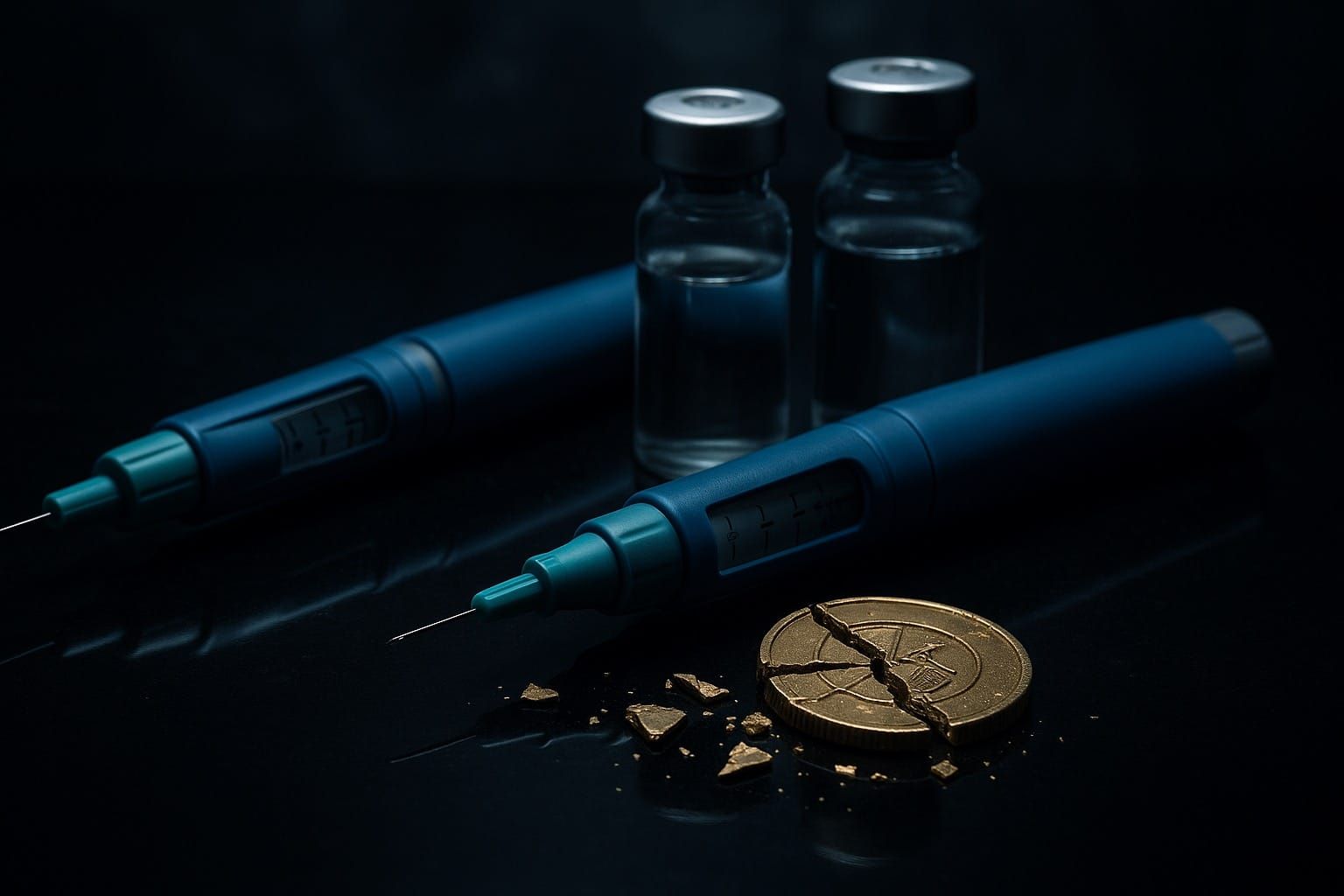
Two years ago, the defining drugs of this decade were rationed like wartime penicillin. Wegovy listed at $1,350 a month, insurers fought tooth and nail to avoid covering it, compounding pharmacies ran a gray market in knockoff semaglutide, and Novo Nordisk — a Danish insulin maker most Americans had never thought about — became Europe's most valuable company on the strength of a single molecule.
Today, a Medicare beneficiary with a BMI of 27 and prediabetes can get the same class of drug for a $50 monthly copay. A cash-paying patient can start on a $199-a-month pill ordered through a manufacturer website. The price of entry to the most commercially hyped drug class in modern pharmaceutical history has fallen roughly 85 percent in under 24 months.
That collapse is the story. Not the science, which keeps getting better, and not the demand, which remains effectively bottomless. The story is that obesity drugs became cheap years before anyone's financial model said they would — and the consequences are now rippling through drugmakers, insurers, national economies, and every industry that quietly assumed GLP-1s would stay a luxury product.
How the price broke
Three forces converged, in sequence.
Compounding broke the psychological price floor. During the 2023–2025 shortage years, compounding pharmacies legally sold semaglutide copies for $200–$300 a month. Millions of Americans learned that the marginal cost of these molecules was nowhere near $1,350, and that knowledge never went away — even after the FDA moved to shut the gray market down.
Washington moved. In November 2025, the Trump administration struck pricing agreements with both Eli Lilly and Novo Nordisk, cutting monthly GLP-1 prices from over $1,000 to as low as $245 for eligible patients, with direct-to-consumer purchasing routed through the TrumpRx portal. Then came the bigger structural shift: starting July 1, 2026, Medicare's bridge demonstration program began offering Wegovy, Zepbound, and Lilly's new pill Foundayo to qualifying beneficiaries for a $50 monthly copay. KFF estimates roughly 3.8 million Medicare enrollees could be eligible. Medicare — the buyer that had refused for two decades to touch weight-loss drugs at all — is now the anchor price-setter for the entire class.
The pills arrived. 2026 turned the obesity market from a supply-constrained injection duopoly into a genuine consumer market. Novo launched its oral Wegovy and topped 3 million prescriptions within roughly five months. Lilly answered in the spring with Foundayo (orforglipron), the first GLP-1 pill with no food or water restrictions — and, critically, a small molecule that can be stamped out in tablet factories at a fraction of the cost of sterile injectable production. Pills killed the scarcity economics. You cannot charge shortage prices for something you can manufacture like a statin.
Briefings like this land in members' inboxes before the market prices them in. Join free →
The scoreboard: Lilly won the first war
While prices were falling, the competitive question got answered. Eli Lilly overtook Novo Nordisk in GLP-1 sales during 2025, and the gap has since become a chasm. Tirzepatide — the molecule behind Mounjaro and Zepbound — generated roughly $27.7 billion in the first six months of 2026 alone, outselling Novo's semaglutide franchise by more than $10 billion over the period. Zepbound has been growing at 80 percent year over year.
Lilly won on efficacy (tirzepatide beat semaglutide head-to-head in Lilly's SURMOUNT-5 trial), on manufacturing scale, and on commercial aggression — it cut cash prices early and often, correctly betting that volume at lower prices beats rationed volume at high ones.
Novo's response tells you everything about where this market is heading. The company that created the category is now guiding to an adjusted sales decline of 4 to 12 percent at constant currency, is cutting 9,000 jobs, and has pre-announced price cuts of roughly 50 percent on Wegovy and 35 percent on Ozempic effective January 2027 — a public capitulation designed to protect volume by sacrificing price. Its stock has round-tripped the entire mania. For Denmark, whose GDP growth, tax receipts, and currency policy had become materially tied to one company's obesity franchise, this is not a stock story. It is a macro event.
Why cheap changes everything
The instinct is to read this as a sector story — Lilly up, Novo down. That misses the larger repricing underway.
The market forecasts were built on the wrong variable. The consensus "$100 billion obesity market by 2030" projections assumed high prices and constrained access. What is actually materializing is the inverse: collapsing revenue per patient and exploding patient volume. The market can still hit $100 billion — but as a high-volume, thinning-margin consumer staple business, not a rationed luxury franchise. Those are very different businesses, and they deserve very different multiples. The equity market has started to figure this out; it has not finished.
Insurers and employers lose their best excuse. For three years, the standard corporate benefits position was that GLP-1 coverage was unaffordable. At $1,350 a month, that was defensible. At $245 — with Medicare itself covering the drugs at $50 — it increasingly is not. Employer plans that continue to exclude coverage will be defending that position against employees who can see the federal government's negotiated price. Expect coverage to broaden and utilization management to shift from "whether" to "which drug, and for how long."
The second-order trades get real. The food, beverage, alcohol, and medical-device industries have spent two years debating whether GLP-1s at 3–4 percent population penetration would dent consumption. Cheap pills with Medicare coverage change the penetration math entirely. If 10–15 percent of American adults end up on an appetite-suppressing drug by the end of the decade — a scenario the new pricing makes plausible — the consumption effects stop being a footnote in packaged-food earnings calls and start being the thesis.
Health economics flips from cost to investment. At old prices, treating obesity was a budget-buster; CBO scoring killed every coverage expansion. At $50–$245 a month, the arithmetic against obesity's downstream costs — diabetes, cardiovascular disease, joint replacement — starts to close. The Medicare demonstration runs through December 2027. If the data shows reduced downstream spending, permanent coverage follows, and the addressable population expands again.
What to watch
- The Medicare demonstration data, through 2027. This is the single biggest catalyst for permanent, expanded coverage — or retrenchment.
- January 2027: Novo's pre-announced 50 percent Wegovy cut takes effect. Watch whether Lilly follows. If it does, the price war enters its second leg and every revenue model in the sector gets rebuilt again.
- Next-generation data. Lilly's retatrutide and Novo's CagriSema are the efficacy escalation — the companies' answer to price compression is a better drug at a defended price.
- Semaglutide's patent cliff. Generic semaglutide is already launching in emerging markets ahead of key expirations. The floor under the price of "good enough" GLP-1 therapy keeps falling.
The gold rush phase — scarcity, four-figure list prices, one company worth more than its home country's entire stock market — is over. The era phase is just beginning: hundreds of millions of patients, single-digit-dollar daily costs, and a fight that will be won on manufacturing scale and next-generation efficacy rather than pricing power. The companies made obesity treatable. Now the market is making it ordinary — and "ordinary" is the most economically disruptive thing a drug can become.
Get this level of intelligence every day. Subscribe to AlphaBriefing — free, member, and paid tiers available.
Sources & Further Reading
- CMS — Coming Soon: CMS to Provide $50 Monthly Access to GLP-1 Medications for Medicare Beneficiaries
- NPR — Medicare launches weight loss drug option with $50 copay
- Medicare Rights Center — GLP-1 Weight-Loss Drug Demonstration Begins July 2026
- BioPharma Dive — FDA approves Lilly obesity pill, triggering battle with Novo Nordisk
- PR Newswire — Novo Nordisk launches introductory self-pay offer for Wegovy and Ozempic for $199 per month
- CNBC — Novo Nordisk launches multi-month subscriptions for Wegovy obesity drugs
- CNBC — Novo Nordisk, Eli Lilly roll out obesity pills, prepare for Medicare coverage
- AJMC — Trump Announces Deals With Lilly, Novo to Cut Weight Loss Drug Prices
Disclaimer
AlphaBriefing is an independent intelligence publication. The content in this article is produced for informational and educational purposes only. Nothing published by AlphaBriefing constitutes financial, investment, legal, tax, or regulatory advice, nor should it be construed as a solicitation or recommendation to buy, sell, or hold any security, asset, or financial instrument.
All views expressed are those of the author at the time of writing and are subject to change without notice. Markets are volatile and unpredictable; past performance is not indicative of future results. Any investment involves risk, including the possible loss of principal.
AlphaBriefing and its principals, employees, or contributors may hold positions in securities or assets mentioned in this article. This should be considered a potential conflict of interest. No material relationship with any company referenced exists unless explicitly disclosed. Readers should conduct their own due diligence and consult qualified financial, legal, and tax advisors before making any investment decisions.
Information in this article is drawn from public sources believed to be reliable at the time of publication. AlphaBriefing makes no warranty, express or implied, as to the accuracy, completeness, or timeliness of any information herein. AlphaBriefing accepts no liability for any loss or damage arising from reliance on this content.
© AlphaBriefing. All rights reserved. Unauthorised reproduction or distribution is prohibited.