Eight Justices Will Decide Whether a Jury Can Price Climate Change
The Supreme Court opened its 2026-27 term with Big Oil in the dock: Suncor v. Boulder County could extinguish dozens of climate lawsuits or send them toward juries -- and Justice Alito's recusal makes the math harder for the industry.

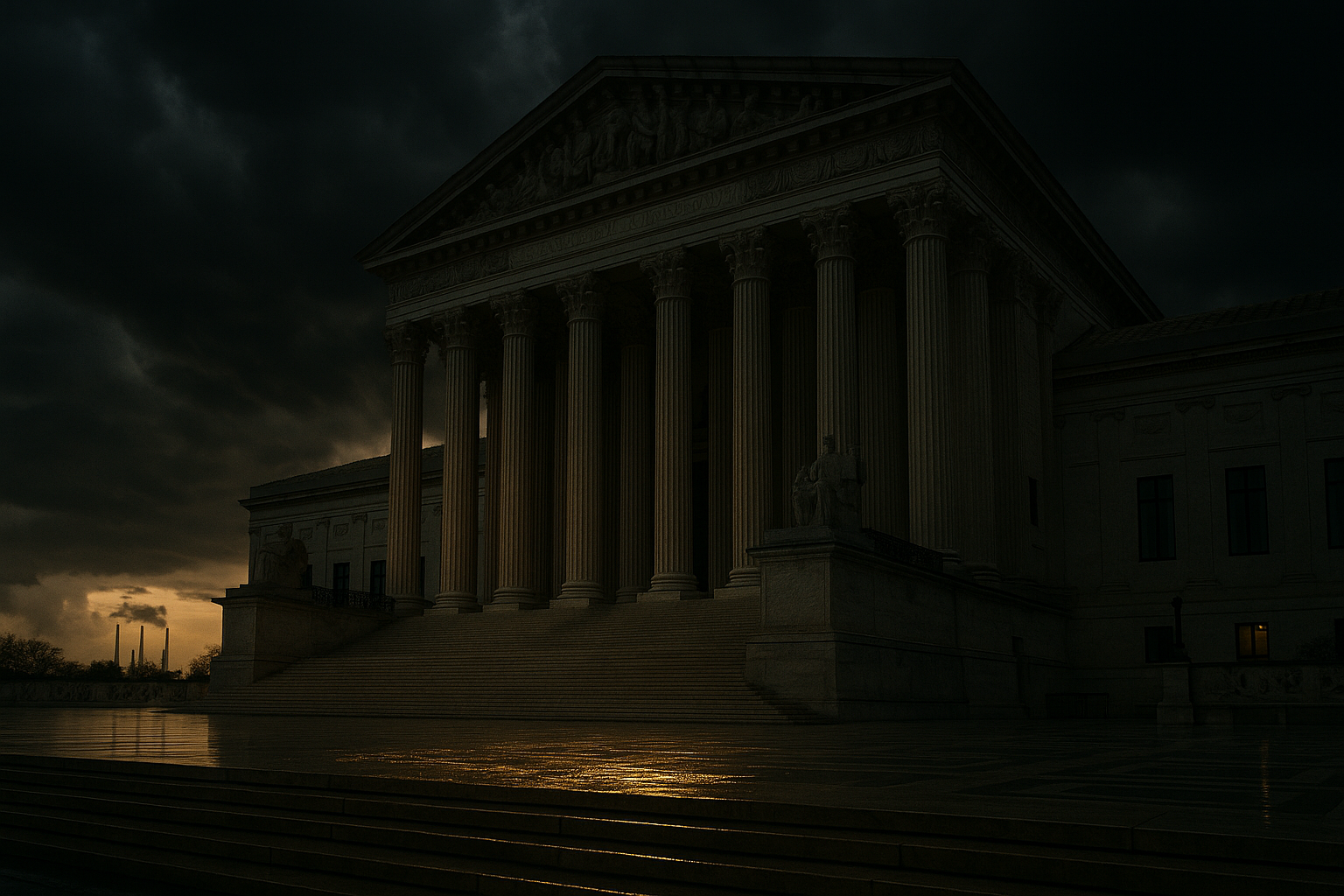
This morning in Washington, the Supreme Court opened its 2026–27 term the way it always does — first Monday in October, the marshal's cry, the justices filing in. What happened next was anything but routine. The first case argued in the new term, Suncor Energy (U.S.A.) Inc. v. County Commissioners of Boulder County, asks whether an American jury can hold oil companies financially liable for climate change. And one of the Court's most reliably industry-friendly votes wasn't on the bench to hear it.
For investors, this is the most consequential business case on the docket this term — and one of the most consequential liability questions of the decade. Here's what's actually at stake, and why the outcome is harder to handicap than it looks.
A lawsuit about local harms — or a national carbon tax?
The dispute began in 2018, when the city and county of Boulder, Colorado, sued two energy companies in state court: Suncor Energy (U.S.A.), the American arm of the Canadian oil major that operates Colorado's only oil refineries, and ExxonMobil, the largest energy company in the United States. Boulder isn't asking a court to cap emissions or shut down production. It wants money — compensation under ordinary Colorado tort law (nuisance, trespass, unjust enrichment, and conspiracy) for the costs of protecting its residents and property from heat, drought, wildfires, and shrinking snowpack. Central to the complaint is the allegation that the companies spent decades deceiving the public about what their products would do to the climate.
The companies tried to move the case to federal court and failed. They asked the trial court to dismiss it and failed. The Colorado Supreme Court then ruled the claims could proceed under state law, and in February 2026 the U.S. Supreme Court agreed to hear the companies' appeal — adding, unusually, a second question: whether it even has jurisdiction to review a state court ruling in a case that hasn't finished.
The framing gap between the two sides is the whole ballgame. Boulder says this is a compensation case about local injuries, the kind state courts have handled for two centuries. The companies say that letting fifty states' juries put a price on global emissions amounts to an "enormous 'carbon tax'" that could "'bankrupt' the energy industry" — and that climate policy "should not be left in the hands of six jurors in Boulder, Colorado." Their legal argument: interstate and international emissions are inherently federal territory, governed by the Clean Air Act and the federal government's foreign affairs power, and state tort law simply cannot reach them.
Briefings like this land in members' inboxes before the market prices them in. Join free →
Why corporate America is treating this as existential
Look at who filed briefs while the Court was deciding whether to take the case: the U.S. Chamber of Commerce (explicitly in support of the companies' petition), the National Association of Manufacturers, the American Petroleum Institute, the American Tort Reform Association, a coalition of states led by Alabama, and House Majority Leader Steve Scalise with 102 other members of Congress. The federal government also weighed in at the cert stage. That is not the amicus lineup for a technical jurisdictional dispute. It's the lineup for a case the defense bar believes could reprice an entire industry.
The reason is simple: Boulder is not alone. Dozens of similar lawsuits from states, cities, and counties are pending across the country, and most have been stuck in procedural trench warfare for years. A ruling that federal law preempts these claims would extinguish nearly all of them in one stroke. A ruling that lets Boulder proceed would send the suits toward discovery and, eventually, juries — and anyone who remembers how the 1998 tobacco Master Settlement Agreement (more than $200 billion) came about knows that the moment this kind of litigation reaches juries, the industry's incentive flips from fighting to settling.
The market, for now, is pricing none of this. ExxonMobil closed Friday at $164.01; Suncor's Canadian parent closed at $69.56 on the NYSE. Climate tort risk sits in the same bucket where tobacco liability sat in the early 1990s and opioid liability sat in 2015: acknowledged in footnotes, discounted to roughly zero.
The Alito wrinkle
A week before argument, the Court announced — without explanation — that Justice Samuel Alito "will not continue to participate" in the case. Watchdog groups had spent months pointing at his holdings in individual oil and gas companies; the Court's position as recently as May was that he had no financial interest in any party and that recusal was not required. He had already stepped aside in January from Chevron v. Plaquemines Parish, another energy-liability dispute, also without explanation.
The math now matters enormously. Eight justices will decide the case, and a 4–4 tie affirms the Colorado Supreme Court's ruling without setting a nationwide precedent. In other words, a split Court means Boulder's case goes forward — toward discovery, toward a Colorado jury — while the national question stays unresolved and every one of those pending suits keeps marching through its own state courts. For the industry, that is very nearly the worst outcome short of losing outright.
Three ways this breaks
The punt. The Court added the jurisdictional question for a reason: the Colorado litigation isn't over, and the Supreme Court normally reviews only final state court judgments. If a majority decides it lacks jurisdiction, the case is dismissed without touching the merits. The suits continue everywhere, the uncertainty persists, and this same question returns to the Court in a year or two in a cleaner procedural posture.
The industry win. A majority holds that federal law — constitutional structure, the Clean Air Act, foreign affairs preemption, or some combination — bars state-law climate claims. Dozens of lawsuits die, a multi-decade tail risk comes off the sector, and the only remaining venue for climate cost-recovery is Congress, which is to say nowhere soon.
The plaintiffs' path. Boulder wins on the merits, or the Court splits 4–4. Either way the case proceeds, and the signal to every plaintiffs' firm and municipal attorney in the country is that the courthouse door is open. Discovery into what the companies knew, and when, begins — and discovery is where the tobacco playbook started working.
The rest of the docket is quieter, but not for everyone
Two other October arguments deserve a line in any investor's notebook. On Tuesday, Anderson v. Intel Corporation Investment Policy Committee will set the pleading standard for ERISA suits claiming a retirement-plan fiduciary imprudently chased underperforming funds — a ruling that reaches every 401(k) sponsor in America. And on October 14, Salazar v. Paramount Global will decide how far the 1988 Video Privacy Protection Act stretches in the streaming era: if a newsletter subscriber counts as a "consumer" under the statute, a wave of class actions against media companies that share viewing data with ad platforms gets a green light.
The Suncor decision is expected by early summer 2027. Between now and then, watch the argument transcript from this morning — how hard the justices press the jurisdictional question will tell you early whether they want to decide this case at all, or whether the biggest liability question in energy gets kicked down the road with the meter still running.
If this analysis was useful, this is what AlphaBriefing does every day — geopolitics, markets, and the law, connected to what they mean for your money. Get this level of intelligence every day: Subscribe to AlphaBriefing — free, member, and paid tiers available.
Get the next briefing free in your inbox: Join AlphaBriefing
Sources & Further Reading
- SCOTUSblog — Supreme Court to consider whether suit may go forward seeking to hold energy companies liable for climate change (Amy Howe, Oct. 1, 2026)
- SCOTUSblog — Justice Alito will no longer participate in climate change dispute (Kelsey Dallas, Sep. 28, 2026)
- SCOTUSblog — Court announces cases it will hear in October (Amy Howe, Aug. 4, 2026)
- George Washington Law Review — Previews for the 2026 October Term, October Sitting
- Supreme Court of the United States — Docket No. 25-170, Suncor Energy (U.S.A.) Inc. v. County Commissioners of Boulder County
- Ballotpedia — Supreme Court cases, October term 2026-2027
- AP — Alito steps aside in a major climate case after scrutiny over oil stock holdings (Sep. 28, 2026)
Disclaimer
AlphaBriefing is an independent intelligence publication. The content in this article is produced for informational and educational purposes only. Nothing published by AlphaBriefing constitutes financial, investment, legal, tax, or regulatory advice, nor should it be construed as a solicitation or recommendation to buy, sell, or hold any security, asset, or financial instrument.
All views expressed are those of the author at the time of writing and are subject to change without notice. Markets are volatile and unpredictable; past performance is not indicative of future results. Any investment involves risk, including the possible loss of principal.
AlphaBriefing and its principals, employees, or contributors may hold positions in securities or assets mentioned in this article. This should be considered a potential conflict of interest. No material relationship with any company referenced exists unless explicitly disclosed. Readers should conduct their own due diligence and consult qualified financial, legal, and tax advisors before making any investment decisions.
Information in this article is drawn from public sources believed to be reliable at the time of publication. AlphaBriefing makes no warranty, express or implied, as to the accuracy, completeness, or timeliness of any information herein. AlphaBriefing accepts no liability for any loss or damage arising from reliance on this content.
© AlphaBriefing. All rights reserved. Unauthorised reproduction or distribution is prohibited.