The Middle East's Last Open Chokepoint Is Now a Battlefield
Hormuz has been shut for seven months. On Monday, Saudi-backed forces retook the coast around Bab el-Mandeb — the strait carrying 12% of global trade — and three armies agreed to deploy. What reopens, what escalates, and how to tell which is coming.

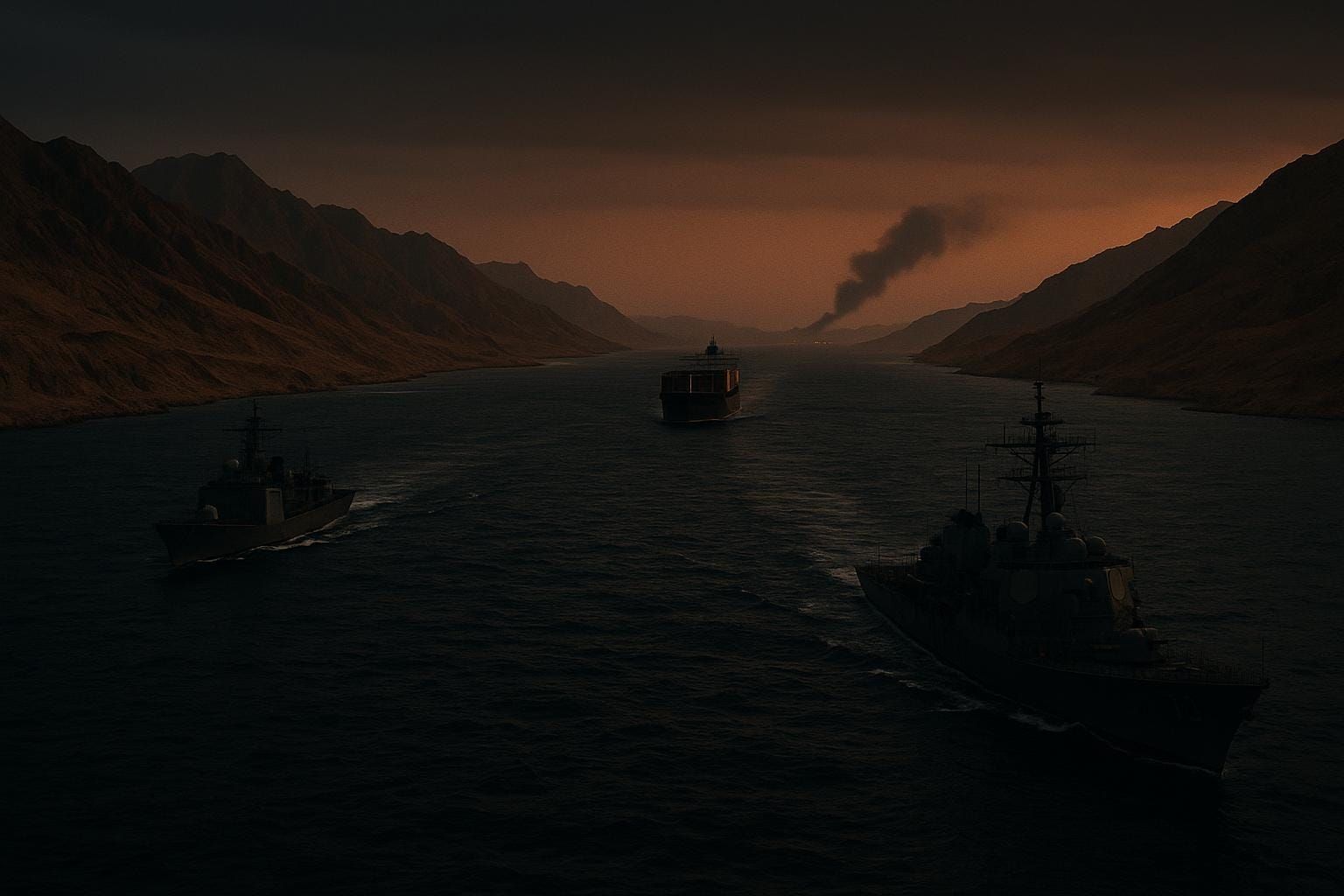
On Monday, Saudi-backed Yemeni government forces staged what Reuters described as a lightning advance along the Red Sea coast, pushing Iran-backed Houthi fighters out of positions around the Bab el-Mandeb Strait. By evening, Yemen's defense ministry was claiming the port city of Mocha had fallen. Four government sources told Reuters that troops, backed by heavy Saudi airstrikes, had reached the city's outskirts. The Houthis called the government's account baseless. None of it could be independently verified as of this writing.
What can be verified is where the fighting is happening — and why it matters more than any battle in this war so far. Mocha sits roughly 80 kilometers north of Bab el-Mandeb, the strait connecting the Red Sea to the Gulf of Aden, a passage that carries roughly 12% of global trade. And since late February, when Iran's Revolutionary Guard declared the Strait of Hormuz closed to most international shipping — a closure Tehran reaffirmed just this weekend, saying it stays shut until Washington accepts its reopening terms — Bab el-Mandeb has been something it has never been before: the Middle East's last partially functioning maritime chokepoint.
Two straits anchor the flow of energy and goods between Asia and the West. One has been effectively shut for seven months. The other just became the front line of a ground war that, as of Monday, formally involves three armies.
How we got here
On September 10, Houthi fighters seized Mocha and pushed south along the coast toward the strait — what Chatham House called the most consequential change in territorial control in Yemen in years. The offensive came as Yemen's dormant civil war reignited inside the wider US–Iran conflict. The Houthis have controlled Sanaa and much of northern Yemen since 2014; holding the coast down to Bab el-Mandeb would have given them a hand on the throat of the only major shipping lane the Hormuz closure left intact.
The timing was brutal for the shipping industry. Through September, major carriers — Maersk, MSC, CMA CGM, Hapag-Lloyd, COSCO — had been cautiously reinstating Suez Canal transits after long stretches of diverting around the Cape of Good Hope. The eagerness is easy to understand. Before Houthi attacks on shipping began in November 2023 with the seizure of the Galaxy Leader, the Suez Canal processed roughly 80 container ships a week; by mid-January 2026 that figure had recovered to just 26, according to gCaptain. More than 100 merchant vessels have been targeted since 2023, and at least four have been sunk. Sailing around Africa adds up to 19 days to a westbound Asia–Europe rotation. Carriers first attempted a structural return in February — and reversed it within weeks when the Iran war erupted. The September return was attempt number two. Then Mocha fell, and the comeback died in its tracks.
Monday changed the map
The counteroffensive has now flipped the board again. Government forces captured key positions near the mouth of the strait, including an airstrip in the Dhubab district. Saudi Arabia said it struck hundreds of targets in Yemen to provide air cover, and the Saudi-led coalition said its naval forces carried out an operation in Houthi-held Hodeidah governorate. The Houthis answered with claimed strikes deep inside Saudi Arabia — King Khalid International Airport in Riyadh, an Aramco refinery in Rabigh, Abha airport, a military base in Khamis Mushait. Neither Riyadh nor Aramco has confirmed any of it, but the group also threatened traffic in Saudi airspace.
Then came the bigger escalation. Saudi Arabia, Türkiye, and Pakistan held an emergency meeting in Riyadh on Monday and agreed to rapidly deploy troops and military capabilities to the kingdom under the Mecca Joint Defense Agreement — the mutual-defense pact the three countries signed in August, which treats an armed attack on one as an attack on all. The UN's migration agency counts 184,000 people displaced since the war resumed. Yemen's internationally recognized president, Rashad al-Alimi, vowed on Sunday to keep fighting "until the country is liberated from the grip of the terrorist militia."
For markets, all of this compresses into a single question: is the world's second-most-important maritime chokepoint about to reopen for good — or about to close completely? The answer decides what happens to the most profitable shipping trade of 2026, to a crude price sitting just under $100, and to every import-dependent economy from Cairo to Rotterdam.
Get the next briefing free in your inbox: Join AlphaBriefing
The rest of this briefing is free — it just requires a free AlphaBriefing account: the repricing math behind Maersk's 52% three-month run (and Frontline's, and Hapag-Lloyd's), the three scenarios for the strait and what each one does to oil and freight, and the five signals that will tell you which scenario is unfolding before the headlines do.
Create your free account → — 30 seconds, no card.