America's Next Mining Boom Is Already Sitting in Garages
The race to recycle EV batteries has pulled in billions of dollars and some of the sharpest operators in clean energy. The math doesn't fully work yet — and that timing gap is the trade.

Jeffrey Straubel built Tesla's battery business. He left to start something stranger.
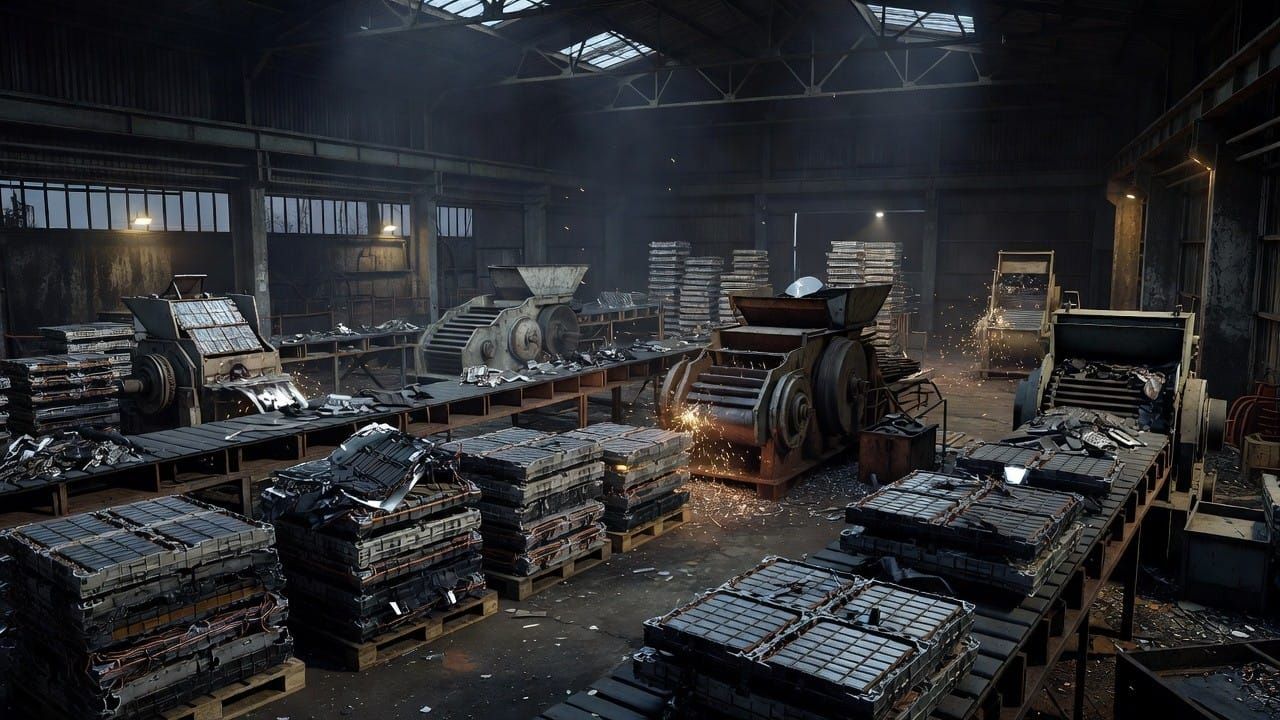
Redwood Materials, the Nevada-based company Straubel founded in 2017, doesn't make cars or batteries. It doesn't mine anything. It takes battery scrap — from consumer electronics, EV manufacturing offcuts, and increasingly, dead EV packs — and pulls out the lithium, nickel, cobalt, and copper. Then it ships those metals back to battery makers. Closed loop. American supply chain. No Chinese refiners in the middle.
The pitch is irresistible. The world will need many times more battery materials by 2040 than it produces today. China refines roughly 70% of the world's lithium, more than half of its cobalt, and a dominant share of graphite. Western governments have decided they cannot live with that. Battery recycling is the cleanest path to fixing it — every dead pack is an above-ground "mine" that doesn't require new permitting, new tailings ponds, or new geopolitical headaches.
That is the bull case. Capital agrees. Redwood has raised more than $2 billion at a valuation comfortably north of $5 billion. Ascend Elements has banked over a billion across equity and tax-credit-backed debt. Cirba Solutions has built a network of facilities across the Southeast and Midwest. The Department of Energy has loaned billions into the sector. The Inflation Reduction Act's 45X manufacturing credit pays domestic processors per kilogram of cathode-grade material produced — effectively turning recycled metal into a subsidized commodity stream.
And then there is the cautionary tale. Li-Cycle, the publicly traded recycler that was meant to be the sector's flagship, paused construction on its flagship Rochester, New York refinery in late 2023 after costs blew through projections. Glencore stepped in with a rescue package. Shares collapsed. The company spent the years since rebuilding under new management and a stretched balance sheet. Smaller entrants have gone quieter or pivoted away from end-of-life packs to the safer business of recycling manufacturing scrap.
The reason for the wobble is awkward: there aren't enough dead batteries yet.
The volume problem
Lithium-ion EV batteries typically last 10–15 years in a car, then often get a second life as stationary storage. The first generation of mass-market EVs — early Model S, Nissan Leaf, first-gen Bolt — are only now reaching retirement age. Most analysts put the inflection point for serious end-of-life pack volumes somewhere between 2028 and 2032 in the US, and later in Europe.
In the meantime, recyclers are surviving on three thinner streams. They take manufacturing scrap from battery and EV plants — offcuts and out-of-spec cells that come off every gigafactory line. They take consumer electronics — laptops, phones, power tools — which carry small amounts of high-value metals. And they take the trickle of warranty returns and crashed EVs that filter back through dealers and dismantlers.
Manufacturing scrap is the workhorse for now. As US battery production ramps with Ford, GM, Stellantis, Hyundai, and the Korean cell-makers all building plants, the offcut volumes are real. But it is also a low-margin business: factories charge per ton for the scrap, and prices have firmed as more recyclers compete for the same supply. Several smaller entrants quietly washed out over 2024 and 2025.
The paradox is that the industry is being scaled now — facilities, hires, permits, financing — for volumes that don't fully arrive for another five to seven years. Whoever survives the in-between earns the right to be the dominant Western processor when the EV-pack flood actually starts.
The strategic frame
For Washington, this is no longer about climate. It is about minerals security.
Defense Production Act funding for domestic mineral processing has been preserved across administrations, alongside expanded 45X credits, Loan Programs Office backing, and Department of Defense direct investment in critical-mineral supply chains. Treasury has tightened the Foreign Entity of Concern rules so that vehicles using Chinese-refined material increasingly lose access to consumer EV tax credits. The effect is to push automakers toward any non-Chinese source they can find — which, for nickel and cobalt especially, often means recycled material.
The geopolitical math is simple. The US imports almost all of its refined lithium, nickel sulfate, and cobalt. New domestic mines take 10–20 years to permit and build, if they get built at all. Recycling can stand up new capacity in 24–36 months, can be sited near demand centers, and produces battery-ready material directly. It is one of the few short-term levers the country actually has.
That gives the sector something unusual in clean-tech: a policy floor anchored less to climate politics than to the much more durable politics of not being dependent on China.
This is where the analysis gets actionable. AlphaBriefing members get the full investment framework — scenarios, positioning, and the bottom line.
Subscribe to AlphaBriefing — Free, Member, and Paid tiers available.